
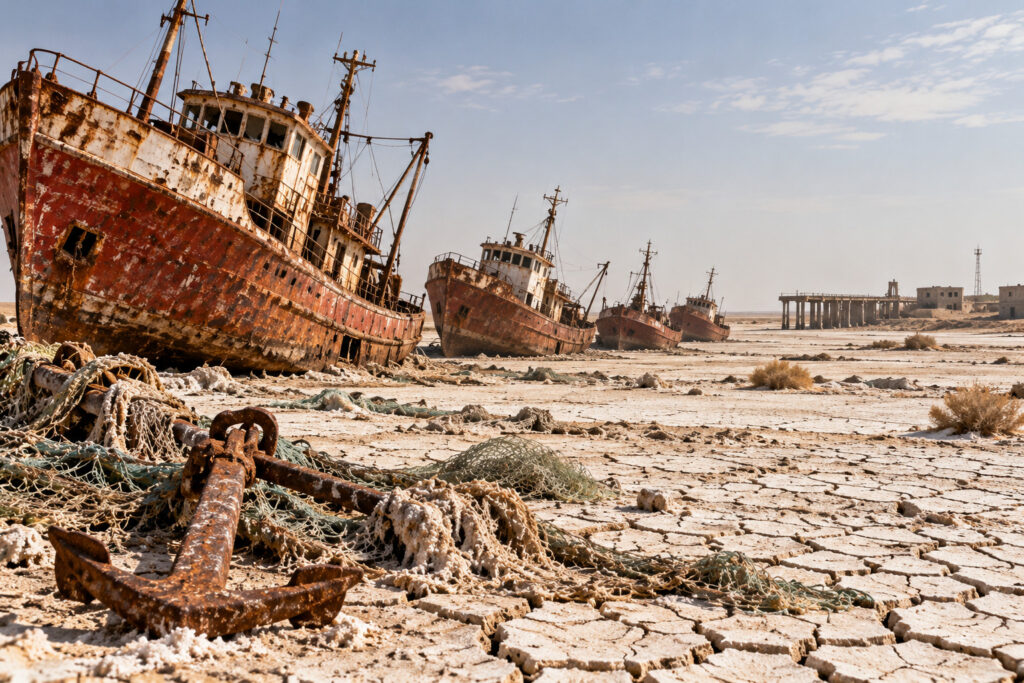
Once the fourth-largest inland sea on Earth, the Aral Sea sat between what are now Kazakhstan and Uzbekistan as a broad saline basin threaded by two rivers: the Amu Darya and the Syr Darya. For centuries its shores supported fishing ports, reed beds, and a regional climate that tempered summers and winters. Over a few decades in the twentieth century, Soviet planners decided to harvest the region’s fertile floodplains for large-scale cotton. To irrigate those fields, engineers diverted and canalized the two great rivers that fed the sea. The result was not merely a smaller lake; it was a wholesale remaking of landscape, economy, and climate.
The Visible Evidence: Ships on Sand and Salt Plains
What is most haunting are the images: trawlers beached miles inland, rusting on a new salt plain that used to be seabed. Fishing towns such as Moynaq, once prosperous ports, watched their harbor recede until fleets could no longer reach water. As the sea withdrew, it left behind a new desert—often called the Aralkum—pocked with the wreckage of industry. Wind swept the exposed sediments into salt storms that covered nearby fields and settlements with crusty white layers. Soil became saline and infertile; wells filled with brine; freshwater fish disappeared as salinity rose.
People, Health, and a Changed Climate
The human toll matched the visual shock. Entire local economies collapsed when the fishing industry vanished. Communities that had lived on the sea adapted unevenly—some migrated, others tried to turn to pastoralism or small-scale farming on increasingly degraded soils. Public-health researchers linked the region’s dust storms—laden with salt, agricultural chemicals, and residues from Soviet-era pesticides—to respiratory illnesses, higher infant mortality rates in some areas, and other chronic conditions. Local weather patterns shifted as well: summers grew hotter and drier, winters colder. The sea that had once moderated local climate was now a source of microclimatic disruption.
Small Recoveries and a Fragile Future
In the early 2000s a partly different story emerged in the northern basin of the Aral, in Kazakhstan. A dam across a narrow channel, combined with better water management, allowed the smaller northern lake to rebound somewhat—water returned to some former shoals, and fishing revived on a reduced scale. The southern basin, however, remained largely a desert. The Aral Sea’s collapse has become a cautionary tale about large-scale environmental engineering: how a single policy—in this case, intensive irrigation for export cotton—can redraw rivers, erase ecosystems, and remap the fortunes of whole regions. What remains on the exposed seabed are not just abandoned ships but a clear record of choices, their costs, and how landscapes remember them.
Conclusion
The Aral Sea’s decline is at once a regional tragedy and a global lesson. It shows how human demands for crops and raw materials can reshape water cycles and climate within a human lifetime. Today the scattered successes and ongoing problems around the Aral underline a plain historical fact: a region’s geography is never only natural—people, policies, and economies make it, and sometimes unmake it, with consequences that last for generations.