
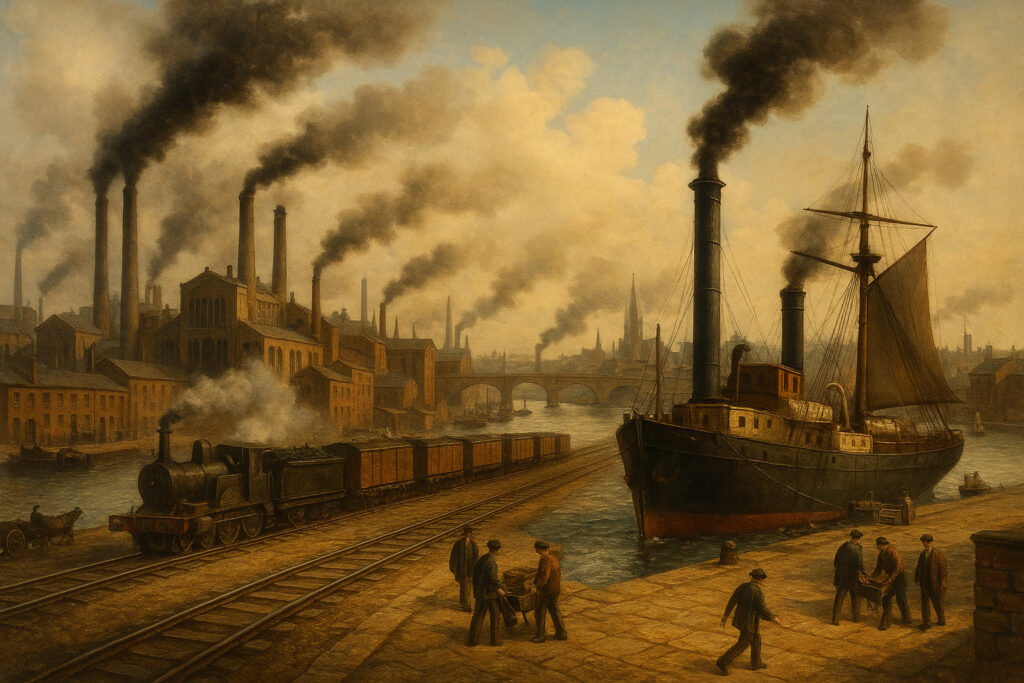
The Industrial Revolution marked one of the most transformative periods in human history. It reshaped economies, societies, and global relationships through innovation, mass production, and the rapid expansion of trade networks. This age not only introduced new technologies but also laid the foundation for the interconnected world we live in today.
The Rise of Industry
Beginning in the late 18th century, industrialization started in Britain and soon spread across Europe, North America, and beyond. Inventions like the steam engine, spinning jenny, and power loom revolutionized manufacturing. Factories replaced cottage industries, and urban centers grew rapidly as people moved from rural areas in search of work.
Global Trade Expands
Industrial growth sparked a surge in international trade. Railways, steamships, and canals connected continents, reducing travel time and transportation costs. Nations began to exchange raw materials and finished goods at an unprecedented scale—cotton from India, coal and steel from Britain, and spices, tea, and rubber from Asia. These exchanges created a truly global economy and strengthened colonial empires seeking new markets and resources.
Social and Economic Shifts
With industrialization came social change. The middle class grew, while labor movements emerged to demand fair wages and better working conditions. Technological innovation also sparked advances in communication, such as the telegraph, which made global coordination faster and more efficient.
Conclusion
The Age of Industrial Growth and Global Trade redefined human progress. It linked distant nations through commerce, innovation, and ambition. Though it brought challenges, it also ignited a spirit of global collaboration that continues to shape modern economies and technological advancement.