
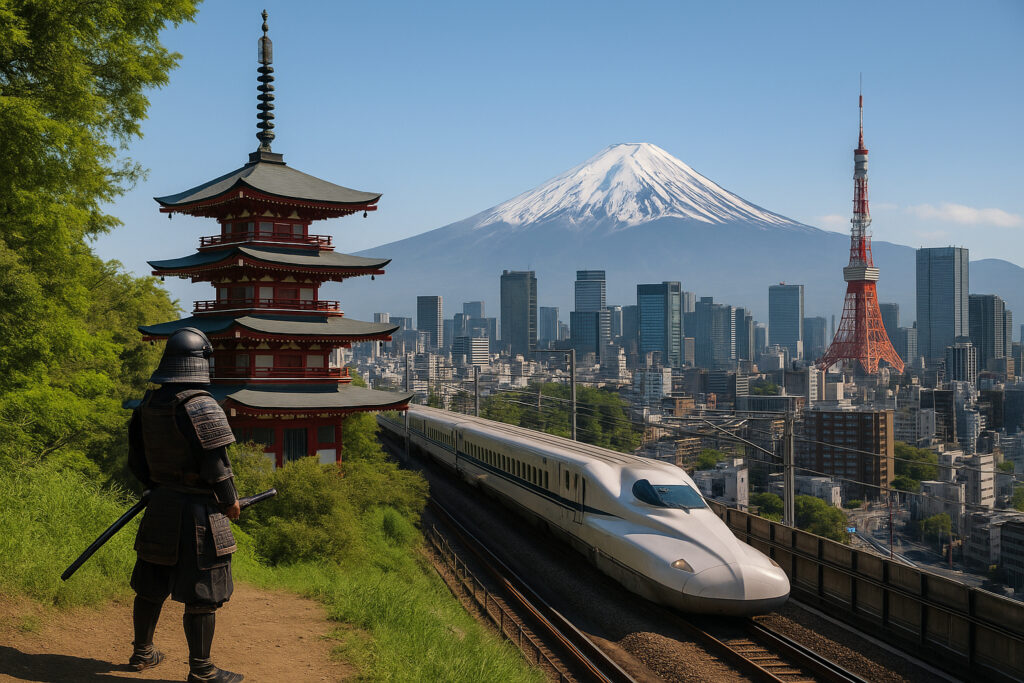
Few nations have undergone a transformation as dramatic and rapid as Japan’s. Within a century, it evolved from a feudal society led by samurai into one of the world’s most technologically advanced and economically powerful countries. This remarkable journey — marked by resilience, reform, and reinvention — stands as one of history’s greatest examples of modernization. The story of modern Japan is not just about progress; it’s about how tradition and innovation can coexist to shape a nation’s identity.
The End of the Samurai Era
For over two centuries, Japan lived under the Tokugawa shogunate, a period defined by isolation, hierarchy, and strict social order. The samurai class maintained control, upholding values of honor and discipline. But by the mid-19th century, Japan’s isolation began to crumble under external pressure. The arrival of foreign ships and trade demands revealed the need for change. The old ways — while noble — could no longer withstand the realities of a rapidly industrializing world.
The Meiji Restoration: A Nation Reborn
The turning point came in 1868 with the Meiji Restoration, when Emperor Meiji reclaimed power from the shogunate and launched an ambitious program of modernization. Japan’s leaders recognized that survival depended on transformation. They sent scholars and officials abroad to study Western technology, governance, and education. Within decades, Japan adopted constitutional reforms, a modern military, and an industrial economy. Railways, factories, and public schools replaced castles and swords — yet the spirit of discipline and unity rooted in the samurai tradition remained central to the nation’s progress.
Industrialization and Global Emergence
By the early 20th century, Japan had become a formidable industrial and military power. Its mastery of technology and efficient governance allowed it to rival Western nations in trade and influence. Urban centers like Tokyo and Osaka became symbols of modern progress, blending Western architecture with Japanese innovation. Japan’s rapid rise, however, was not without conflict. Expansionist ambitions and world wars tested its moral and political foundations. Yet, through devastation and reconstruction, Japan repeatedly demonstrated its extraordinary capacity to rebuild and adapt.
Postwar Reconstruction and Economic Miracle
After World War II, Japan faced ruin. But from the ashes of defeat emerged a nation determined to redefine itself once again — this time through peace and productivity. The U.S.-led occupation introduced democratic reforms, while Japanese industries focused on technology, quality, and efficiency. Within decades, Japan became an economic powerhouse, pioneering electronics, automobiles, and manufacturing systems that set global standards. The nation’s resilience, discipline, and commitment to excellence became models of postwar recovery.
Balancing Tradition and Modernity
What makes Japan’s story truly remarkable is its ability to modernize without losing its cultural soul. Ancient temples stand beside neon-lit skyscrapers; tea ceremonies coexist with robotics. The principles of respect, harmony, and craftsmanship — once embodied by the samurai — continue to influence modern life. Japan’s success lies not in abandoning tradition, but in weaving it into progress. This balance between old and new has allowed the nation to remain uniquely Japanese, even as it leads on the world stage.
Conclusion
The birth of modern Japan is a story of transformation through vision, resilience, and cultural integrity. From the fall of the samurai to the rise of a superpower, Japan’s journey illustrates that modernization need not mean the loss of identity. Instead, it shows how tradition can guide progress, and how a nation can honor its past while embracing its future. Japan’s evolution is not just a lesson in reform — it’s an enduring symbol of how change, when rooted in purpose, can redefine destiny.