
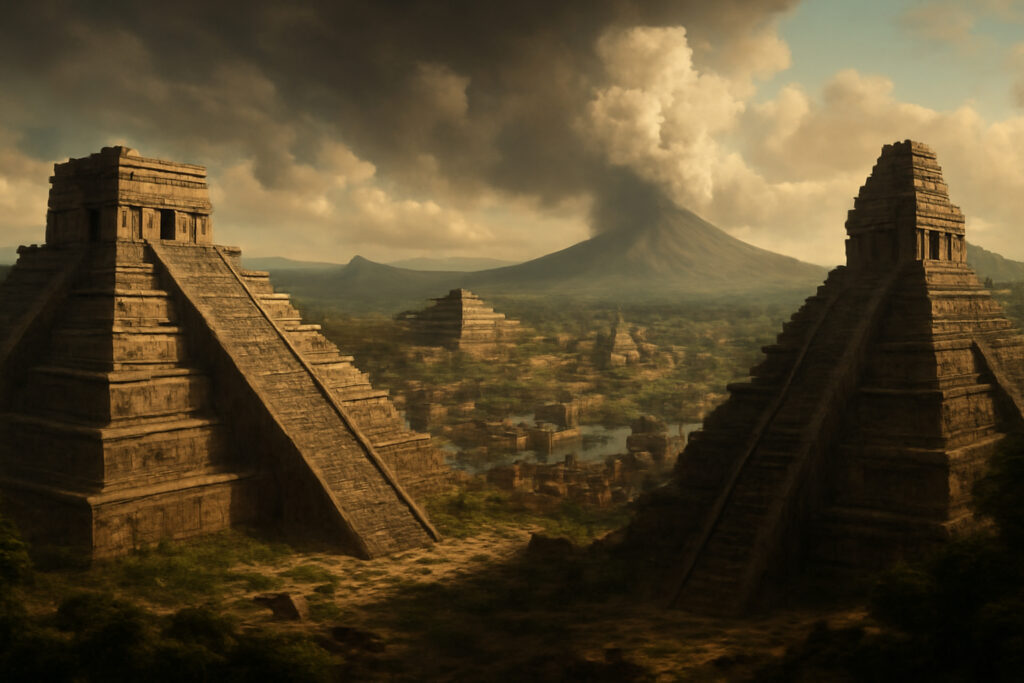
The Aztec and Maya civilizations were two of the most sophisticated and influential cultures in the ancient Americas. Known for their monumental architecture, advanced astronomy, complex writing systems, and rich artistic traditions, they flourished for centuries before experiencing dramatic declines. Although often grouped together, their falls occurred under very different circumstances—and understanding why reveals a great deal about resilience, power, and the consequences of cultural collision.
The Fall of the Maya: A Slow Decline Over Centuries
Unlike the Aztecs, the Maya collapse was not a single event but a long, gradual unraveling. At their height, the Maya built vast cities, developed intricate calendars, and created one of the most advanced writing systems in the world. Yet between the 8th and 10th centuries, many major Maya cities in the southern lowlands were abandoned.
Historians believe the decline was caused by a combination of factors:
-
Environmental strain: Deforestation, soil depletion, and long-lasting drought weakened agricultural systems.
-
Overpopulation: Too many people competing for too few resources destabilized society.
-
Internal conflict: Rival Maya city-states battled for power, draining military and economic strength.
-
Political collapse: As people lost faith in their rulers, centralized authority weakened.
However, the Maya people themselves never disappeared. Millions of Maya descendants still live across Mexico, Guatemala, Belize, and Honduras, carrying forward language, culture, and tradition.
The Fall of the Aztecs: A Rapid Conquest
While the Maya decline was gradual, the fall of the Aztec Empire was shockingly swift. At its peak, the Aztec capital—Tenochtitlán—was a dazzling city of canals, temples, and marketplaces, home to hundreds of thousands of people. But in 1519, Spanish conquistador Hernán Cortés arrived, seeking wealth and power.
Several key factors led to the Aztec downfall:
-
Alliances with Aztec enemies: Indigenous groups resentful of Aztec dominance joined the Spanish forces.
-
Superior weaponry: Steel swords, firearms, horses, and cannons gave the Spanish a major advantage.
-
Disease: Smallpox swept through the population, killing thousands and destabilizing Aztec society.
-
The capture of Emperor Moctezuma II: Leadership faltered at a critical moment, weakening resistance.
By 1521, Tenochtitlán fell, marking the end of the Aztec Empire and the beginning of a new colonial era.
A Legacy That Still Shapes the World
Though their political powers fell, both the Maya and Aztecs left legacies that continue to influence modern culture:
-
Architectural wonders like Chichen Itza, Teotihuacán, and Templo Mayor
-
Mathematical and astronomical discoveries
-
Rich traditions in art, food, myth, and ritual
-
Living descendants who carry forward languages and customs
Their falls were not endings but turning points—moments that reshaped entire regions and continue to inspire awe and study today.