Uncover History’s Secrets with Daily Updates!
Daily News Entertainment
  • Home
  • History
  • Biographies
  • Eras
  • Regions
  • Timeline
No Result
View All Result
History Ours
  • Home
  • History
  • Biographies
  • Eras
  • Regions
  • Timeline
No Result
View All Result
History Ours
No Result
View All Result
Home Regions

The Great Stink and How London Reengineered the Thames

in Regions
The Great Stink and How London Reengineered the Thames

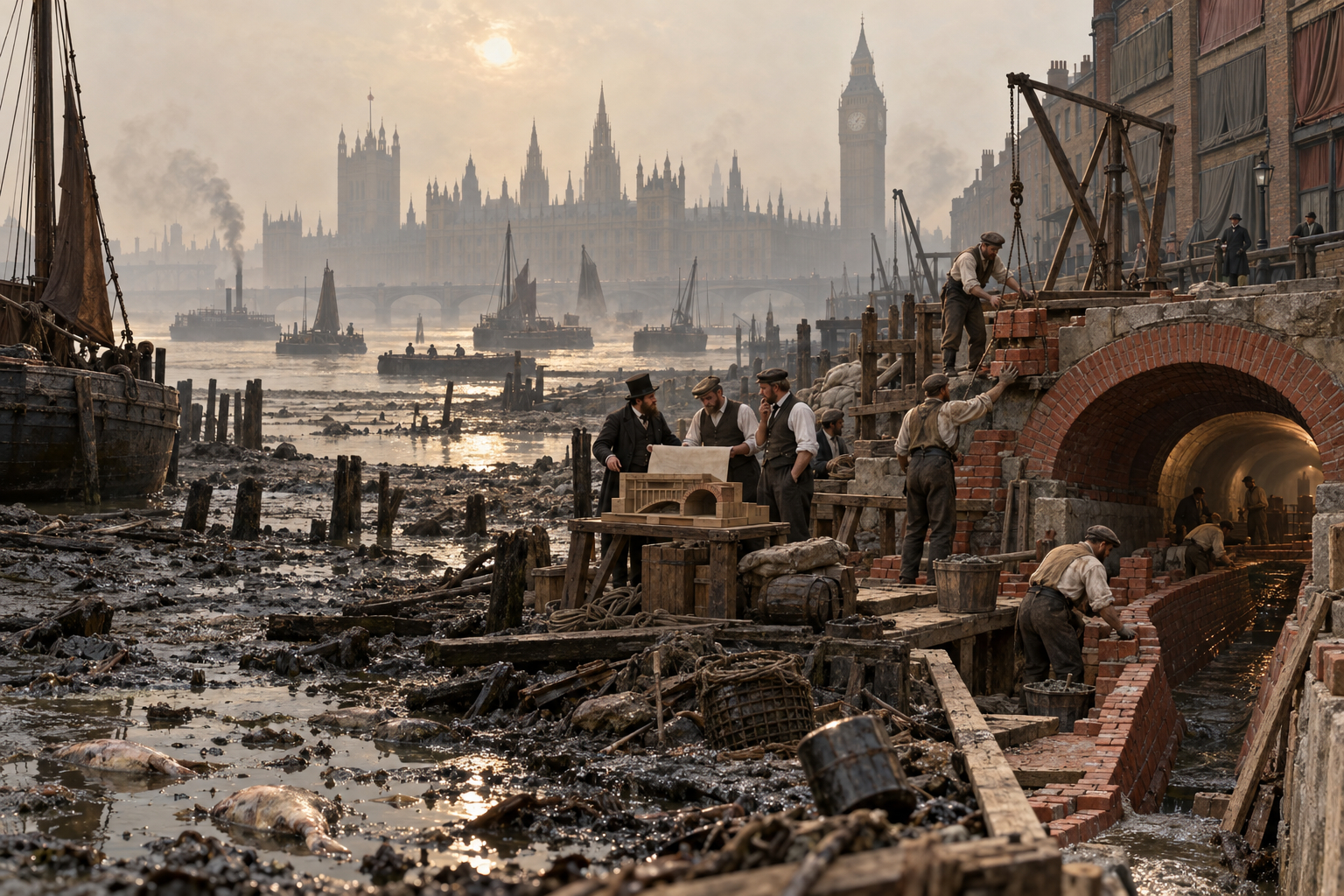
By the mid-19th century the river that had sustained London for centuries had become a sewer. Population growth, factories, brewery and slaughterhouse waste, and a patchwork of medieval drains poured into the tidal Thames. In hot weather the organic load fermented and the city was assailed by an unbearable stench that settled over wharves, taverns, and Parliament itself.

The smell was more than nuisance; it was a symptom. Recurrent cholera outbreaks—most famously the 1854 epidemic whose map by John Snow implicated contaminated water—had already exposed the link between foul water and disease. Still, only when the summer of 1858 produced the “Great Stink”—a heatwave that concentrated the odors and forced the closure of some riverside rooms in the Houses of Parliament—did national attention harden into action.

Bazalgette and the Engineering Rewrite of a River

Enter Joseph Bazalgette, an engineer of the Metropolitan Board of Works. He proposed something radical for Victorian London: not just local fixes but a city-wide system to carry sewage away from the centre. The plan used large intercepting sewers built well above the level of the river’s high tide, a series of pumping stations to lift effluent when needed, and outfalls that discharged downstream at ebb tide.

What was delivered in the following years was a monument to civil engineering—vast brick tunnels, monumental pumping houses at places like Crossness and Abbey Mills, and new embankments that concealed the works while reclaiming land. The concrete and brickwork, the long, gently sloping gradients and the careful calculations of capacity were designed to last. The system anticipated a much larger city than Victorian London then was, a deliberate bet on growth.

The River Remade: Health, Space, and Memory

The immediate payoff was dramatic. The offensive smells that had paralysed summer life diminished, and the conditions that allowed cholera to spread through contaminated water supplies were broken. Beyond public health, the project reshaped London’s geography. Embankments created new streets and public promenades; the river’s edge was rationalized for trade and leisure rather than makeshift disposal.

Today the Crossness engine house and the line of embankments are visible traces of that transformation. The Thames did not become pristine overnight, nor has the city’s relationship to its river ever been static. Still, the response to the Great Stink is a clear episode when a dirty, dangerous river was made into an asset by engineering, politics, and a sudden public urgency that turned nuisance into reform.

Conclusion

The Great Stink was more than a Victorian scandal about smell. It was a turning point in how a metropolis treated waste and a reminder that the contours of a region—its streets, promenades, and health—can be made or remade by infrastructure. In London’s case, engineers rebuilt the river’s margins and, in doing so, helped define the modern city.
Previous Post

The Salt Trade That Built Timbuktu and the Sahel

Next Post

The Voynich Manuscript: A Timeline of Secret Pages

Related Posts

The Salt Trade That Built Timbuktu and the Sahel
Regions

The Salt Trade That Built Timbuktu and the Sahel

October 12, 2026
Sea Islands: Rice, Sweetgrass, and a Living West African Legacy
Regions

Sea Islands: Rice, Sweetgrass, and a Living West African Legacy

October 7, 2026
Kelp and Coin: Scotland’s Seaweed Economy and the Clearances
Regions

Kelp and Coin: Scotland’s Seaweed Economy and the Clearances

October 7, 2026
How Wind and Loess Built the Palouse Wheatlands
Regions

How Wind and Loess Built the Palouse Wheatlands

October 2, 2026
Next Post
The Voynich Manuscript: A Timeline of Secret Pages

The Voynich Manuscript: A Timeline of Secret Pages

Search..

No Result
View All Result

Recent Articles

The South Sea Bubble: A Year of Speculation and Collapse

The South Sea Bubble: A Year of Speculation and Collapse

October 13, 2026
The Voynich Manuscript: A Timeline of Secret Pages

The Voynich Manuscript: A Timeline of Secret Pages

October 13, 2026
The Great Stink and How London Reengineered the Thames

The Great Stink and How London Reengineered the Thames

October 12, 2026
The Salt Trade That Built Timbuktu and the Sahel

The Salt Trade That Built Timbuktu and the Sahel

October 12, 2026
Mapping Time: Understanding How Eras Shape Histories

Mapping Time: Understanding How Eras Shape Histories

October 11, 2026

Subscribe Us

By clicking submit, I authorize History Ours and its affiliated companies to: (1) use, sell, and share my information for marketing purposes, including cross-context behavioral advertising, as described in our Terms of Service and Privacy Policy, (2) supplement the information that I provide with additional information lawfully obtained from other sources, like demographic data from public sources, interests inferred from web page views, or other data relevant to what might interest me, like past purchase or location data, (3) contact me or enable others to contact me by email with offers for goods and services from any category at the email address provided, and (4) retain my information while I am engaging with marketing messages that I receive and for a reasonable amount of time thereafter. I understand I can opt out at any time through an email that I receive, or by clicking here

Subscribe To Our Newsletter

By clicking submit, I authorize History Ours and its affiliated companies to: (1) use, sell, and share my information for marketing purposes, including cross-context behavioral advertising, as described in our Terms of Service and Privacy Policy, (2) supplement the information that I provide with additional information lawfully obtained from other sources, like demographic data from public sources, interests inferred from web page views, or other data relevant to what might interest me, like past purchase or location data, (3) contact me or enable others to contact me by email with offers for goods and services from any category at the email address provided, and (4) retain my information while I am engaging with marketing messages that I receive and for a reasonable amount of time thereafter. I understand I can opt out at any time through an email that I receive, or by clicking here.

© 2026 History Ours | All Rights Reserved

  • Contact Us
  • Privacy Policy
  • Terms of Service
  • Unsubscribe
  • Privacy Choices
  • Contact Us
  • Privacy Policy
  • Terms of Service
  • Unsubscribe
  • Privacy Choices

© 2026 History Ours | All Rights Reserved

No Result
View All Result
  • Home
  • History
  • Biographies
  • Eras
  • Regions
  • Timeline

© 2026 History Ours | All Rights Reserved

Skip to content
Open toolbar Accessibility Tools

Accessibility Tools

  • Increase TextIncrease Text
  • Decrease TextDecrease Text
  • GrayscaleGrayscale
  • High ContrastHigh Contrast
  • Negative ContrastNegative Contrast
  • Light BackgroundLight Background
  • Links UnderlineLinks Underline
  • Readable FontReadable Font
  • Reset Reset