
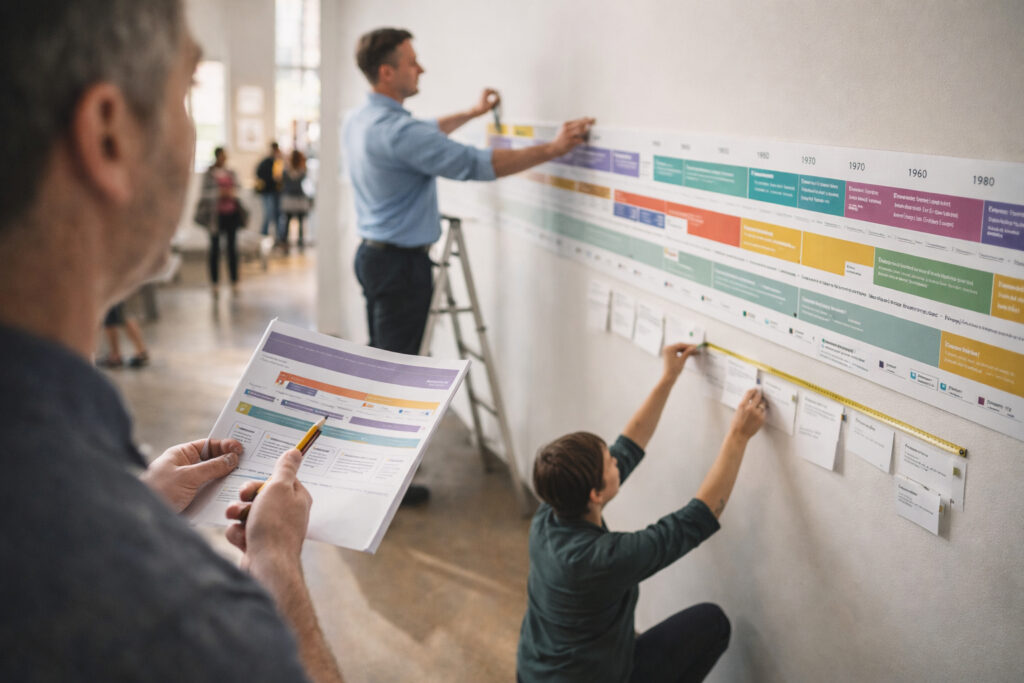
Creating a clear, engaging chronological display begins with a focused purpose and a practical sense of audience. Start by defining the scope: what time span, whose stories, and which themes matter most to visitors. Early planning should balance the need for accuracy with readability so that detail enhances rather than overwhelms. Thoughtful sequencing helps audiences follow connections and draw meaning from temporal relationships.
Scoping the Timeline
Begin by setting explicit objectives for the timeline and identifying primary research sources that will anchor the narrative. Decide on an appropriate scale—decades, years, or specific dates—based on the density of events and the attention span of your typical visitor. Establish inclusion criteria so each entry serves the overarching story rather than competing for attention. Clear scope reduces clutter and makes curation decisions easier.
When scope is fixed, create a preliminary list of milestones and categories that will structure the sequence. This list becomes a working checklist during research and design phases.
Designing for Legibility and Scale
Design choices determine how easily visitors can navigate time and compare events at a glance. Use consistent visual hierarchies—type size, color contrast, and spacing—to signal importance and relationships without relying on excessive text. Consider physical constraints of the display area and adapt the timeline to fit sightlines and circulation patterns. Legible typography and a restrained palette improve comprehension in public settings.
Mock up different formats, from linear panels to stacked bands, and test them with sample audiences to refine readability and flow.
Layering Context and Interaction
Effective timelines combine events with contextual layers that illuminate causes, consequences, and concurrent developments. Introduce thematic tracks—political, social, technological—that run parallel to the main sequence to show connections across spheres. Provide concise interpretive captions that summarize significance while linking to deeper resources for visitors who want more. Interactive elements like touchpoints or modular inserts invite exploration without breaking the core narrative.
- Use thematic bands to compare trends.
- Offer QR links or small flip-panels for extended reading.
Layering should enhance narrative clarity and offer multiple entry points so different visitors can engage at their preferred depth.
Conclusion
Sequencing a public timeline requires decisions about scope, design, and interpretive layering that work together to guide understanding. Prioritize clarity and test with real audiences to ensure the display communicates context and invites inquiry. A well-crafted timeline turns dates into a coherent story that resonates with diverse visitors.