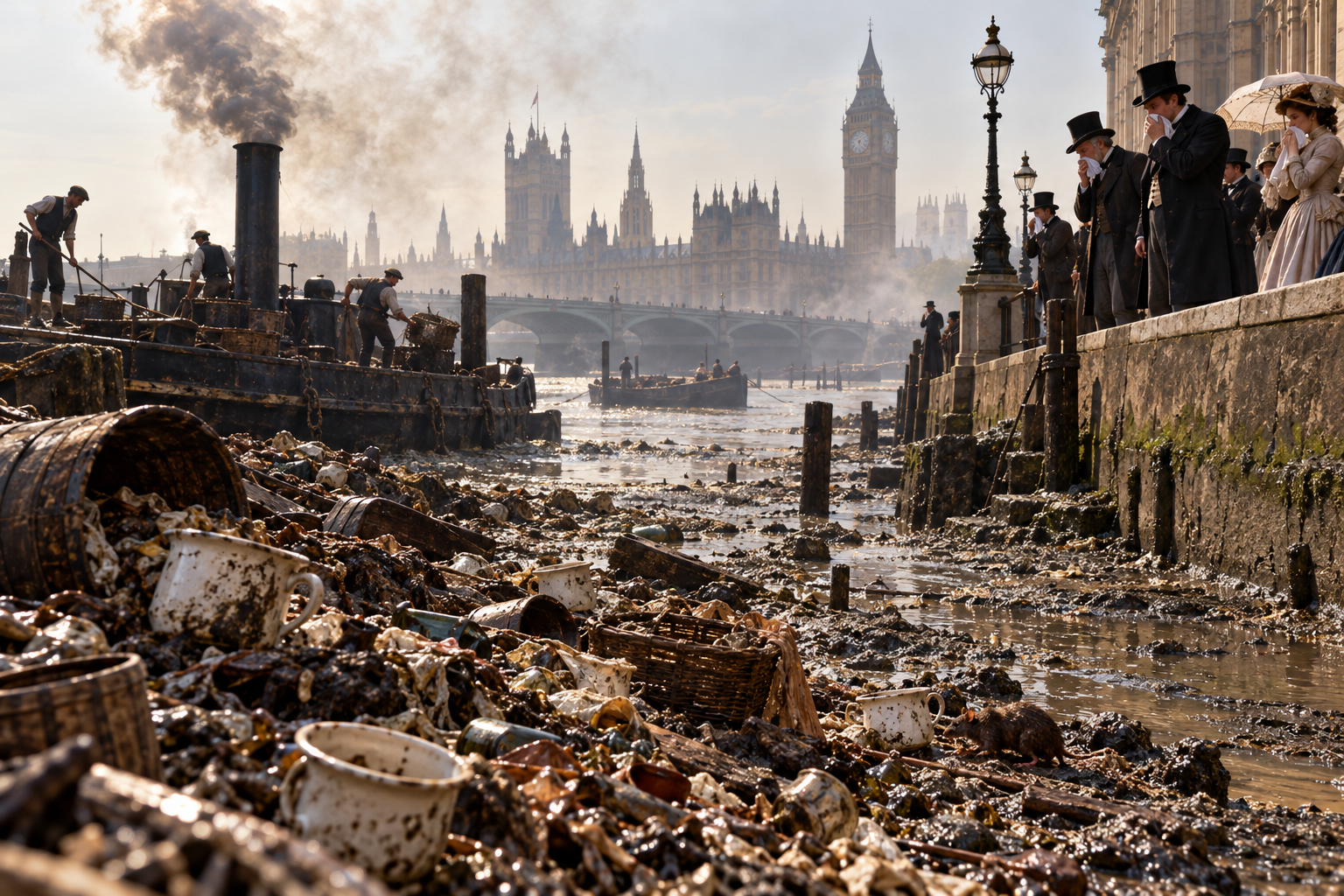
By the summer of 1858 the Thames had stopped being a river and become a slow-moving sewer. A succession of hot weeks reduced the river’s flow, and raw human and industrial waste accumulated along the Victorian city’s central artery. The smell grew worse and worse: not merely unpleasant but unmistakably intrusive, drifting into shops, taverns, and the new glass-and-iron halls of Parliament on the riverbank. For Londoners the nuisance was also a civic emergency—one that exposed a failure of public infrastructure and a growing anxiety about disease.
Pressure, panic, and a plan (1854–1859)
The Great Stink did not emerge from nowhere. Cholera outbreaks in 1832, 1848–49 and John Snow’s 1854 work on contaminated water had already begun shifting opinions about how disease spread. Still, old habits—cesspits, minimal drainage, and dense riverside development—left London vulnerable.
When the stench peaked in July 1858, the problem could no longer be deferred. Parliament, close to the worst stretches of the Thames, found debates interrupted by the heat and the odor. The visible disruption pushed politicians and engineers to act: the recently established Metropolitan Board of Works turned to its chief engineer, Joseph Bazalgette, for a comprehensive remedy.
Bazalgette’s pipes and the shape of modern London
Bazalgette’s idea was straightforward in principle if ambitious in scale: intercept the sewage flowing into the Thames through a network of high-capacity sewers that would carry waste downstream of the city and out to sea. The scheme also created the riverfront embankments—most famously the Victoria Embankment—that reclaimed land, buried ugly open sewers, and provided space for roads, sewers, and the new metropolitan underground services.
Construction began quickly after approval in 1859. Massive brick tunnels, pumping stations, and riverside outfalls were built over the 1860s and into the 1870s. The results transformed London’s public health infrastructure and its appearance: broad embanked riverbanks replaced muddy foreshore and slumped wharves, and for the first time a unified system carried the city’s waste away from drinking water supplies.
Conclusion
The Great Stink reads like a Victorian moral tale: unbearable filth forced reform. It was less a single dramatic disaster than a tipping point—the moment when smell, science, and politics aligned. The sewers Joseph Bazalgette designed kept their promise. They didn’t instantly erase disease or urban dirt, but they changed how cities could be engineered and governed. Today London’s grand embankments and subterranean arteries remain a quiet, enduring answer to an odor that once stopped a parliament and remade a metropolis.