
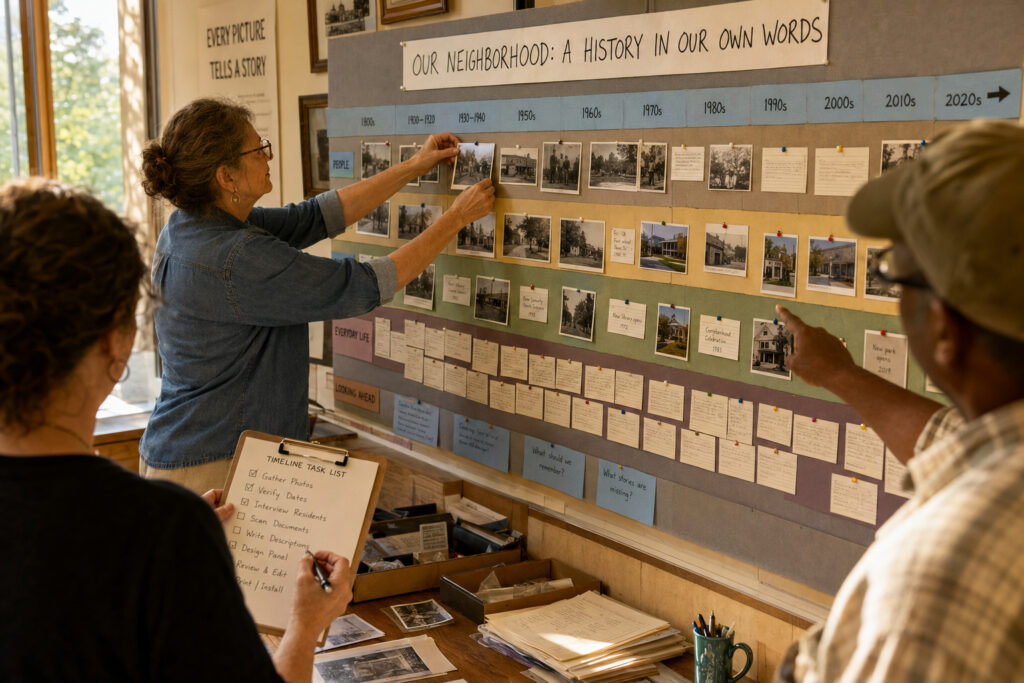
Effective timelines require clear decisions about scope and audience.
Begin with a focused question that your timeline will answer and the story you want to surface.
Decide the period, geographic scale, and the thematic threads you will follow to avoid scattershot coverage.
Early choices shape research needs and the user experience, so document them before deep work begins.
Defining Scope and Threads
Begin by choosing a manageable chronological frame and one or two thematic threads that will carry through the timeline. Narrowing focus avoids overwhelming viewers and helps you prioritize events and sources. For community projects, center lived experience and representative milestones rather than exhaustive lists. Balance representative landmarks with everyday moments to reflect broader experience and to surface patterns beyond headline events.
Keep a simple checklist for inclusion criteria and sources so each entry has a clear justification. Revisit criteria as new evidence emerges and note changes for transparency. This will speed decisions during research and design.
Establishing Chronology and Scale
Decide how to represent different temporal scales so long arcs and short events are both legible. Use proportional spacing for wide spans and expandable entries or insets for dense periods. Annotate uncertainty clearly when dates are approximate or disputed, and keep provenance visible for each claim. Integrate comparative or inset timelines to show concurrent developments without collapsing separate threads.
Pilot the scale with test audiences to spot compression or gaps in the narrative logic. Record scale and granularity decisions in a brief style guide for consistency across the project. Adjust granularity until patterns, not clutter, are visible.
Designing Layers and Visual Cues
Layering allows multiple storylines to coexist without confusion by assigning color, banding, or parallel lanes to distinct threads. Use typographic hierarchy and simple iconography to signal event types and significance at a glance. Interactive timelines can reveal deeper context on demand, while static displays should prioritize clarity and immediate takeaway. Include brief primary source excerpts or images to humanize entries while keeping the main layout uncluttered.
Maintain accessible contrast and avoid overreliance on color alone for meaning. Provide alternative text and clear captions for images and excerpts to ensure accessibility. Ensure labels are concise and legible at intended viewing distances.
Testing, Maintenance, and Community Curation
Test early versions with representative users, including those with local knowledge, to catch omissions and ambiguities. Solicit feedback about pacing, readability, and perceived gaps in coverage and adjust entries accordingly. Plan for ongoing maintenance so new research or community contributions can be integrated without breaking chronology. Establish clear roles and workflows for curators, editors, and technical maintainers to keep the timeline reliable.
Encourage community annotation and provide a transparent process for reviewing additions. Treat the timeline as a living resource and schedule periodic audits to incorporate fresh sources and corrections.
Conclusion
Sequencing local history is an iterative craft that balances research, narrative, and design.
Test early and often with representative audiences to refine clarity and relevance.
A clear, layered timeline turns discrete events into meaningful patterns for public understanding.