
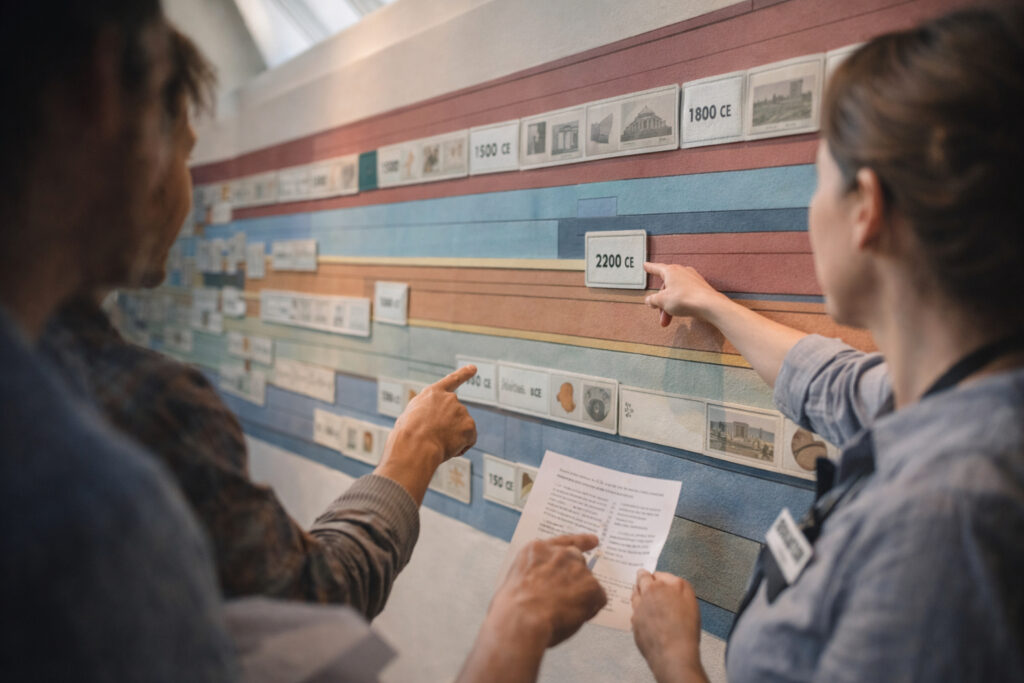
Historical timelines are powerful tools for turning complex sequences into readable narratives.
They help visitors and readers locate events in time and see connections across topics and scales.
Good timeline design balances clarity with enough context to support further inquiry.
This article outlines practical approaches to layering information for public audiences.
Clarify Purpose and Audience
Begin by identifying the timeline’s core purpose: orientation, interpretation, or prompting exploration. A public-facing timeline aimed at general audiences emphasizes clear entry points and avoids specialist jargon. Consider the likely knowledge level of your viewers and the typical contexts where they will encounter the timeline. These decisions guide choices about scale, labeling, and how much background to include.
Keep the user’s goals central when making layout and content choices. A focused purpose reduces clutter and helps prioritize events and themes.
Layering Information for Different Users
Layering allows a single timeline to serve varied needs by presenting information in tiers. Top-level elements show major dates and themes for quick comprehension, while secondary layers provide dates, short descriptions, and interpretive notes. Digital timelines can offer interactive expansion for deep dives; printed panels use clear visual cues to suggest where to look next. Thoughtful layering prevents overload while preserving richness for interested readers.
Design each layer with consistent markers so users can navigate intuitively. Layering should feel additive rather than fragmented.
Visual Hierarchy and Spatial Scale
Visual hierarchy guides attention: size, color, and position signal importance and chronological grouping. Use consistent spacing to represent time intervals, but be prepared to compress or expand ranges to highlight dense periods without losing overall scale. Color palettes and iconography help differentiate themes and make scanning easier for visitors. Accessibility considerations—contrast, font size, and clear labels—ensure the timeline reaches a broad audience.
Test visual choices with representative users when possible. Iteration reveals where emphasis or spacing need adjustment.
Sourcing, Context, and Interpretive Notes
Transparent sourcing and concise interpretive notes build trust and invite further research. Include brief citations or a reference panel so curious users can trace claims. Where interpretation is necessary, signal analysis clearly to distinguish it from basic chronology. This approach preserves both factual grounding and the narrative insights that make timelines meaningful.
Balance detail with readability by offering pathways to more information rather than crowding the main timeline. Clear sourcing supports education and credibility.
Conclusion
Layered timelines guide diverse audiences from a quick overview to deeper engagement.
They rely on clear purpose, intuitive hierarchy, and transparent sourcing to communicate effectively.
Thoughtful iteration and testing keep timelines accessible and informative for public users.