In September 1928 Alexander Fleming noticed something odd on a forgotten Petri dish: a colony of mold had killed the surrounding bacteria. He identified the mold as a Penicillium species and described a substance he called “penicillin” that prevented bacterial growth. Fleming published his observations in 1929, but he lacked a way to purify or produce the compound in useful quantities. For a decade penicillin remained a promising laboratory curiosity rather than a practical drug.
1939–1941: Oxford sharpens the idea into treatment
By the late 1930s a team at Oxford—led by Howard Florey and including Ernst Chain and Norman Heatley—returned to Fleming’s work with new urgency. Using careful extraction and assay techniques they showed penicillin could cure bacterial infections in mice and then in humans. In 1941 the first patient treated with purified penicillin showed clear improvement; supplies ran out before the infection was fully controlled, and the case underscored both the drug’s potential and the problem: how to make enough.
1941–1945: Mass production, wartime urgency, and global impact
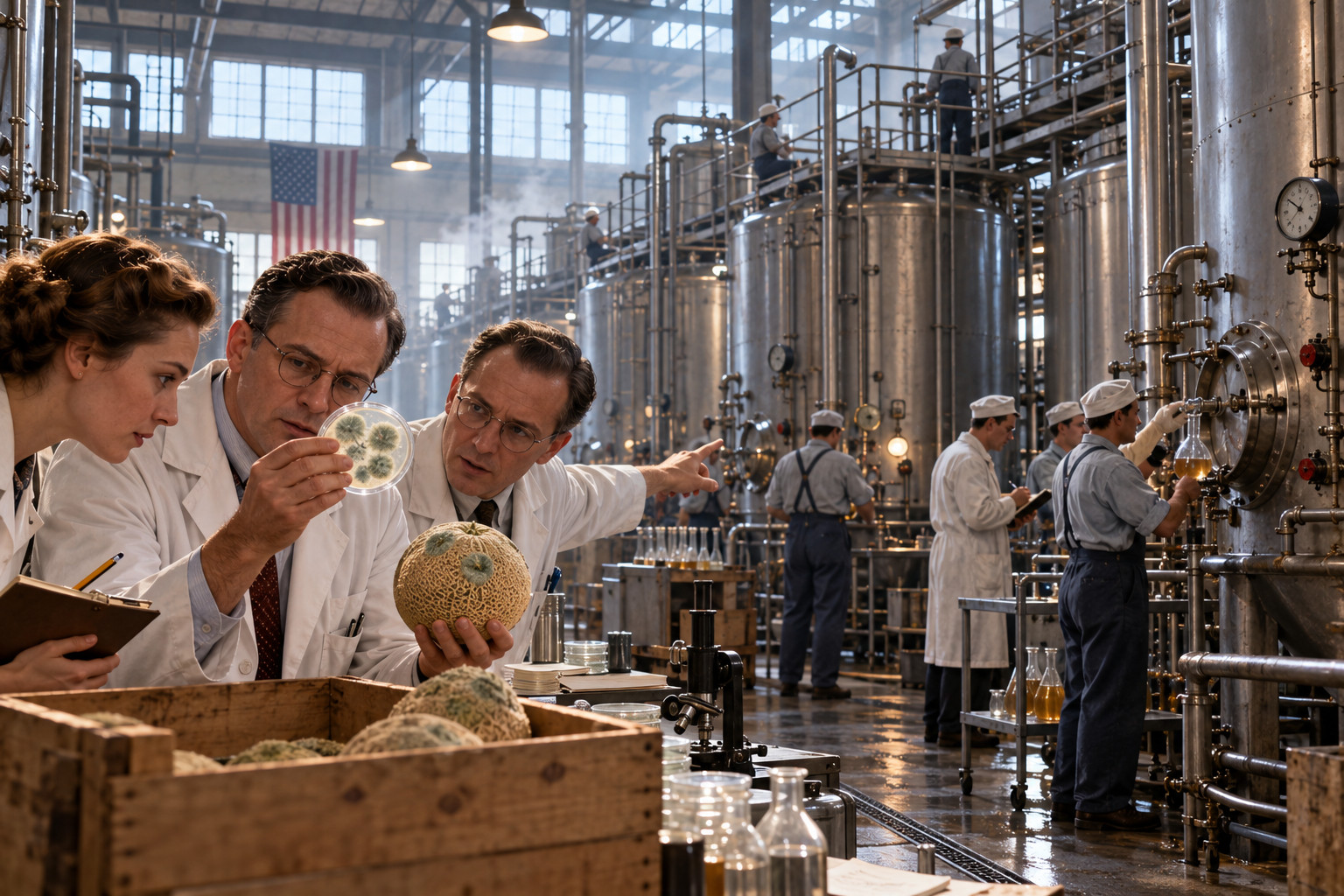
World War II turned penicillin into a strategic priority. Britain lacked the industrial capacity to produce the volumes the Allies needed, so the Oxford team shared their methods with pharmaceutical firms in the United States. American scientists and manufacturers developed deep-tank fermentation processes and launched an unprecedented screening program to find high-yield strains. One breakthrough came from an unlikely source: a moldy cantaloupe from a Peoria, Illinois, market produced a Penicillium strain that significantly increased yields.
These advances moved penicillin from gram-scale laboratory production to the tons required for hospitals and battlefields. By D-Day in 1944 and the campaigns that followed, penicillin was being used to treat wound infections and save thousands of lives. In 1945 Fleming, Florey, and Chain shared the Nobel Prize in Physiology or Medicine for their roles in discovering and developing the drug.
Conclusion
Penicillin’s path—an accidental observation, years of patient refinement, and wartime scaling—changed medicine. It turned a single mold colony in a cluttered lab into the first widely effective antibiotic, inaugurating an era in which many once-deadly infections became treatable. The story also hints at how discovery, technical ingenuity, and industrial muscle must converge before a laboratory finding becomes a medicine in patients’ hands.