
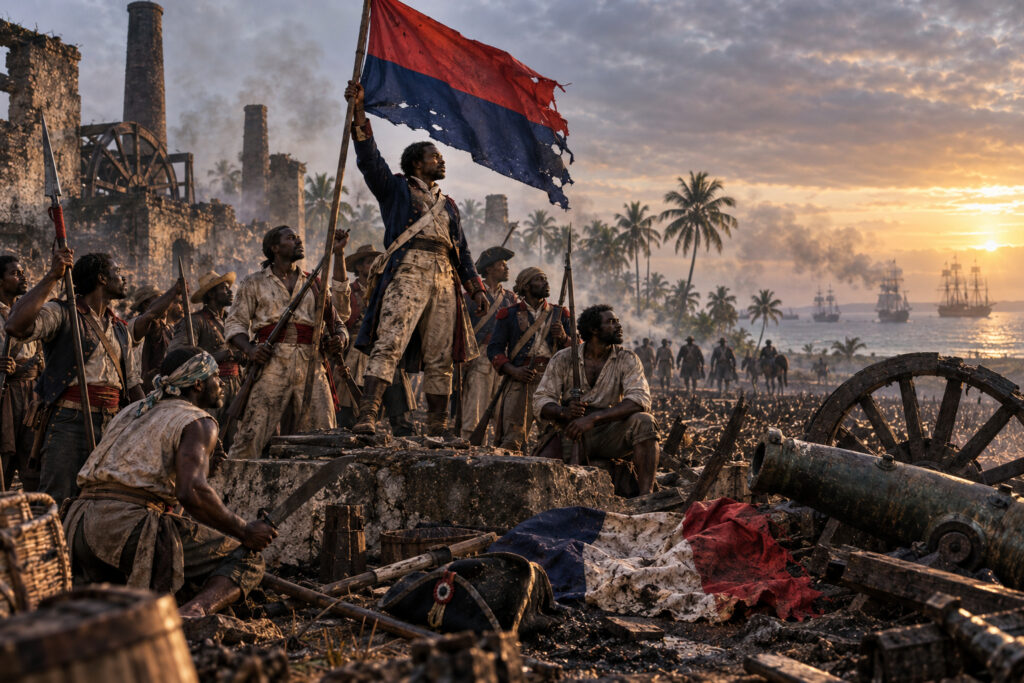
Saint-Domingue was the richest European colony in the Caribbean by the late 18th century, built on vast sugar and coffee plantations worked by an enslaved majority. In August 1791 a rebellion in the northern mountains—often linked in memory to a Bois Caïman ceremony—ignited a broader insurrection. What began as coordinated uprisings among enslaved people quickly spread into a general war: plantations burned, planters fled, and rival forces—enslaved insurgents, free people of color, white colonists, and foreign powers—competed for advantage.
Emancipation, shifting alliances, and Toussaint’s rise (1793–1801)
Revolution in France changed everything. Facing wars across Europe, the French revolutionary government declared the abolition of slavery in 1794, and many Black commanders in Saint-Domingue sided with the Republic. One of them, Toussaint Louverture, a formerly enslaved man who became a skilled general and administrator, emerged as the dominant figure by the late 1790s. Toussaint consolidated control over most of the colony, restored aspects of plantation agriculture to revive the economy, and navigated a web of treaties with Britain and Spain while keeping nominal loyalty to France.
Napoleon’s intervention and the final push (1802–1804)
When Napoleon Bonaparte moved to reassert imperial control, he dispatched a large expedition in 1802 under General Charles Leclerc. The arrival of French troops initially gained ground, and Toussaint was captured by treachery and deported to France, where he died in captivity in 1803. But the military situation turned against the French. Tropical disease—especially yellow fever—decimated their ranks, and new leaders, notably Jean-Jacques Dessalines, sustained guerrilla resistance and conventional battles. By late 1803 French forces were collapsing. On January 1, 1804, Dessalines proclaimed the independent state of Haiti—the first modern nation founded by formerly enslaved people and the second independent republic in the Americas.
Conclusion
The Haitian Revolution was more than a sequence of battles; it rewrote assumptions about who could claim sovereignty in the Atlantic world. Its consequences were immediate and long-lasting: the plantation economy was transformed, international recognition was delayed and often hostile, and France demanded a heavy indemnity decades later that hampered Haiti’s development. Still, between 1791 and 1804, formerly enslaved people overturned an entrenched colonial order and created a new nation—an achievement that reshaped the map and reverberated through revolutions and debates about liberty across the Americas.