
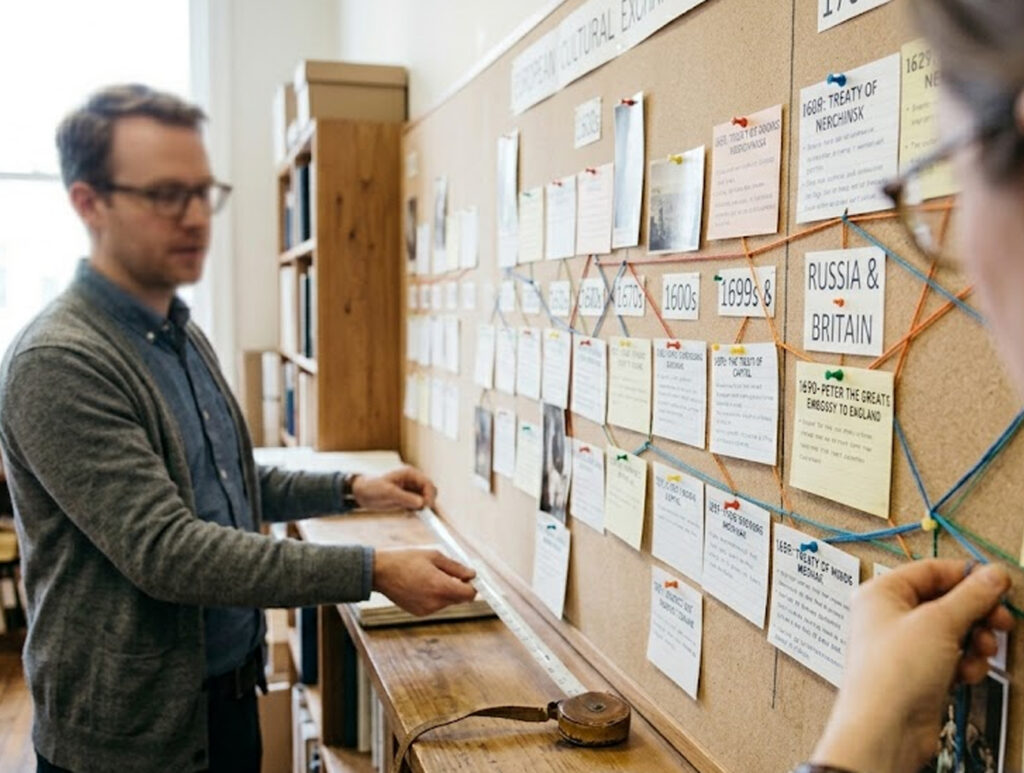
Timelines are essential tools for organizing historical events into a coherent narrative.
They reveal patterns, causal relationships, and durations that prose alone may obscure.
A well-designed timeline helps readers see connections across periods and perspectives.
This article explains practical choices for structure, scope, and clarity when building timelines.
Whether curating a public exhibit or a classroom resource, intentional design matters.
Define Purpose and Audience
Before assembling dates and events, clarify what the timeline must accomplish. Is it a reference, a teaching aid, or a narrative device? Audience expectations shape granularity, tone, and visual design. Narrowing purpose saves time and prevents clutter. Document selection criteria early to maintain consistency as the project grows.
Identify core users and common questions they will ask. Use that insight to set inclusion rules for events. Revisiting purpose mid-project reduces redundant work.
Select an Appropriate Scale and Scope
Scale determines how time is represented – by years, decades, or eras. Scope controls which events qualify and where to draw boundaries. Small scales support detail but can overwhelm; broad scales show trends but hide nuance. Match scale to your audience and purpose. Consider logarithmic or proportional scales for unevenly spaced events.
Be explicit about start and end points to avoid scope creep. Annotate choices so readers understand why items were included. Document assumptions about temporal boundaries for future editors.
Design Principles and Practical Tools
Good timelines balance accuracy, legibility, and narrative flow. Use consistent labeling, clear color coding, and legible typography to guide attention. Visual hierarchy helps distinguish major turning points from contextual entries. Digital timelines can add interactivity, while print versions benefit from concise captions. Provide metadata for each entry to aid research and reuse.
- Consistent date format
- Grouped themes or categories
- Accessible color contrasts
Test your timeline with a sample of users to catch ambiguities. Iterate based on feedback until the story reads smoothly. Maintain a changelog to track edits and sources.
Sourcing and Verification
Accurate timelines rely on dependable sources and careful verification. Cross-check primary documents, contemporary accounts, and peer-reviewed scholarship when available. Note conflicting dates and explain your selection where disagreements exist. Keep provenance metadata for each item to facilitate future validation. Transparent sourcing builds trust and supports further research.
Cite sources inline and in a bibliography to aid readers. Where uncertainty remains, label entries clearly and offer alternatives. Regularly review sources as new research emerges.
Conclusion
Timelines translate chronological data into insight through deliberate design.
Clear purpose, scale, and visual choices determine usability and understanding.
A thoughtful timeline invites further exploration and meaningful connections.