
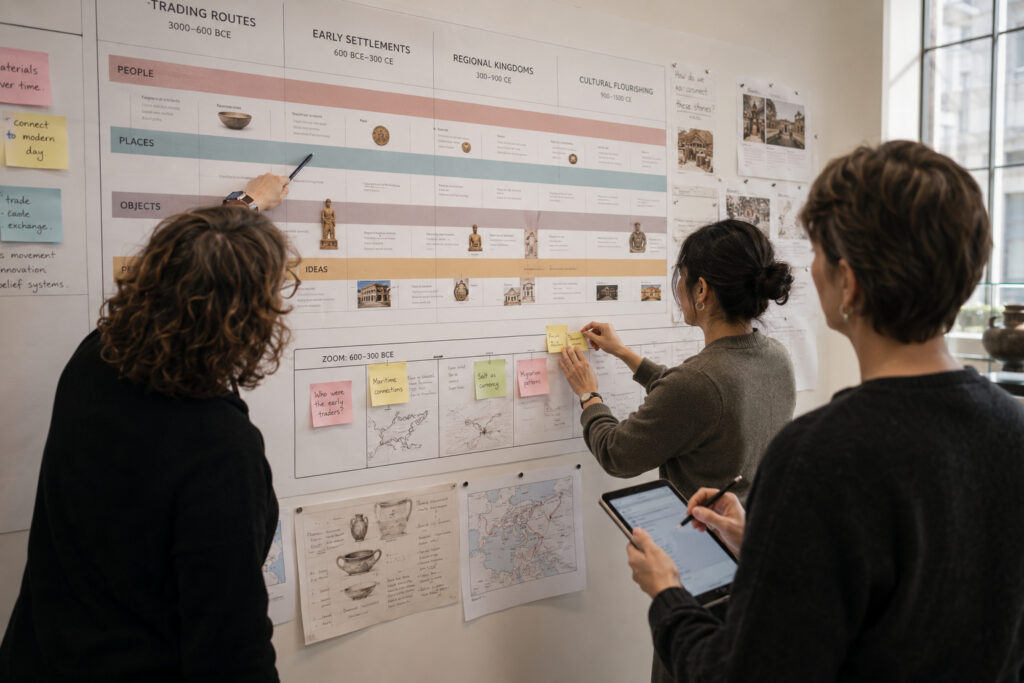
Timelines in museum settings turn collections and research into readable, compelling sequences that invite visitors to explore context and consequence. A well-crafted timeline balances narrative clarity with space for curiosity, allowing different visitors to move at their own pace. Thoughtful decisions about scope, scale, and visual emphasis make historical patterns legible without oversimplifying complexity. This article outlines practical steps to plan timelines that support interpretation and public engagement.
Define audience and narrative focus
Begin by clarifying who the timeline is for and what question it should answer; a family audience has different needs than researchers or school groups. Identify a primary narrative thread—technological change, social movements, or everyday life—and allow secondary threads to appear as layers rather than competing stories. Keep the core message concise, so every included event contributes to that focus. Early decisions about audience and focus guide choices about language, labeling, and supplemental materials.
Use simple interpretive prompts and accessible language to maintain engagement while leaving room for deeper inquiry. A clear focus helps curators prioritize which events and artifacts to highlight.
Choose scale, scope, and visual hierarchy
Decide the chronological span and the level of detail you will present; wide spans require aggregation while narrow spans can afford granular entries. Establish a visual hierarchy through size, color, and placement to direct attention to major milestones and recurring patterns. Consider multiple scales on one plane—decades across the top with zoomed-in event rows below—to help visitors move between overview and detail. Consistent gridlines and spacing aid legibility and support comparative reading.
Test layouts with sketches and low-fidelity prototypes to spot clutter and adjust emphasis before final production. Iteration reduces information overload and improves visitor flow.
Source integration, annotation, and navigation
Integrate primary sources and short annotations that give evidence and texture without overwhelming the main sequence. Use concise captions and icons to signal source types and provenance so interested visitors can dig deeper through labels or QR-linked resources. Provide navigational cues—color bands, index keys, or timelines keyed to exhibit zones—to orient visitors and support self-directed exploration. Maintain transparency about uncertainties and multiple perspectives to preserve scholarly integrity.
- Include a brief bibliography or reference panel for further reading.
- Offer digital supplements for extended narratives and primary documents.
Balancing clarity with depth ensures the timeline serves both as an interpretive tool and a gateway to more complex stories. Thoughtful annotations encourage questions and follow-up learning.
Conclusion
Effective museum timelines combine clear purpose, coherent scale, and layered sources to guide visitor interpretation. Small design choices—hierarchy, labeling, and navigation—have outsized effects on understanding. Prioritize iteration and testing to create timelines that invite curiosity and support learning.