
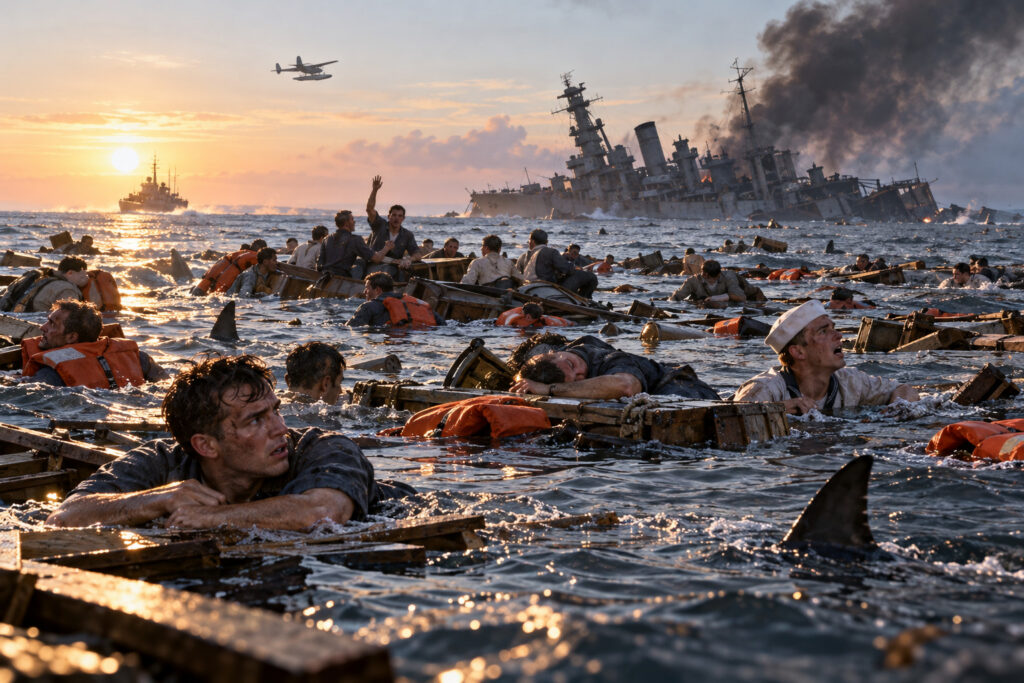
In late July 1945 the heavy cruiser USS Indianapolis completed a mission that would make it a footnote in one of the twentieth century’s greatest turning points. The ship had steamed from San Francisco to the Mariana Islands carrying, in separate crates, the final components needed to assemble the atomic bomb dropped on Hiroshima. After transferring that cargo at Tinian on July 26, the Indianapolis received orders to steam to the Philippines—her crew expecting routine convoy sailing and a short rest.
Torched by Torpedoes: July 30, 1945
On the night of July 30, while slicing through the Philippine Sea and sailing unescorted, the Indianapolis was struck by two torpedoes fired by the Japanese submarine I-58. The explosions tore the hull and knocked out power; the cruiser sank in roughly 12 minutes. Men had little time to abandon ship. Lifeboats were few, damage control was overwhelmed, and hundreds went into warm, shark-filled water with only life jackets.
The Ordeal: Days Adrift and a Delayed Rescue
What turned a catastrophic sinking into one of the worst losses of life at sea in U.S. naval history was not only the torpedoes but the long, fatal delay before anyone realized the ship had disappeared. Because the Indianapolis’s movements had been secret and because radio silence in the area obscured the loss, a full search was not mounted for several days. Survivors floated, clung to rafts, or drifted in groups while dehydration, exposure, saltwater poisoning, and shark attacks claimed many lives. A routine patrol aircraft finally spotted survivors on August 2, and rescue vessels plucked the living from the water; only a few hundred sailors—roughly a third of the crew—survived.
Aftermath and Questions
The sinking left searing controversies. Captain Charles B. McVay III was court-martialed—not for the ship’s loss but on charges related to failure to zigzag and for poor supervision of his vessel—and his conviction haunted him for the rest of his life. Decades later veterans and investigators pushed for reconsideration; the Navy and Congress revisited aspects of the case and the public narrative, and many accounts restore blame to wartime command decisions, communication failures, and the chaos of the final Pacific campaign.
Conclusion
The story of the Indianapolis reads like a compressed tragedy: a secret mission tied to the war’s climax, a swift, violent sinking, and a slow, terrible struggle for survival that exposed organizational fractures within wartime operations. For the men who served aboard her, the last voyage was not merely another chapter in naval history but a cautionary, human reminder of how speed, secrecy, and a single torpedo can change everything.