
When World War II ended, Berlin became a city with four masters: American, British, French and Soviet. The postwar settlement that looked temporary on maps hardened into two German states in 1949 — the Federal Republic in the west, the German Democratic Republic in the east — and a city cleaved down the middle. For a decade the divide was porous. People crossed daily for work, family visits and commerce.
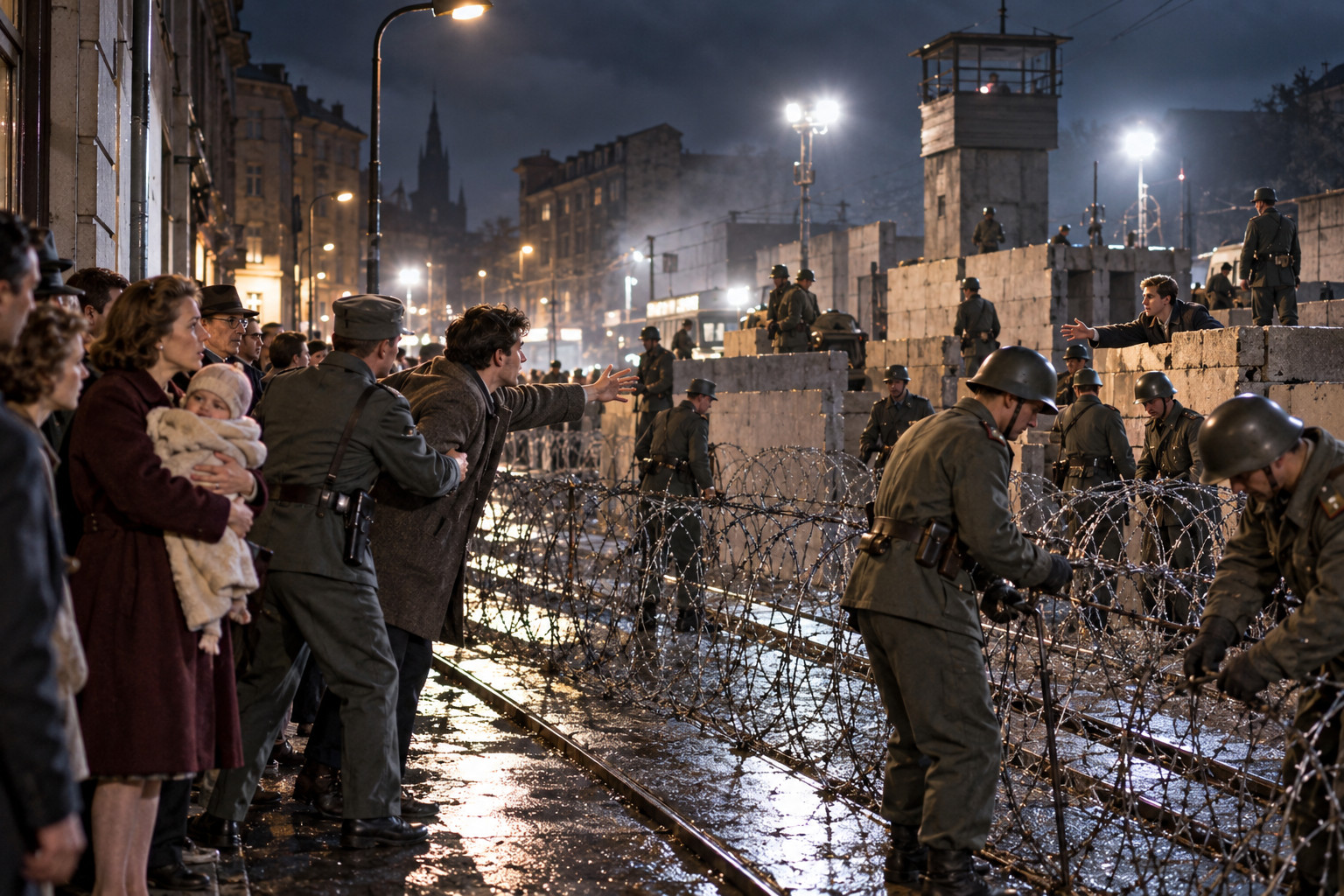
That flow changed everything. Between 1949 and 1961 millions left the Soviet zone for West Germany, taking skills, money and hopes with them. The losing of population and legitimacy alarmed East German officials and their Soviet patrons. On the night of August 12–13, 1961, East German troops began sealing the border in Berlin with barbed wire and later concrete — not as a single dramatic act so much as a fast, determined attempt to stop a steady exodus.
Barrier and Daily Life (1961–1989)
What grew over the next years was neither a single wall nor purely defensive earthworks, but a layered frontier: inner-city concrete slabs, patrols, guard towers, a cleared “death strip” and a legal regime that criminalized flight. Streets that had once linked neighborhoods became blind alleys. Families were split; children woke up one morning to discover their schools in another jurisdiction. Escape attempts became part of the city’s lore — tunnels dug beneath apartment blocks, improvised wings for hot-air balloons, daring drives through checkpoints — and so did the tragedies when people were shot, captured, or lost at night.
Internationally Berlin remained a pressure point. A tense stand-off at Checkpoint Charlie in October 1961 tested the superpowers. Yet the city also hosted stages of détente: treaties, cultural exchanges and practical agreements that made life less brittle without changing the barrier itself. By the 1970s and 1980s the wall was both a hardened frontier and a global symbol of divided Europe.
Breakdown and Reunification (1989–1990)
The wall did not fall because of a single explosion of force. It crumbled under political shifts and sustained civic pressure. Reform currents from Moscow, economic stagnation in the East and a chain of openings — notably Hungary’s loosening of its border in 1989 — let tens of thousands leave for the West. Mass demonstrations in East German cities, especially the weekly Monday protests in Leipzig, turned public dissent into an unstoppable tide.
On November 9, 1989, an East German announcement about relaxed travel rules, poorly worded and badly timed, produced the moment: crowds surged to the checkpoints and border guards, unwilling to fire on them, eventually allowed people through. The concrete came down as people chipped away at a structure that had stood for 28 years. Formal reunification followed on October 3, 1990.
Conclusion
Today fragments of the wall are museum pieces and murals, while the route itself is traced by cobbles and plaques through the city. Berlin’s barrier was more than concrete; it was a machine for shaping lives. Its rise and collapse compress a Cold War story into a handful of decisive years — partition, fortification, dissent, and a public insistence that borders cannot hold back history forever.