Uncover History’s Secrets with Daily Updates!
Daily News Entertainment
  • Home
  • History
  • Biographies
  • Eras
  • Regions
  • Timeline
No Result
View All Result
History Ours
  • Home
  • History
  • Biographies
  • Eras
  • Regions
  • Timeline
No Result
View All Result
History Ours
No Result
View All Result
Home Timeline

The Timeline of Great Philosophical Movements

in Timeline
The Timeline of Great Philosophical Movements

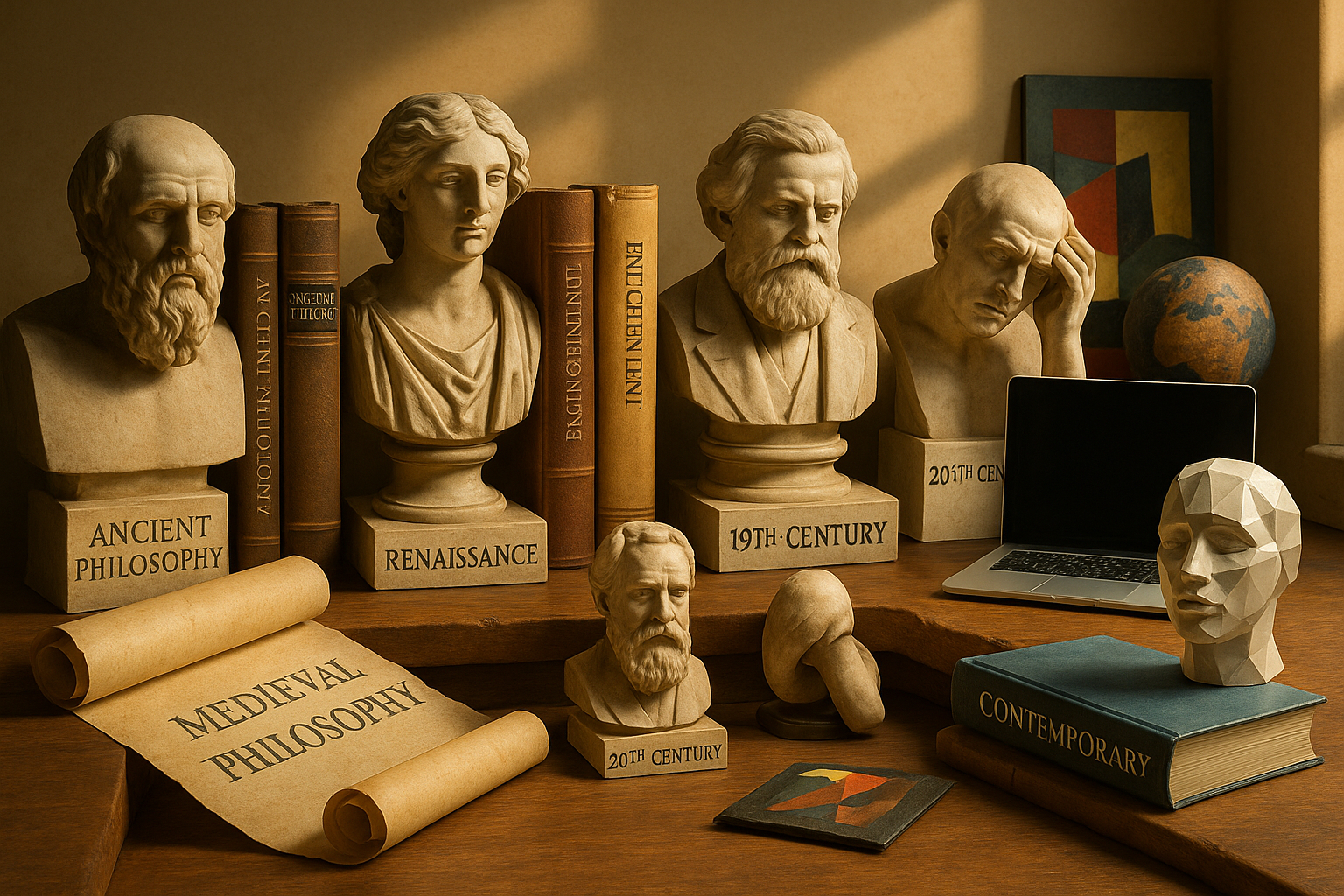
Philosophy — the pursuit of wisdom — has guided humanity’s understanding of existence, morality, and knowledge for millennia. From ancient thinkers pondering the cosmos to modern philosophers questioning technology and identity, each era has contributed ideas that continue to shape our worldview. This timeline explores the great philosophical movements that defined civilizations and transformed human thought.

Ancient Philosophy: The Birth of Reason (600 BCE – 300 CE)

Philosophy began in ancient Greece with the early Pre-Socratic philosophers, who sought natural explanations for the world instead of mythological ones. Socrates, Plato, and Aristotle then revolutionized thinking with their inquiries into ethics, politics, and metaphysics. Plato’s idealism and Aristotle’s empiricism became foundational pillars of Western thought.
Meanwhile, in the East, Confucius and Laozi in China emphasized moral harmony and the balance between order and nature, while Indian philosophy developed profound ideas about consciousness and reality through schools like Vedanta and Buddhism.

Medieval Philosophy: Faith and Reason (400 – 1400 CE)

During the medieval period, philosophy became intertwined with theology. Thinkers like St. Augustine and Thomas Aquinas sought to reconcile faith with reason, merging classical Greek philosophy with Christian doctrine.
In the Islamic world, philosophers such as Avicenna (Ibn Sina) and Averroes (Ibn Rushd) preserved and expanded upon Aristotle’s works, influencing both the East and the West. Jewish philosophers like Maimonides also played a crucial role in bridging religion and rational inquiry.

Renaissance and Enlightenment: The Age of Humanism and Reason (1400 – 1800)

The Renaissance revived classical learning, emphasizing human potential and creativity. Thinkers such as Niccolò Machiavelli and Erasmus focused on human agency and moral governance.
The Enlightenment later sparked a revolution in thought, emphasizing reason, individual rights, and scientific inquiry. Philosophers like Descartes, Locke, Voltaire, and Kant questioned authority and championed rationality, paving the way for modern democracy and empirical science.

19th-Century Philosophy: The Age of Ideology (1800 – 1900)

The Industrial Revolution and social upheavals inspired new philosophical movements. Hegel introduced dialectical idealism, influencing political and existential thought. Karl Marx reinterpreted history through materialism and class struggle, while Nietzsche challenged traditional morality and proclaimed the “death of God.”
In America, Transcendentalists like Ralph Waldo Emerson and Henry David Thoreau emphasized individual conscience and connection to nature.

20th-Century Philosophy: Language, Existence, and Experience (1900 – 2000)

The 20th century brought an explosion of philosophical diversity. Existentialists like Sartre, Camus, and Heidegger explored freedom, meaning, and human anxiety in a world without absolute truth.
At the same time, Analytic philosophy, led by Bertrand Russell and Ludwig Wittgenstein, focused on language, logic, and clarity of thought.
Meanwhile, Postmodernists such as Foucault, Derrida, and Lyotard questioned grand narratives, truth, and power structures, reshaping the way we view knowledge and culture.

Contemporary Philosophy: Technology, Ethics, and Identity (2000 – Present)

Today, philosophy continues to evolve, addressing the moral and existential challenges of the digital age. Thinkers engage with artificial intelligence, environmental ethics, gender identity, and global justice. The blending of philosophy with science, technology, and culture reflects a new era of interconnected inquiry — where ancient questions meet modern complexities.

Conclusion

From Socratic dialogues to postmodern deconstructions, the great philosophical movements chart humanity’s quest to understand itself and the world. Philosophy remains a living conversation — one that adapts, questions, and inspires every generation to think more deeply about what it means to be human.


Previous Post

The Dynasties of China: From Qin to Qing

Next Post

The Journey of Art: From Cave Walls to Canvas

Related Posts

How the Black Death Spread Across Europe, 1347–1351
Timeline

How the Black Death Spread Across Europe, 1347–1351

October 28, 2026
The Great Stink of 1858: How London Smell Rebuilt Itself
Timeline

The Great Stink of 1858: How London Smell Rebuilt Itself

October 28, 2026
A Timeline of the Dutch Golden Age and the VOC
Timeline

A Timeline of the Dutch Golden Age and the VOC

October 23, 2026
The Printing Press: A Timeline from Gutenberg to Mass Media
Timeline

The Printing Press: A Timeline from Gutenberg to Mass Media

October 23, 2026
Next Post
The Journey of Art: From Cave Walls to Canvas

The Journey of Art: From Cave Walls to Canvas

Search..

No Result
View All Result

Recent Articles

Mary Seacole: The Jamaican Nurse Who Went to War

Mary Seacole: The Jamaican Nurse Who Went to War

October 30, 2026
Ada Lovelace: The Poet Who Helped Imagine Modern Computers

Ada Lovelace: The Poet Who Helped Imagine Modern Computers

October 30, 2026
John Snow, the Broad Street Pump, and Cholera’s Fall

John Snow, the Broad Street Pump, and Cholera’s Fall

October 29, 2026
The Vasa: Sweden’s Giant Ship That Couldn’t Sail

The Vasa: Sweden’s Giant Ship That Couldn’t Sail

October 29, 2026
How the Black Death Spread Across Europe, 1347–1351

How the Black Death Spread Across Europe, 1347–1351

October 28, 2026

Subscribe Us

By clicking submit, I authorize History Ours and its affiliated companies to: (1) use, sell, and share my information for marketing purposes, including cross-context behavioral advertising, as described in our Terms of Service and Privacy Policy, (2) supplement the information that I provide with additional information lawfully obtained from other sources, like demographic data from public sources, interests inferred from web page views, or other data relevant to what might interest me, like past purchase or location data, (3) contact me or enable others to contact me by email with offers for goods and services from any category at the email address provided, and (4) retain my information while I am engaging with marketing messages that I receive and for a reasonable amount of time thereafter. I understand I can opt out at any time through an email that I receive, or by clicking here

Subscribe To Our Newsletter

By clicking submit, I authorize History Ours and its affiliated companies to: (1) use, sell, and share my information for marketing purposes, including cross-context behavioral advertising, as described in our Terms of Service and Privacy Policy, (2) supplement the information that I provide with additional information lawfully obtained from other sources, like demographic data from public sources, interests inferred from web page views, or other data relevant to what might interest me, like past purchase or location data, (3) contact me or enable others to contact me by email with offers for goods and services from any category at the email address provided, and (4) retain my information while I am engaging with marketing messages that I receive and for a reasonable amount of time thereafter. I understand I can opt out at any time through an email that I receive, or by clicking here.

© 2026 History Ours | All Rights Reserved

  • Contact Us
  • Privacy Policy
  • Terms of Service
  • Unsubscribe
  • Privacy Choices
  • Contact Us
  • Privacy Policy
  • Terms of Service
  • Unsubscribe
  • Privacy Choices

© 2026 History Ours | All Rights Reserved

No Result
View All Result
  • Home
  • History
  • Biographies
  • Eras
  • Regions
  • Timeline

© 2026 History Ours | All Rights Reserved

Skip to content
Open toolbar Accessibility Tools

Accessibility Tools

  • Increase TextIncrease Text
  • Decrease TextDecrease Text
  • GrayscaleGrayscale
  • High ContrastHigh Contrast
  • Negative ContrastNegative Contrast
  • Light BackgroundLight Background
  • Links UnderlineLinks Underline
  • Readable FontReadable Font
  • Reset Reset