
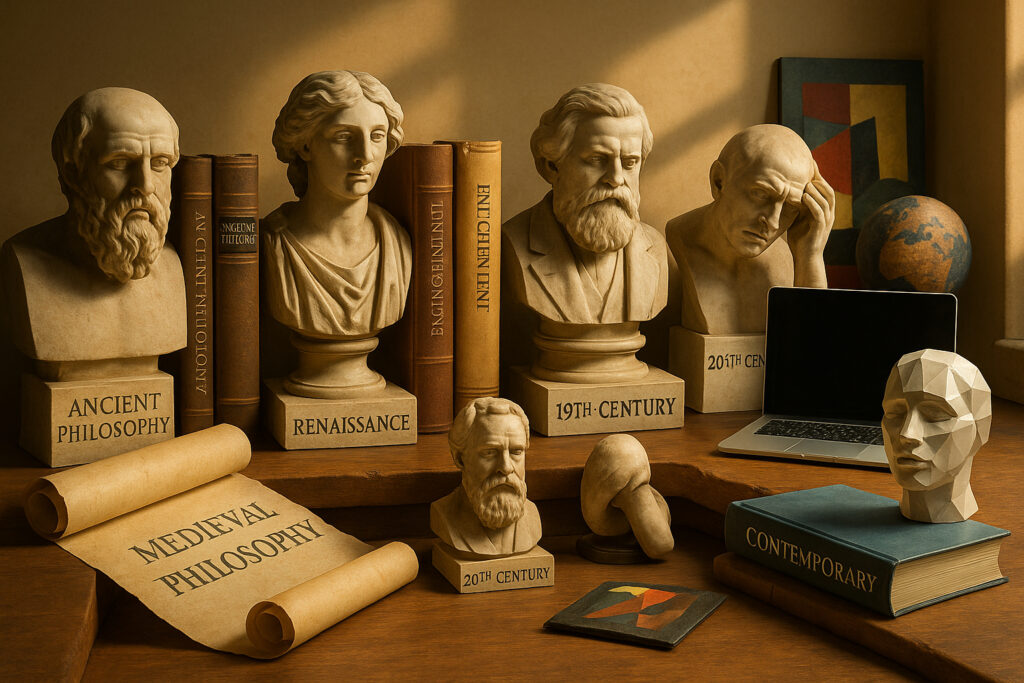
Philosophy — the pursuit of wisdom — has guided humanity’s understanding of existence, morality, and knowledge for millennia. From ancient thinkers pondering the cosmos to modern philosophers questioning technology and identity, each era has contributed ideas that continue to shape our worldview. This timeline explores the great philosophical movements that defined civilizations and transformed human thought.
Ancient Philosophy: The Birth of Reason (600 BCE – 300 CE)
Philosophy began in ancient Greece with the early Pre-Socratic philosophers, who sought natural explanations for the world instead of mythological ones. Socrates, Plato, and Aristotle then revolutionized thinking with their inquiries into ethics, politics, and metaphysics. Plato’s idealism and Aristotle’s empiricism became foundational pillars of Western thought.
Meanwhile, in the East, Confucius and Laozi in China emphasized moral harmony and the balance between order and nature, while Indian philosophy developed profound ideas about consciousness and reality through schools like Vedanta and Buddhism.
Medieval Philosophy: Faith and Reason (400 – 1400 CE)
During the medieval period, philosophy became intertwined with theology. Thinkers like St. Augustine and Thomas Aquinas sought to reconcile faith with reason, merging classical Greek philosophy with Christian doctrine.
In the Islamic world, philosophers such as Avicenna (Ibn Sina) and Averroes (Ibn Rushd) preserved and expanded upon Aristotle’s works, influencing both the East and the West. Jewish philosophers like Maimonides also played a crucial role in bridging religion and rational inquiry.
Renaissance and Enlightenment: The Age of Humanism and Reason (1400 – 1800)
The Renaissance revived classical learning, emphasizing human potential and creativity. Thinkers such as Niccolò Machiavelli and Erasmus focused on human agency and moral governance.
The Enlightenment later sparked a revolution in thought, emphasizing reason, individual rights, and scientific inquiry. Philosophers like Descartes, Locke, Voltaire, and Kant questioned authority and championed rationality, paving the way for modern democracy and empirical science.
19th-Century Philosophy: The Age of Ideology (1800 – 1900)
The Industrial Revolution and social upheavals inspired new philosophical movements. Hegel introduced dialectical idealism, influencing political and existential thought. Karl Marx reinterpreted history through materialism and class struggle, while Nietzsche challenged traditional morality and proclaimed the “death of God.”
In America, Transcendentalists like Ralph Waldo Emerson and Henry David Thoreau emphasized individual conscience and connection to nature.
20th-Century Philosophy: Language, Existence, and Experience (1900 – 2000)
The 20th century brought an explosion of philosophical diversity. Existentialists like Sartre, Camus, and Heidegger explored freedom, meaning, and human anxiety in a world without absolute truth.
At the same time, Analytic philosophy, led by Bertrand Russell and Ludwig Wittgenstein, focused on language, logic, and clarity of thought.
Meanwhile, Postmodernists such as Foucault, Derrida, and Lyotard questioned grand narratives, truth, and power structures, reshaping the way we view knowledge and culture.
Contemporary Philosophy: Technology, Ethics, and Identity (2000 – Present)
Today, philosophy continues to evolve, addressing the moral and existential challenges of the digital age. Thinkers engage with artificial intelligence, environmental ethics, gender identity, and global justice. The blending of philosophy with science, technology, and culture reflects a new era of interconnected inquiry — where ancient questions meet modern complexities.
Conclusion
From Socratic dialogues to postmodern deconstructions, the great philosophical movements chart humanity’s quest to understand itself and the world. Philosophy remains a living conversation — one that adapts, questions, and inspires every generation to think more deeply about what it means to be human.