
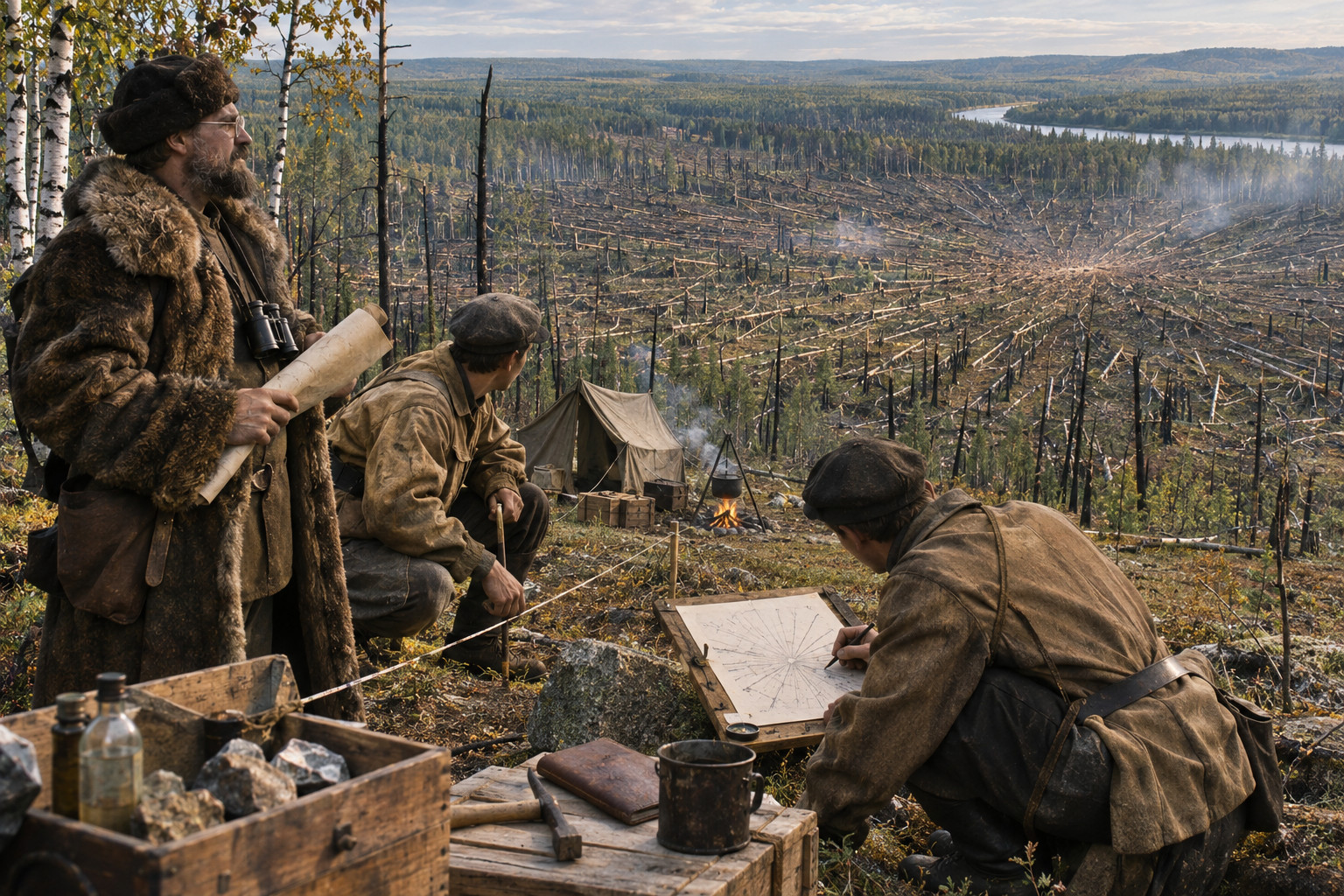
On the morning of June 30, 1908 (Gregorian calendar), a shock of light and sound tore across a remote stretch of Siberian forest near the Podkamennaya Tunguska River. Survivors in riverside settlements reported a brilliant fireball racing across the sky, followed by a thunderous concussion that knocked people off their feet and shattered windows hundreds of kilometres away. When searchers finally reached the area, they found an astonishing pattern: roughly 2,000 square kilometres of trees flattened in a radial pattern, laid down like spokes from a central zone—but no obvious impact crater.
1927 onward — Kulik and the First Field Expeditions
The first organized scientific visit to the site came almost two decades later. Russian mineralogist Leonid Kulik led expeditions beginning in 1927 to map the devastation and collect eyewitness testimony. Kulik’s teams confirmed the widespread forest flattening and recovered scorched vegetation and charred resin, but they never found a classic meteorite crater. Those early surveys framed the central mystery: a massive release of energy had occurred, but where had the impacting rock—or whatever it was—gone?
Late 20th–21st centuries — From Wild Theories to Airburst Models
Through much of the 20th century the Tunguska event attracted speculative ideas—exploding comet, piece of asteroid, even exotic notions such as a mini black hole. By the late 1900s, accumulating evidence favoured a simpler explanation: an incoming body that disintegrated and detonated in the atmosphere, an airburst. Modern modelling and comparisons with recent events—most notably the 2013 Chelyabinsk airburst—show how a stony or icy fragment exploding several kilometres above the ground can produce enormous blast pressure without leaving a crater. Energy estimates for Tunguska vary, but most place it in the range of several megatons of TNT, enough to flatten forests across a region the size of a small country.
Conclusion
Tunguska remains both solved and stubbornly strange. Scientists now broadly agree an airburst explains the tree-fall pattern, lack of crater, and eyewitness reports, yet direct physical remnants of the original body are scant and some local anomalies still invite study. The 1908 blast serves as a reminder that even in remote wilderness, Earth is vulnerable to sudden celestial violence. A century and more after the flash, Tunguska continues to be a laboratory for understanding atmospheric explosions and a humbling footnote in human encounters with the sky.