
Uncover History’s Secrets with Daily Updates!
Daily News Entertainment
  • Home
  • History
  • Biographies
  • Eras
  • Regions
  • Timeline
No Result
View All Result
History Ours
  • Home
  • History
  • Biographies
  • Eras
  • Regions
  • Timeline
No Result
View All Result
History Ours
No Result
View All Result
Home Regions

How the Sound Dues Shaped the Baltic’s Map of Power

in Regions
How the Sound Dues Shaped the Baltic’s Map of Power

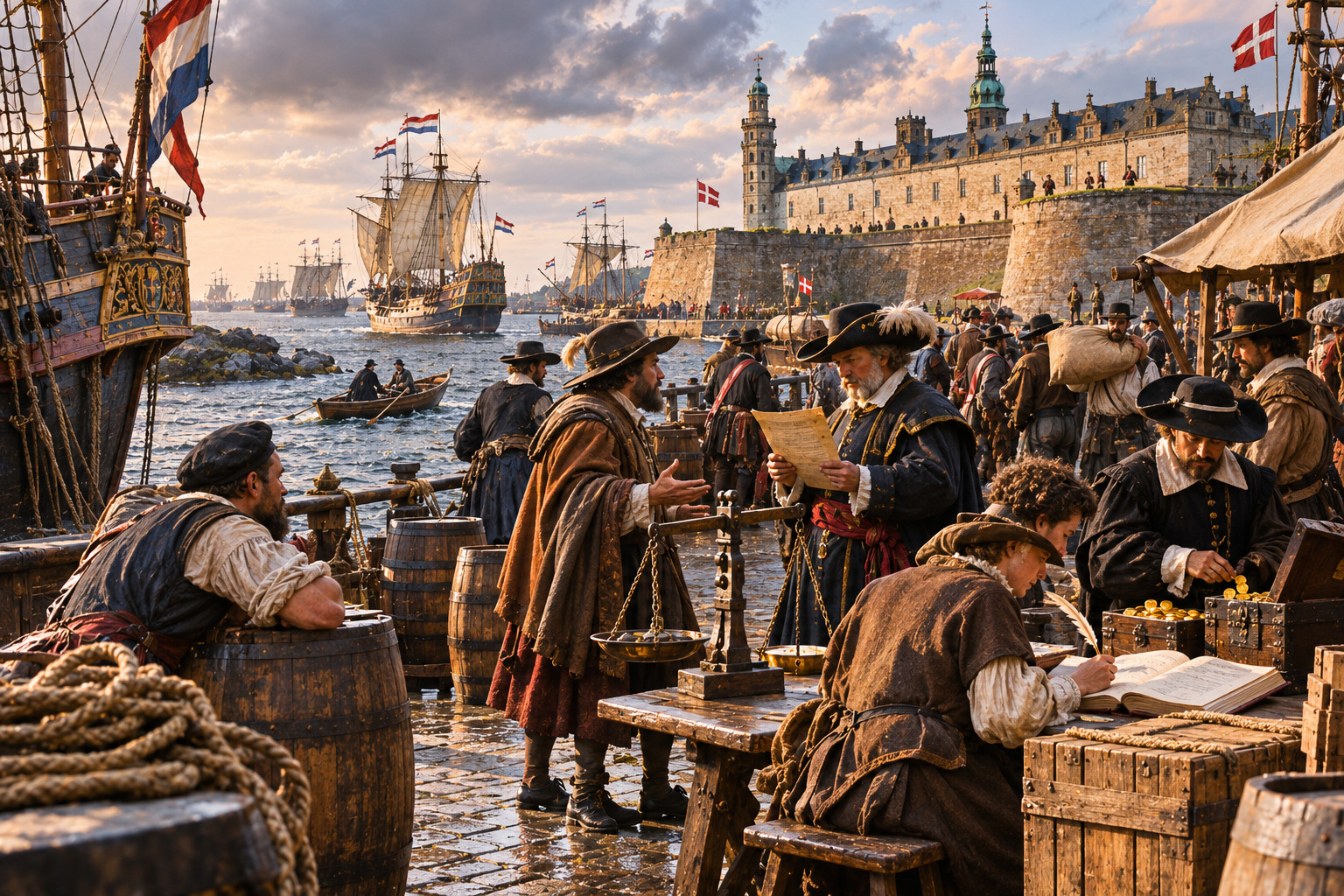
From 1429 until the mid-19th century a single rule altered the shape of northern Europe’s trade: every merchant ship passing through the Øresund, the narrow choke point between modern Denmark and Sweden, had to stop and pay a toll to the Danish crown. Known as the Sound Dues, this tariff turned a stretch of water only a few miles wide into one of the earliest and most durable forms of maritime customs enforcement.

Collection took place at Helsingør—Elsinore in English—where the stately walls of Kronborg Castle watched ships enter and leave the Baltic. The character of the town and the castle shifted as money arrived: fortifications were strengthened, pilot services and provisioning grew into steady businesses, and a small bureaucracy learned to inspect cargoes, calculate dues and manage complaints from merchants who had hoped for quicker passage.

Money, Warfare, and the Balance of Trade

The sums taken at the Sound mattered. For centuries the dues supplied a steady income stream that helped fund Denmark’s navy and its coastal defenses. That meant the toll didn’t just collect fees; it bought influence. Controlling the Øresund allowed Denmark to affect the flows of grain, timber, fish and Baltic amber. Cities that depended on access to the North Sea—Gdańsk, Lübeck, Amsterdam—felt the effect whenever Copenhagen tightened collections or sent warships into the strait.

Periodically the dues became a political flashpoint. Hanseatic League merchants bristled, Dutch captains complained, and Scandinavian rivalries over territory and trade simmered into open conflict. Whoever held the shoreline at key moments could make maritime policy; whoever could not would pay the price in disrupted trade.

Evasion, Smuggling, and Everyday Lives

Wherever money is at stake, people find ways around rules. Smugglers plied the coastal skerries, pilots offered back-channel knowledge, and shipmasters tried to reclassify or conceal cargo. Local economies adapted: taverns and chandlers profited from waiting crews, while pilots and lightermen carved out livelihoods by guiding vessels through shallows that official charts barely recorded.

The dues also shaped culture. Ports on both sides of the sound developed rivalries and interdependence. Helsingør swelled with customs officers and sailors; across the water Helsingborg and other towns learned to live with—and sometimes resist—the traffic and inspections that defined the strait.

Conclusion

When the great powers finally negotiated the abolition of the Sound Dues in 1857, the old mathematics of control unknotted. Ships no longer had to stop at Kronborg for inspection; trade patterns shifted, and the strategic leverage Denmark once enjoyed diminished. Yet the long shadow of the dues remains visible: in fortified walls, in the layered urban life of Helsingør, and in the map of northern European trade routes that developed around a toll booth at the mouth of the Baltic.


Previous Post

The Halifax Explosion: The Blast That Shattered a City

Next Post

Hildegard of Bingen: Visions, Songs, and Medieval Science

Related Posts

After the Quake: How 1755 Lisbon Reshaped an Empire
Regions

After the Quake: How 1755 Lisbon Reshaped an Empire

November 21, 2026
Baku: Oil, Ports, and the Birth of a Caspian Metropolis
Regions

Baku: Oil, Ports, and the Birth of a Caspian Metropolis

November 16, 2026
How Kraków’s Cloth Hall Knit a Central European Region
Regions

How Kraków’s Cloth Hall Knit a Central European Region

November 16, 2026
How Cotton Turned the Aral Sea into a Desert
Regions

How Cotton Turned the Aral Sea into a Desert

November 11, 2026
Next Post
Hildegard of Bingen: Visions, Songs, and Medieval Science

Hildegard of Bingen: Visions, Songs, and Medieval Science

Search..

No Result
View All Result

Recent Articles

Hildegard of Bingen: Visions, Songs, and Medieval Science

Hildegard of Bingen: Visions, Songs, and Medieval Science

November 24, 2026
How the Sound Dues Shaped the Baltic’s Map of Power

How the Sound Dues Shaped the Baltic’s Map of Power

November 24, 2026
The Halifax Explosion: The Blast That Shattered a City

The Halifax Explosion: The Blast That Shattered a City

November 23, 2026
The Dhow Age: How Lateen Sails Connected the Indian Ocean

The Dhow Age: How Lateen Sails Connected the Indian Ocean

November 23, 2026
Isabella Stewart Gardner: Boston’s Provocative Collector and Her Museum

Isabella Stewart Gardner: Boston’s Provocative Collector and Her Museum

November 22, 2026

Subscribe Us

By clicking submit, I authorize History Ours and its affiliated companies to: (1) use, sell, and share my information for marketing purposes, including cross-context behavioral advertising, as described in our Terms of Service and Privacy Policy, (2) supplement the information that I provide with additional information lawfully obtained from other sources, like demographic data from public sources, interests inferred from web page views, or other data relevant to what might interest me, like past purchase or location data, (3) contact me or enable others to contact me by email with offers for goods and services from any category at the email address provided, and (4) retain my information while I am engaging with marketing messages that I receive and for a reasonable amount of time thereafter. I understand I can opt out at any time through an email that I receive, or by clicking here

Subscribe To Our Newsletter

By clicking submit, I authorize History Ours and its affiliated companies to: (1) use, sell, and share my information for marketing purposes, including cross-context behavioral advertising, as described in our Terms of Service and Privacy Policy, (2) supplement the information that I provide with additional information lawfully obtained from other sources, like demographic data from public sources, interests inferred from web page views, or other data relevant to what might interest me, like past purchase or location data, (3) contact me or enable others to contact me by email with offers for goods and services from any category at the email address provided, and (4) retain my information while I am engaging with marketing messages that I receive and for a reasonable amount of time thereafter. I understand I can opt out at any time through an email that I receive, or by clicking here.

© 2026 History Ours | All Rights Reserved

  • Contact Us
  • Privacy Policy
  • Terms of Service
  • Unsubscribe
  • Privacy Choices
  • Contact Us
  • Privacy Policy
  • Terms of Service
  • Unsubscribe
  • Privacy Choices

© 2026 History Ours | All Rights Reserved

No Result
View All Result
  • Home
  • History
  • Biographies
  • Eras
  • Regions
  • Timeline

© 2026 History Ours | All Rights Reserved

Skip to content
Open toolbar Accessibility Tools

Accessibility Tools

  • Increase TextIncrease Text
  • Decrease TextDecrease Text
  • GrayscaleGrayscale
  • High ContrastHigh Contrast
  • Negative ContrastNegative Contrast
  • Light BackgroundLight Background
  • Links UnderlineLinks Underline
  • Readable FontReadable Font
  • Reset Reset