
Ada Lovelace stands at the crossroads of mathematics and visionary engineering, known for her work on early mechanical computation.
Her writings transformed technical notes into reflections on algorithmic possibility and the limits of calculation.
She balanced rigorous mathematical practice with a literary sensibility, imagining machines that could go beyond arithmetic.
This blend of precision and imagination helped shape later thinking about programmable machines.
Early intellectual formation
Ada developed an early appetite for numbers and logical puzzles under careful tutoring that emphasized both science and the arts. Her education combined formal lessons in mathematics with encouragement to read widely, which fostered an ability to translate complex ideas into accessible prose. Despite health setbacks and social expectations, she pursued intellectual work with persistent curiosity and discipline.
Her grounding in mathematics gave her the tools to interrogate mechanical designs and to ask imaginative questions about what those designs could accomplish.
Collaboration with Charles Babbage
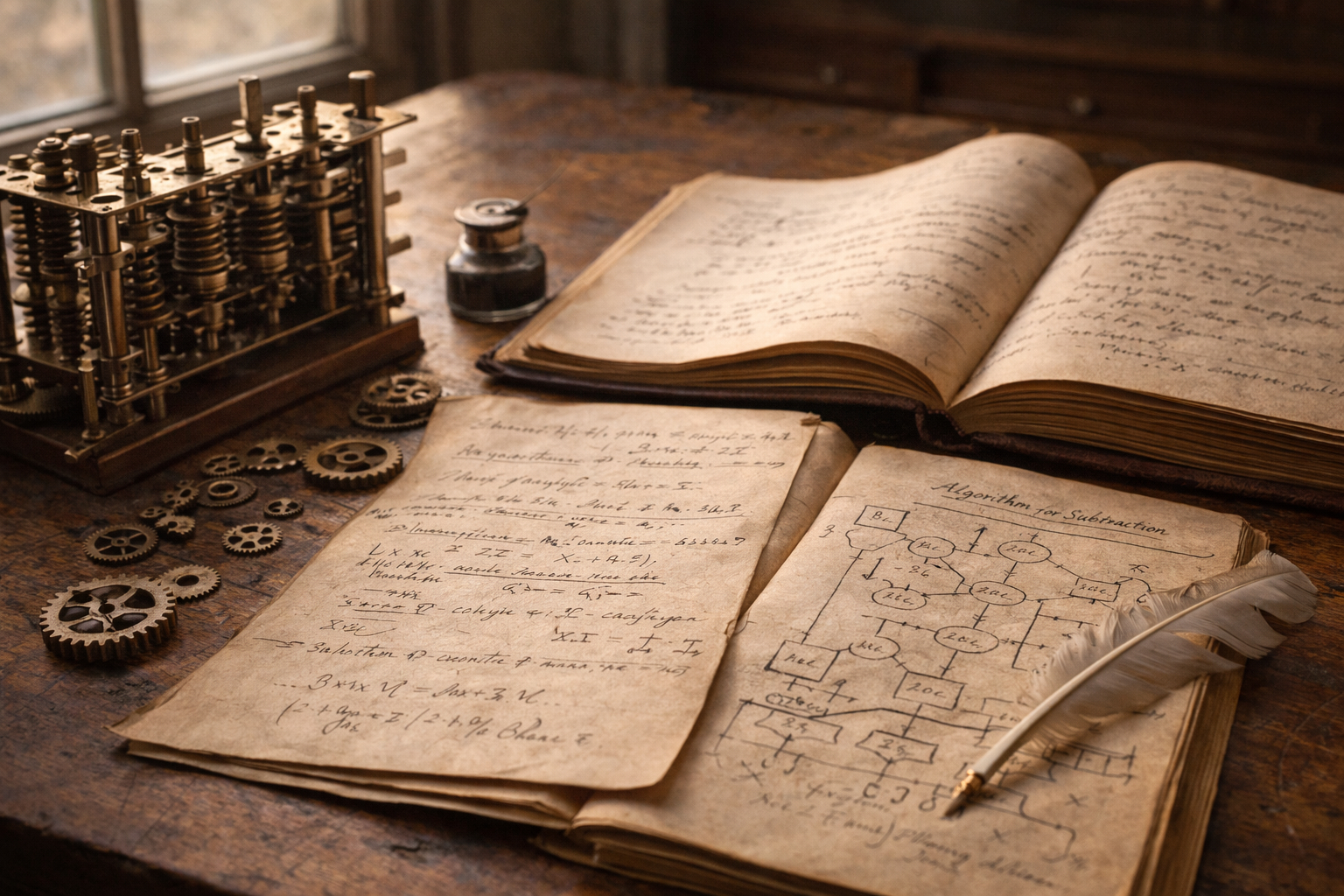
Her relationship with Charles Babbage placed her in direct contact with innovative mechanical computing concepts, sparking a productive exchange of ideas. She translated a technical memoir and expanded it substantially with her own notes, which contained extended commentary on potential uses for a programmable machine. That document elevated a practical description into a broader meditation on computation and instruction.
Her annotation demonstrated both technical comprehension and original insight, showing how close collaboration between theorist and practitioner can advance understanding.
The algorithm and conceptual leap
Within her notes she presented a systematic procedure for calculating a sequence of numbers, often cited as an early example of an algorithm intended for machine execution. More importantly, she argued that such a machine might manipulate symbols according to rules, suggesting that computation could address domains beyond raw arithmetic. This perspective reframed the machine as a general-purpose processor of formal operations rather than a single-purpose calculator.
– Example: a stepwise routine to compute Bernoulli numbers illustrated how operations could be formalized.
– Concept: machines could follow conditional steps and structured sequences, a precursor to programmatic thinking.
Her articulation of these ideas anticipated later developments in algorithm design and programming methodology.
Legacy and modern resonance
Interest in her work has grown as historians and technologists reassessed the roots of computing and intellectual history. She has become a symbol for the often-overlooked contributions of women in science and an inspiration for interdisciplinary thinking that links mathematics, engineering, and the humanities. Contemporary discussions draw on her example to argue for broader perspectives in technical education and innovation.
Her writings remain a reminder that technical progress benefits from clear exposition and imaginative foresight.
Conclusion
Ada Lovelace offered a rare combination of analytic skill and speculative vision, framing early machines as more than calculators.
Her notes provided concrete procedures and a conceptual leap that influenced later generations of thinkers and builders.
Remembered as both mathematician and interpreter of mechanical possibility, her ideas continue to inform how we think about computation and creativity.