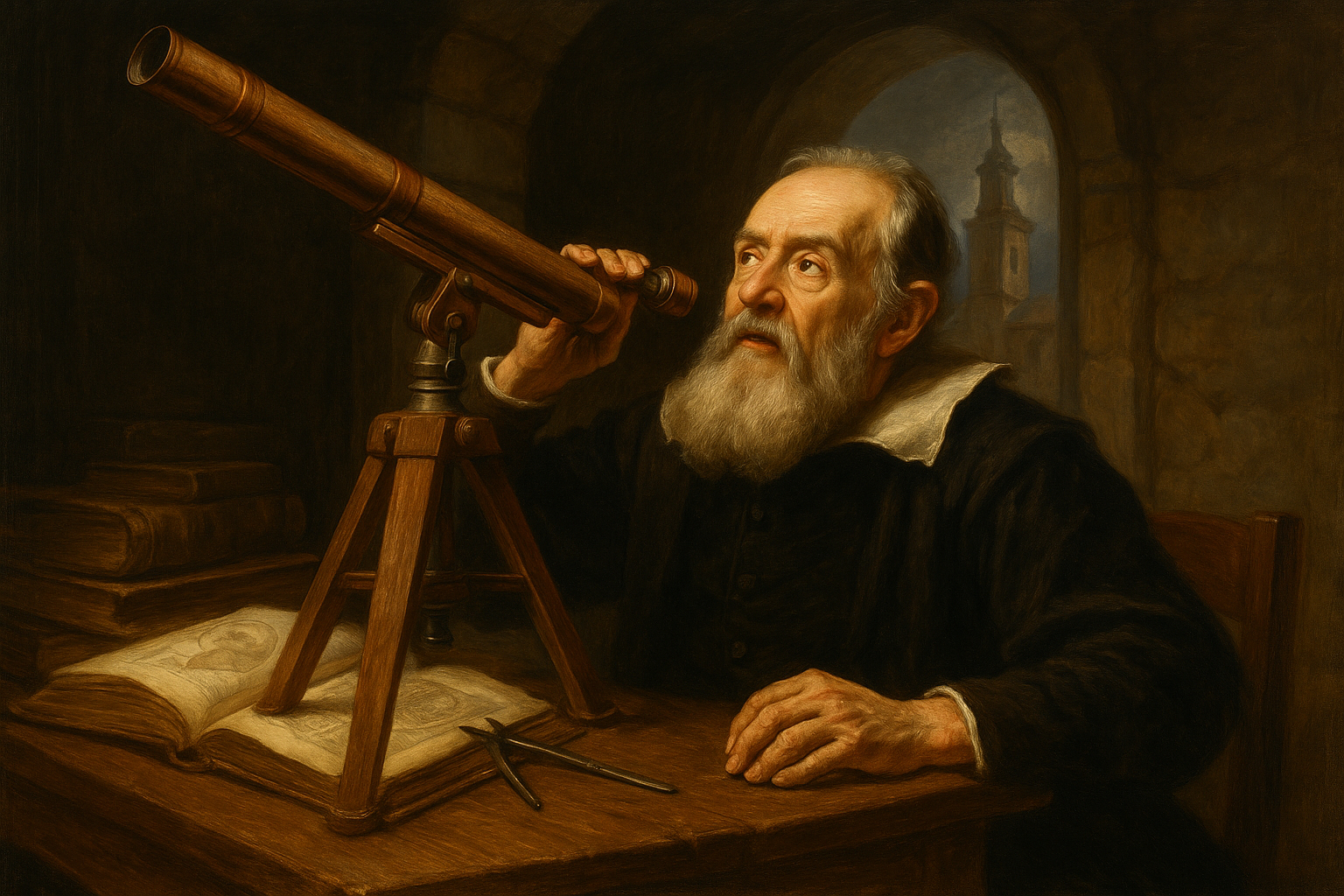
Galileo Galilei, often called the “father of modern science,” was more than an astronomer—he was a visionary who dared to question the very foundations of human understanding. His curiosity and defiance against conventional thought propelled the world into a new age of discovery and scientific truth.
A Mind Ahead of Its Time
Born in 1564 in Pisa, Italy, Galileo’s fascination with motion, mathematics, and the cosmos set him apart from his peers. His improvements to the telescope allowed him to make groundbreaking observations—the craters of the Moon, the moons of Jupiter, and the phases of Venus—all of which challenged centuries-old beliefs rooted in geocentric thought.
Defying the Establishment
At a time when the Church’s authority shaped science, Galileo’s discoveries provoked controversy. His support for Copernicus’s heliocentric theory—that Earth revolves around the Sun—was seen as heresy. Despite opposition and trial by the Inquisition, Galileo stood firm in his pursuit of truth, famously stating, “And yet it moves,” after being forced to recant.
Legacy Beyond the Stars
Galileo’s courage laid the groundwork for modern physics and astronomy. His methods—observation, experimentation, and logical reasoning—became the pillars of the scientific method. Today, his name stands as a symbol of intellectual freedom, critical thinking, and the relentless human drive to explore.
Conclusion
Galileo Galilei was more than a scientist; he was a rebel of reason. His story reminds us that progress often begins with a question—and that the courage to seek truth can change the way humanity sees the universe.