
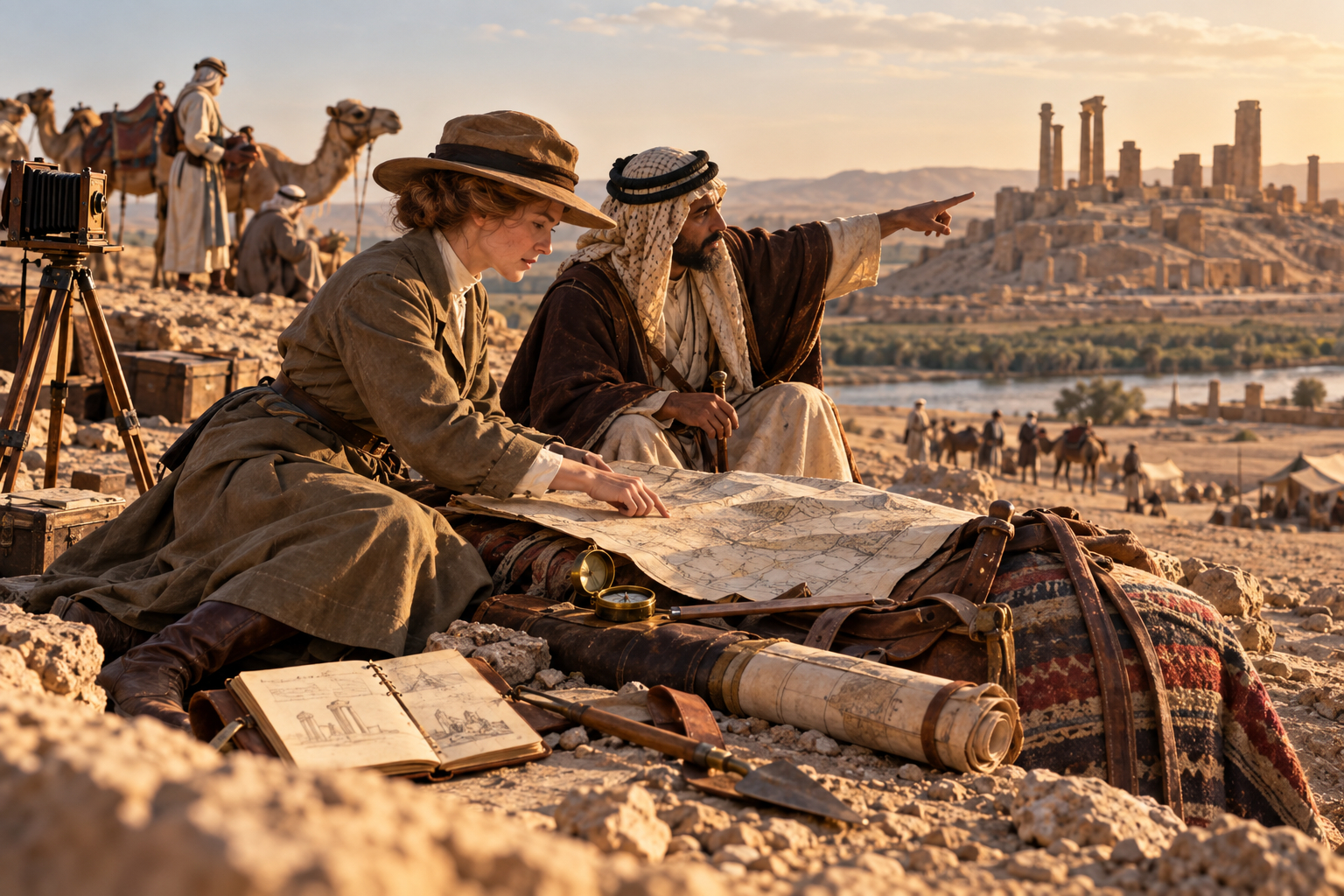
Gertrude Bell was born in 1868 in County Durham to a wealthy industrial family, but wealth did not keep her at home. She took a first-class degree in Modern History at Oxford in 1888 at a moment when women still lacked full university status, then set out across the Ottoman provinces with an appetite for ruins, languages, and landscape. Bell learned Arabic and Persian, picked up local customs, and became as comfortable riding across plains and dunes as she was in drawing rooms back in England. Her 1907 book, Syria: The Desert and the Sown, mixed travel narrative, archaeological observation, and political commentary; it announced that she was more than a dilettante collector of curiosities.
Maps, intelligence, and the making of a state
When the First World War upended the Middle East, Bell’s fluency with language, tribes, and terrain made her a sought-after asset to British officials. Recruited into political work, she produced reports, maps, and assessments that informed policy at a time when borders and governments were being fashioned with pen and paper. After the war she served as Oriental Secretary in Baghdad and was deeply involved in establishing administrative structures for the new mandate. She argued for a native monarch and lent crucial support to Faisal ibn Hussein’s elevation as king of Iraq in 1921—an intervention that helped shape the foundations of the modern Iraqi state.
Archaeology, museums, and a complicated legacy
Bell wore many hats: field archaeologist, collector, and founder of institutions. She worked with excavations, recorded inscriptions, and campaigned for preservation; the objects she documented helped form early collections for museums in Baghdad and in Britain. Her notebooks and photographs remain valuable records of sites that have since been damaged or lost. At the same time, her role was inseparable from British imperial power. Her intimate knowledge of local leaders and customs gave her influence, but that influence often operated within—and sometimes reinforced—the colonial structures of the day.
Conclusion
Gertrude Bell is not an easy figure to classify. Adventurer, scholar, diplomat and collector, she moved across deserts and drawing rooms with equal ease and helped to shape institutions whose consequences are still visible. Her papers brim with precise observations on people and places; her choices helped redraw a map. For those who prize vivid travel writing and messy, consequential lives, Bell offers a compact, revealing story: one woman’s erudition and determination left real traces—both constructive and contentious—across a region remade in the twentieth century.