
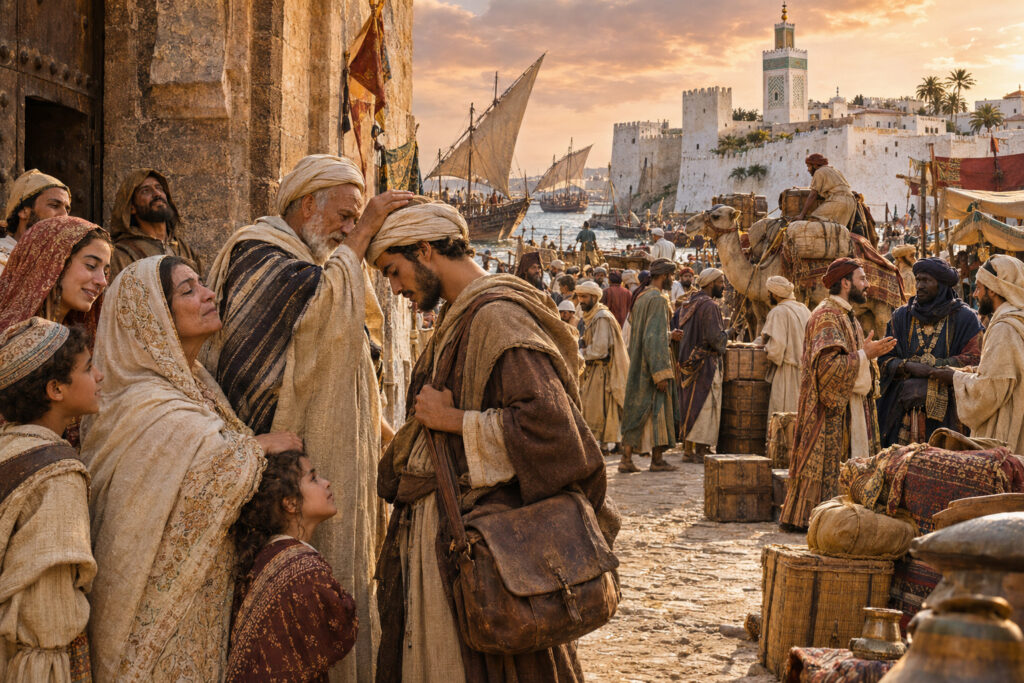
Born in Tangier and trained as a jurist, Ibn Battuta left home as a young man to perform the hajj. What began as a religious pilgrimage turned quickly into something else: decades on the road. Over the course of his travels he moved beyond the routes most pilgrims took, following caravans, sailing along coasts, and accepting invitations from courts that wanted an educated visitor. His journeys carried him across North Africa, the eastern Mediterranean, sub‑Saharan West Africa, the Arabian Peninsula, Persia, Central Asia, South Asia, and as far as China.
Journeys, encounters, and unexpected stops
Ibn Battuta’s eye was practical and social: he noticed legal customs, marketplace bargains, marriage arrangements, and the rituals of Sufi lodges. In Damascus he recorded the rhythms of the city’s mosques; in Cairo he described schools and judges; in Delhi he accepted an official post as a qadi and spent several years at the court of a sultan. He also sailed across the Indian Ocean, visiting port towns where merchants from East Africa, Arabia, India, and Southeast Asia met. His account includes a visit to the wealthy Mali Empire — a section that excited later readers and has prompted scholars to weigh how much he relied on testimony in addition to his own observations.
Travel for Ibn Battuta was unpredictable. Routes could change because of politics or weather, a caravan might turn back, a ship might detour, and hospitality could swing from lavish to scant. Those uncertainties show up in his descriptions: detailed notes on caravans and inns sit beside brief, sometimes puzzled sketches of places he passed through quickly. He was as interested in law and governance as in architecture and cuisine, which makes his narrative valuable for historians who want more than sightseeing notes.
How his Rihla became a map of people and practices
When Ibn Battuta finally returned home he narrated his travels to a scholar at the local court, and that compilation is what we call the Rihla — a travelogue that strings together encounters, legal decisions, and cultural observations. It is not a modern travel journal with dates for every stop; it reads instead like a traveling jurist’s ledger crossed with an ethnographer’s notebook. Because he moved through so many different political and religious worlds, his account offers one of the few contemporary panoramas of the fourteenth‑century Muslim world and its connections.
Scholars still debate details in the Rihla and where Ibn Battuta might have relied on hearsay. That debate is part of its appeal: the work forces readers to think about what travelers saw for themselves, what they heard along the way, and how a single life could stitch scattered places into a story that later generations would return to again and again.
Conclusion
Ibn Battuta did not redraw maps in ink, but his writing redrew how people understood distant cities and courts. His journeys, unpredictable and often improvised, created a portrait of a world in motion — merchants, judges, pilgrims, and rulers moving across continents long before modern travel made such movement commonplace.