Uncover History’s Secrets with Daily Updates!
Daily News Entertainment
  • Home
  • History
  • Biographies
  • Eras
  • Regions
  • Timeline
No Result
View All Result
History Ours
  • Home
  • History
  • Biographies
  • Eras
  • Regions
  • Timeline
No Result
View All Result
History Ours
No Result
View All Result
Home Biographies

Rosalind Franklin and Photo 51: The X‑Ray That Changed Genetics

in Biographies
Rosalind Franklin and Photo 51: The X‑Ray That Changed Genetics

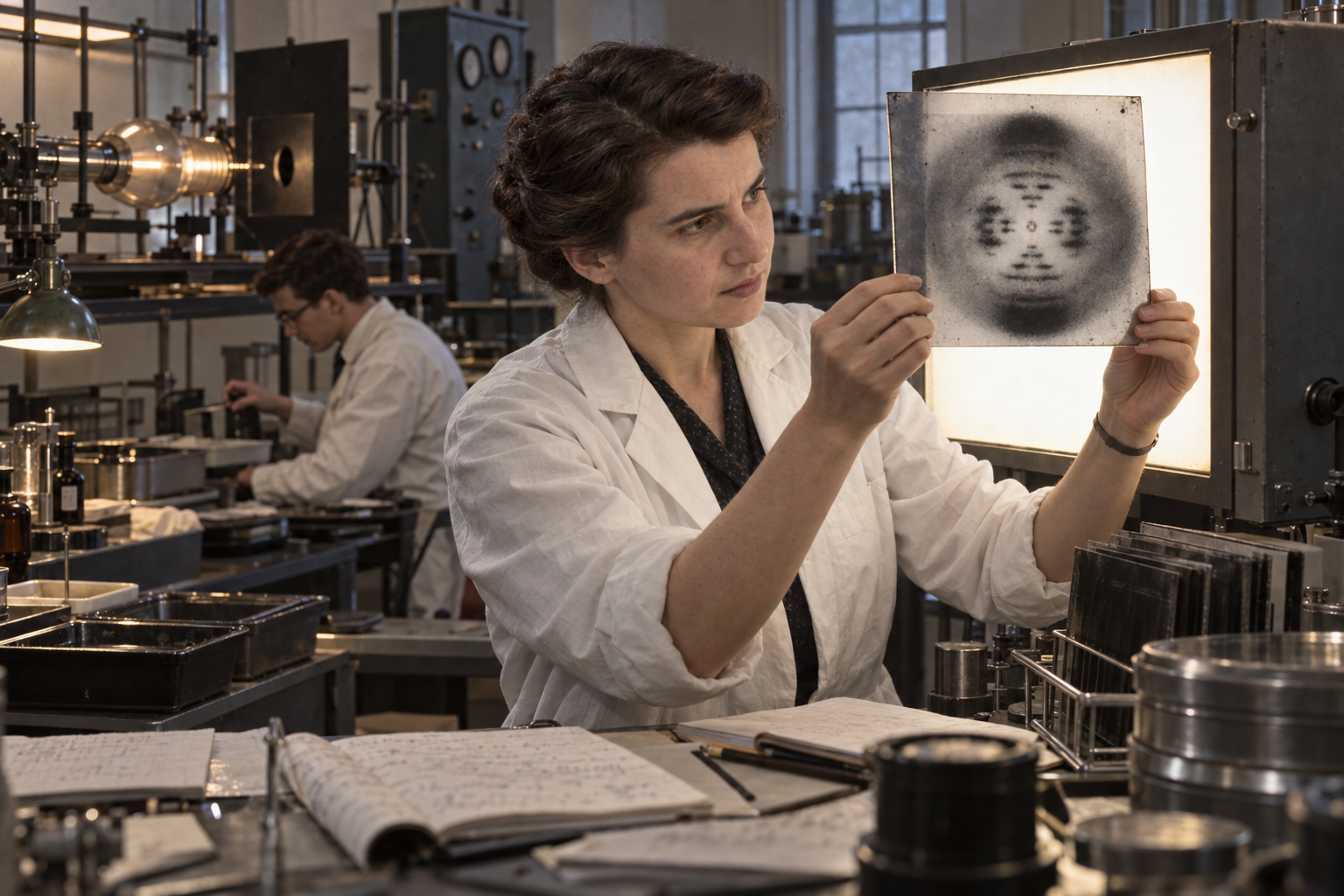
Rosalind Franklin trained as a physical chemist but made her name with X‑ray diffraction, a technique that translates patterns of scattered X‑rays into information about molecular structure. After wartime work on coal and carbon, she joined King’s College London in 1951 with a rare combination of meticulous experimental skill and an eye for clear, reproducible data. Her X‑ray set‑ups were precise; her notes were careful. That attention to detail produced images unusually sharp for the era—images that would prove decisive.

Photo 51 and the race to the double helix

In 1952 Franklin and her student Raymond Gosling produced an X‑ray image labeled “Photo 51.” The photograph showed a striking cross shape and a spacing of dark bands that pointed to a helical arrangement. At the same time, Francis Crick and James Watson in Cambridge were hunting for a model that fit existing chemistry and X‑ray evidence. When Photo 51 came to the attention of researchers outside Franklin’s immediate circle, its clarity accelerated model‑building. Within months Watson and Crick published a paper proposing the double helix; later that decade Watson, Crick, and Maurice Wilkins received the Nobel Prize in Physiology or Medicine. Franklin was not among the laureates—she had died in 1958 and Nobel rules do not award prizes posthumously—and historians have debated how her data circulated during those crucial months.

After DNA: viruses, stubborn curiosity, and a short life

Rather than resting on the DNA controversy, Franklin moved to Birkbeck College and turned her X‑ray lens toward viruses. Her work on the tobacco mosaic virus and on the structure of spherical viruses laid foundations for structural virology and showed how physical methods could illuminate biological function. Colleagues remembered her as demanding of herself and others, impatient with sloppiness, and uninterested in charm for its own sake. She published rigorously and left a trail of careful experiments that later researchers could reproduce and extend.

Conclusion

Rosalind Franklin’s story is less a tidy heroic arc than a portrait of scientific craft: precise methods, stubborn attention to data and an appetite for hard problems. Photo 51 remains the vivid image that links her to the discovery of DNA’s shape, but her contributions reach beyond a single photograph. They live on in the techniques structural biologists still use and in a quieter lesson about how credit and recognition in science can be complicated by personality, timing, and the realities of publication. Today, Franklin is remembered both for what she discovered and for the uncompromising standards she brought to laboratory work.
Previous Post

Matthew Henson: The Black Explorer Who Climbed Toward the Pole

Related Posts

Matthew Henson: The Black Explorer Who Climbed Toward the Pole
Biographies

Matthew Henson: The Black Explorer Who Climbed Toward the Pole

November 4, 2026
Mary Seacole: The Jamaican Nurse Who Went to War
Biographies

Mary Seacole: The Jamaican Nurse Who Went to War

October 30, 2026
Ada Lovelace: The Poet Who Helped Imagine Modern Computers
Biographies

Ada Lovelace: The Poet Who Helped Imagine Modern Computers

October 30, 2026
Katherine Johnson: The Numbers Behind America’s First Orbits
Biographies

Katherine Johnson: The Numbers Behind America’s First Orbits

October 25, 2026

Search..

No Result
View All Result

Recent Articles

Rosalind Franklin and Photo 51: The X‑Ray That Changed Genetics

Rosalind Franklin and Photo 51: The X‑Ray That Changed Genetics

November 4, 2026
Matthew Henson: The Black Explorer Who Climbed Toward the Pole

Matthew Henson: The Black Explorer Who Climbed Toward the Pole

November 4, 2026
When Boston Flooded with Molasses: The 1919 North End Disaster

When Boston Flooded with Molasses: The 1919 North End Disaster

November 3, 2026
The 1518 Dancing Plague: When Strasbourg Danced to Exhaustion

The 1518 Dancing Plague: When Strasbourg Danced to Exhaustion

November 3, 2026
1453: The Fall of Constantinople — A Brief Timeline

1453: The Fall of Constantinople — A Brief Timeline

November 2, 2026

Subscribe Us

By clicking submit, I authorize History Ours and its affiliated companies to: (1) use, sell, and share my information for marketing purposes, including cross-context behavioral advertising, as described in our Terms of Service and Privacy Policy, (2) supplement the information that I provide with additional information lawfully obtained from other sources, like demographic data from public sources, interests inferred from web page views, or other data relevant to what might interest me, like past purchase or location data, (3) contact me or enable others to contact me by email with offers for goods and services from any category at the email address provided, and (4) retain my information while I am engaging with marketing messages that I receive and for a reasonable amount of time thereafter. I understand I can opt out at any time through an email that I receive, or by clicking here

Subscribe To Our Newsletter

By clicking submit, I authorize History Ours and its affiliated companies to: (1) use, sell, and share my information for marketing purposes, including cross-context behavioral advertising, as described in our Terms of Service and Privacy Policy, (2) supplement the information that I provide with additional information lawfully obtained from other sources, like demographic data from public sources, interests inferred from web page views, or other data relevant to what might interest me, like past purchase or location data, (3) contact me or enable others to contact me by email with offers for goods and services from any category at the email address provided, and (4) retain my information while I am engaging with marketing messages that I receive and for a reasonable amount of time thereafter. I understand I can opt out at any time through an email that I receive, or by clicking here.

© 2026 History Ours | All Rights Reserved

  • Contact Us
  • Privacy Policy
  • Terms of Service
  • Unsubscribe
  • Privacy Choices
  • Contact Us
  • Privacy Policy
  • Terms of Service
  • Unsubscribe
  • Privacy Choices

© 2026 History Ours | All Rights Reserved

No Result
View All Result
  • Home
  • History
  • Biographies
  • Eras
  • Regions
  • Timeline

© 2026 History Ours | All Rights Reserved

Skip to content
Open toolbar Accessibility Tools

Accessibility Tools

  • Increase TextIncrease Text
  • Decrease TextDecrease Text
  • GrayscaleGrayscale
  • High ContrastHigh Contrast
  • Negative ContrastNegative Contrast
  • Light BackgroundLight Background
  • Links UnderlineLinks Underline
  • Readable FontReadable Font
  • Reset Reset