Uncover History’s Secrets with Daily Updates!
Daily News Entertainment
  • Home
  • History
  • Biographies
  • Eras
  • Regions
  • Timeline
No Result
View All Result
History Ours
  • Home
  • History
  • Biographies
  • Eras
  • Regions
  • Timeline
No Result
View All Result
History Ours
No Result
View All Result
Home Biographies

Morning Habits That Spark Fresh One-Liners Daily

in Biographies
Morning Habits That Spark Fresh One-Liners Daily

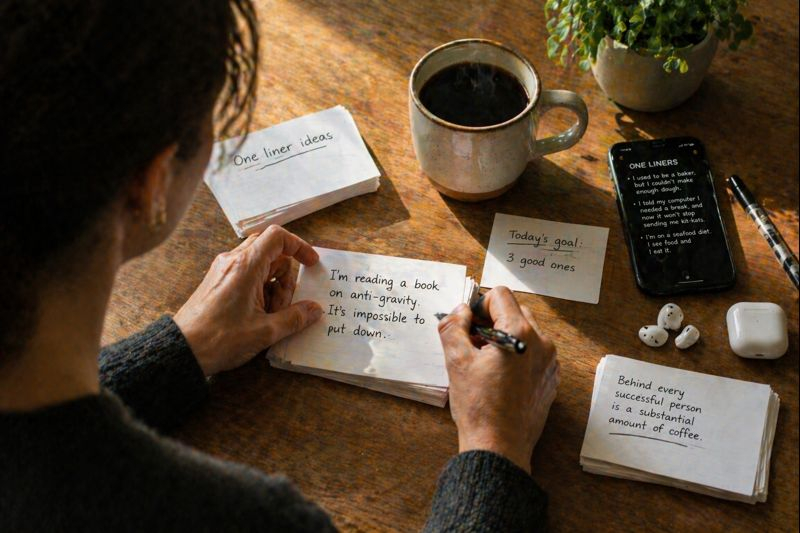
Developing a steady stream of one-liners starts with small, repeatable habits you can do each morning. A focused routine primes your mind to notice the ordinary and twist it into something witty. With consistent practice, short jokes become easier to generate and share. This article outlines practical steps to make one-liner creativity a daily habit.

Starting small reduces pressure and leaves room for playful experimentation. Over time, small riffs turn into reliable material for posts, messages, or quick conversations. The goal is to build a habit that fits into your morning rather than disrupts it. Use the checkpoints below to craft a sustainable approach.

Why One-Liners Thrive with Routine

Routine creates mental scaffolding that helps the brain spot patterns and contrasts—two key ingredients in one-liners. When you consistently observe a specific context like your commute, breakfast, or news feed, you train attention toward sources of surprise. Predictable inputs make unexpected connections easier to find and compress into short jokes. This predictability also reduces the friction of starting to write.

  • Consistency sharpens observation.
  • Short sessions prevent burnout.

By narrowing the scope to familiar moments, you can generate material quickly and refine it the next day. A brief morning habit becomes a content funnel rather than a chore.

A Simple Morning Routine to Generate Lines

Begin with five minutes of free association: note three observations from your immediate surroundings and force a brief twist on each. Follow that with a one-sentence edit to tighten wording and remove filler. Finally, pick one line to store in a running list or schedule for posting. The whole routine should take no more than ten minutes and fits easily before other tasks.

  • Observation (3 minutes): list what stands out.
  • Tighten (4 minutes): trim to the punchiest phrasing.

Keeping the exercise short prevents overthinking and preserves the snappy tone that makes one-liners land. Repeating this every morning builds both a backlog and a muscle for quick wit.

Techniques to Keep Your One-Liners Fresh

Use contrast, misdirection, and economy of words as core techniques: set up an expectation and then undercut it with a small surprise. Swap familiar metaphors, play with literal versus figurative meanings, and favor verbs that carry weight. Record every line, even the rough ones, because a small tweak often transforms a draft into a keeper.

  • Try opposites or exaggerated details.
  • Test rhythms by reading lines aloud.

Regular review sessions help you identify patterns that work and ones to avoid. Rotate successful formats to keep your feed varied without reinventing the process.

Conclusion

Simple, short morning habits make one-liner writing manageable and repeatable. Commit to a tiny routine, practice core techniques, and keep a running archive of lines. Over weeks, you will see steady improvement and a reliable supply of fresh one-liners.


Previous Post

Micro-Humor: Creating Short Jokes with Lasting Impact

Next Post

Choosing Boundaries That Make Historical Eras Useful

Related Posts

The Disguise That Broke Chains: Ellen and William Craft
Biographies

The Disguise That Broke Chains: Ellen and William Craft

September 15, 2026
Bass Reeves: The Marshal Who Hunted Outlaws in Indian Territory
Biographies

Bass Reeves: The Marshal Who Hunted Outlaws in Indian Territory

September 15, 2026
Ellen Craft: Passing as a Planter to Secure Freedom
Biographies

Ellen Craft: Passing as a Planter to Secure Freedom

September 15, 2026
Chien‑Shiung Wu: The Physicist Who Proved Parity’s Failure
Biographies

Chien‑Shiung Wu: The Physicist Who Proved Parity’s Failure

September 15, 2026
Next Post
Choosing Boundaries That Make Historical Eras Useful

Choosing Boundaries That Make Historical Eras Useful

Search..

No Result
View All Result

Recent Articles

The Disguise That Broke Chains: Ellen and William Craft

The Disguise That Broke Chains: Ellen and William Craft

September 15, 2026
Bass Reeves: The Marshal Who Hunted Outlaws in Indian Territory

Bass Reeves: The Marshal Who Hunted Outlaws in Indian Territory

September 15, 2026
How the Crystal Palace Turned Glass and Iron into a Modern Stage

How the Crystal Palace Turned Glass and Iron into a Modern Stage

September 15, 2026
Anne Bonny: The Pirate Who Broke Rules and Expectations

Anne Bonny: The Pirate Who Broke Rules and Expectations

September 15, 2026
How Haiti Broke Its Chains: A 1791–1804 Timeline

How Haiti Broke Its Chains: A 1791–1804 Timeline

September 15, 2026

Subscribe Us

By clicking submit, I authorize History Ours and its affiliated companies to: (1) use, sell, and share my information for marketing purposes, including cross-context behavioral advertising, as described in our Terms of Service and Privacy Policy, (2) supplement the information that I provide with additional information lawfully obtained from other sources, like demographic data from public sources, interests inferred from web page views, or other data relevant to what might interest me, like past purchase or location data, (3) contact me or enable others to contact me by email with offers for goods and services from any category at the email address provided, and (4) retain my information while I am engaging with marketing messages that I receive and for a reasonable amount of time thereafter. I understand I can opt out at any time through an email that I receive, or by clicking here

Subscribe To Our Newsletter

By clicking submit, I authorize History Ours and its affiliated companies to: (1) use, sell, and share my information for marketing purposes, including cross-context behavioral advertising, as described in our Terms of Service and Privacy Policy, (2) supplement the information that I provide with additional information lawfully obtained from other sources, like demographic data from public sources, interests inferred from web page views, or other data relevant to what might interest me, like past purchase or location data, (3) contact me or enable others to contact me by email with offers for goods and services from any category at the email address provided, and (4) retain my information while I am engaging with marketing messages that I receive and for a reasonable amount of time thereafter. I understand I can opt out at any time through an email that I receive, or by clicking here.

© 2026 History Ours | All Rights Reserved

  • Contact Us
  • Privacy Policy
  • Terms of Service
  • Unsubscribe
  • Privacy Choices
  • Contact Us
  • Privacy Policy
  • Terms of Service
  • Unsubscribe
  • Privacy Choices

© 2026 History Ours | All Rights Reserved

No Result
View All Result
  • Home
  • History
  • Biographies
  • Eras
  • Regions
  • Timeline

© 2026 History Ours | All Rights Reserved

Skip to content
Open toolbar Accessibility Tools

Accessibility Tools

  • Increase TextIncrease Text
  • Decrease TextDecrease Text
  • GrayscaleGrayscale
  • High ContrastHigh Contrast
  • Negative ContrastNegative Contrast
  • Light BackgroundLight Background
  • Links UnderlineLinks Underline
  • Readable FontReadable Font
  • Reset Reset