Uncover History’s Secrets with Daily Updates!
Daily News Entertainment
  • Home
  • History
  • Biographies
  • Eras
  • Regions
  • Timeline
No Result
View All Result
History Ours
  • Home
  • History
  • Biographies
  • Eras
  • Regions
  • Timeline
No Result
View All Result
History Ours
No Result
View All Result
Home Biographies

Portraits in Context: Writing Balanced Short Biographies

in Biographies
Portraits in Context: Writing Balanced Short Biographies

Short biographies demand precise choices and careful sourcing.
Writers must decide what to include and how to signal uncertainty.
Readers rely on clear contextual framing to interpret sparse facts.
This article outlines practical approaches for concise, responsible portraits.
Practical habits and clear notes make modest claims useful to readers.

Anchoring a Life in Evidence

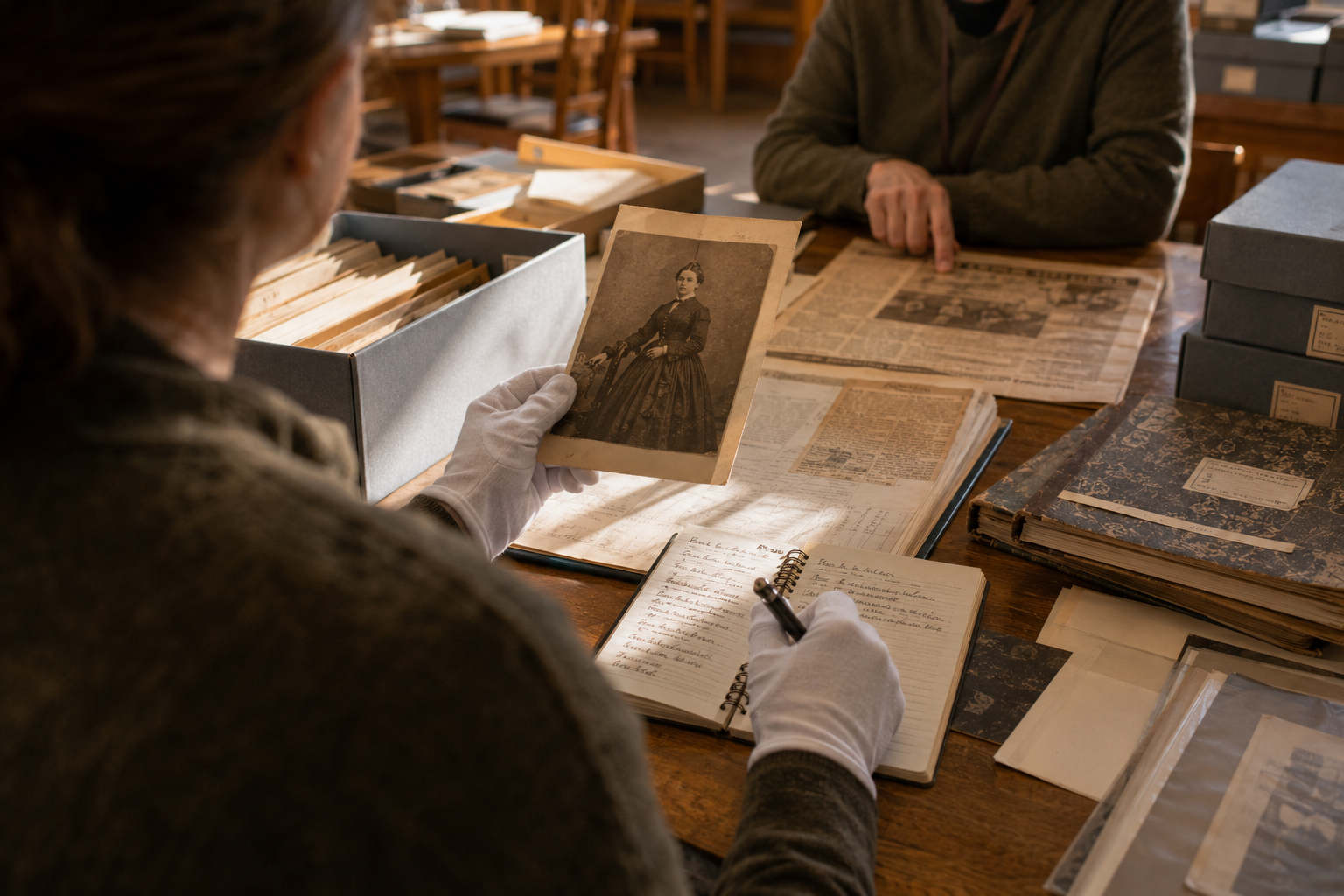
Begin by anchoring a life to verifiable facts: dates, places, documented roles, and direct quotations where available. Prioritize primary sources but use published secondary accounts to fill context, always noting their distance from the subject. When records are thin, trace habits, networks, or institutions that shaped everyday choices. Make provenance explicit so readers can judge reliability. Where possible, include a short provenance note about archival gaps.

A clear chain of evidence strengthens trust and helps avoid overstated claims. Simple source notes within the text improve transparency. This habit also aids later researchers seeking to reassess conclusions.

Balancing Narrative and Uncertainty

Craft a narrative voice that distinguishes between what is known and what is inferred. Use hedging language for speculation and offer alternatives when multiple explanations fit the evidence. Contextual paragraphs can explain typical patterns without asserting them as personal facts. This balance preserves narrative momentum while respecting evidentiary limits. Footnotes or parenthetical notes help manage competing interpretations.

  • Flag conjecture and label speculative passages.
  • Offer comparative context rather than definitive personality readings.

Explicitly mark hypotheses and keep interpretation proportional to sources. Readers will appreciate honesty about limits. Aim for proportional inference: small evidence, small claims; larger claims require stronger proof.

Practical Steps for Short Portraits

For short portraits, structure matters: lead with an arresting fact, follow with evidence-based context, and close with a reflection that connects the life to broader themes. Keep sentences tight and avoid archival melodrama; every detail should serve interpretation or verification. Use micro-narratives—brief stories or representative episodes—to illustrate patterns without overreaching. Maintain consistent tense and chronological markers to help readers follow gaps. Be deliberate about what you omit; absence of evidence is itself informative when framed carefully.

  • Collect and rank sources by directness and reliability.
  • Write a brief source note for ambiguous items.
  • Use context paragraphs to situate facts within institutions and norms.

These practical steps make concise biographies readable and reliable. They also create a defensible framework for future revision. Shared templates and consistent notes also help editors update portraits as new sources emerge.

Ethics and Respect

Treat subjects—especially those with limited records—with humility, avoiding sensationalism or undue moralizing. When dealing with marginalized individuals, foreground structural forces and acknowledge the historian’s positionality. Seek consent when working with descendants or living communities and be transparent about editorial choices. Balance empathy with critical distance so interpretation remains evidence-based and not purely speculative.

Footnotes can note contested material and explain decisions. Ethical habits strengthen public trust and long-term scholarly value.

Conclusion

Respect for sources and clear phrasing keep short biographies honest.
Good portraits reveal pattern without pretending completeness.
A careful, modular approach lets others build on your work.
Previous Post

Tastes of the Market: Food, Labor, and Urban Rituals

Next Post

Crafting Concise Life Portraits with Historical Rigor

Related Posts

The Disguise That Broke Chains: Ellen and William Craft
Biographies

The Disguise That Broke Chains: Ellen and William Craft

September 15, 2026
Bass Reeves: The Marshal Who Hunted Outlaws in Indian Territory
Biographies

Bass Reeves: The Marshal Who Hunted Outlaws in Indian Territory

September 15, 2026
Ellen Craft: Passing as a Planter to Secure Freedom
Biographies

Ellen Craft: Passing as a Planter to Secure Freedom

September 15, 2026
Chien‑Shiung Wu: The Physicist Who Proved Parity’s Failure
Biographies

Chien‑Shiung Wu: The Physicist Who Proved Parity’s Failure

September 15, 2026
Next Post
Crafting Concise Life Portraits with Historical Rigor

Crafting Concise Life Portraits with Historical Rigor

Search..

No Result
View All Result

Recent Articles

Edo: Japan’s Urban Revolution of Lanterns and Printshops

Edo: Japan’s Urban Revolution of Lanterns and Printshops

September 16, 2026
How the Little Ice Age Changed Everyday Life in Europe

How the Little Ice Age Changed Everyday Life in Europe

September 16, 2026
The Disguise That Broke Chains: Ellen and William Craft

The Disguise That Broke Chains: Ellen and William Craft

September 15, 2026
Bass Reeves: The Marshal Who Hunted Outlaws in Indian Territory

Bass Reeves: The Marshal Who Hunted Outlaws in Indian Territory

September 15, 2026
How the Crystal Palace Turned Glass and Iron into a Modern Stage

How the Crystal Palace Turned Glass and Iron into a Modern Stage

September 15, 2026

Subscribe Us

By clicking submit, I authorize History Ours and its affiliated companies to: (1) use, sell, and share my information for marketing purposes, including cross-context behavioral advertising, as described in our Terms of Service and Privacy Policy, (2) supplement the information that I provide with additional information lawfully obtained from other sources, like demographic data from public sources, interests inferred from web page views, or other data relevant to what might interest me, like past purchase or location data, (3) contact me or enable others to contact me by email with offers for goods and services from any category at the email address provided, and (4) retain my information while I am engaging with marketing messages that I receive and for a reasonable amount of time thereafter. I understand I can opt out at any time through an email that I receive, or by clicking here

Subscribe To Our Newsletter

By clicking submit, I authorize History Ours and its affiliated companies to: (1) use, sell, and share my information for marketing purposes, including cross-context behavioral advertising, as described in our Terms of Service and Privacy Policy, (2) supplement the information that I provide with additional information lawfully obtained from other sources, like demographic data from public sources, interests inferred from web page views, or other data relevant to what might interest me, like past purchase or location data, (3) contact me or enable others to contact me by email with offers for goods and services from any category at the email address provided, and (4) retain my information while I am engaging with marketing messages that I receive and for a reasonable amount of time thereafter. I understand I can opt out at any time through an email that I receive, or by clicking here.

© 2026 History Ours | All Rights Reserved

  • Contact Us
  • Privacy Policy
  • Terms of Service
  • Unsubscribe
  • Privacy Choices
  • Contact Us
  • Privacy Policy
  • Terms of Service
  • Unsubscribe
  • Privacy Choices

© 2026 History Ours | All Rights Reserved

No Result
View All Result
  • Home
  • History
  • Biographies
  • Eras
  • Regions
  • Timeline

© 2026 History Ours | All Rights Reserved

Skip to content
Open toolbar Accessibility Tools

Accessibility Tools

  • Increase TextIncrease Text
  • Decrease TextDecrease Text
  • GrayscaleGrayscale
  • High ContrastHigh Contrast
  • Negative ContrastNegative Contrast
  • Light BackgroundLight Background
  • Links UnderlineLinks Underline
  • Readable FontReadable Font
  • Reset Reset