Uncover History’s Secrets with Daily Updates!
Daily News Entertainment
  • Home
  • History
  • Biographies
  • Eras
  • Regions
  • Timeline
No Result
View All Result
History Ours
  • Home
  • History
  • Biographies
  • Eras
  • Regions
  • Timeline
No Result
View All Result
History Ours
No Result
View All Result
Home History

Tastes of the Market: Food, Labor, and Urban Rituals

in History
Tastes of the Market: Food, Labor, and Urban Rituals

Markets have long been more than places of exchange; they are stages where food, labor, and social life intersect. Studying everyday culinary practices reveals how communities organized time, space, and work. Vendors, households, and consumers each shaped the textures of public life through routines around provision and consumption. This article traces how foodways illuminate broader patterns of urban ritual and economic adaptation.

The Market as Culinary Stage

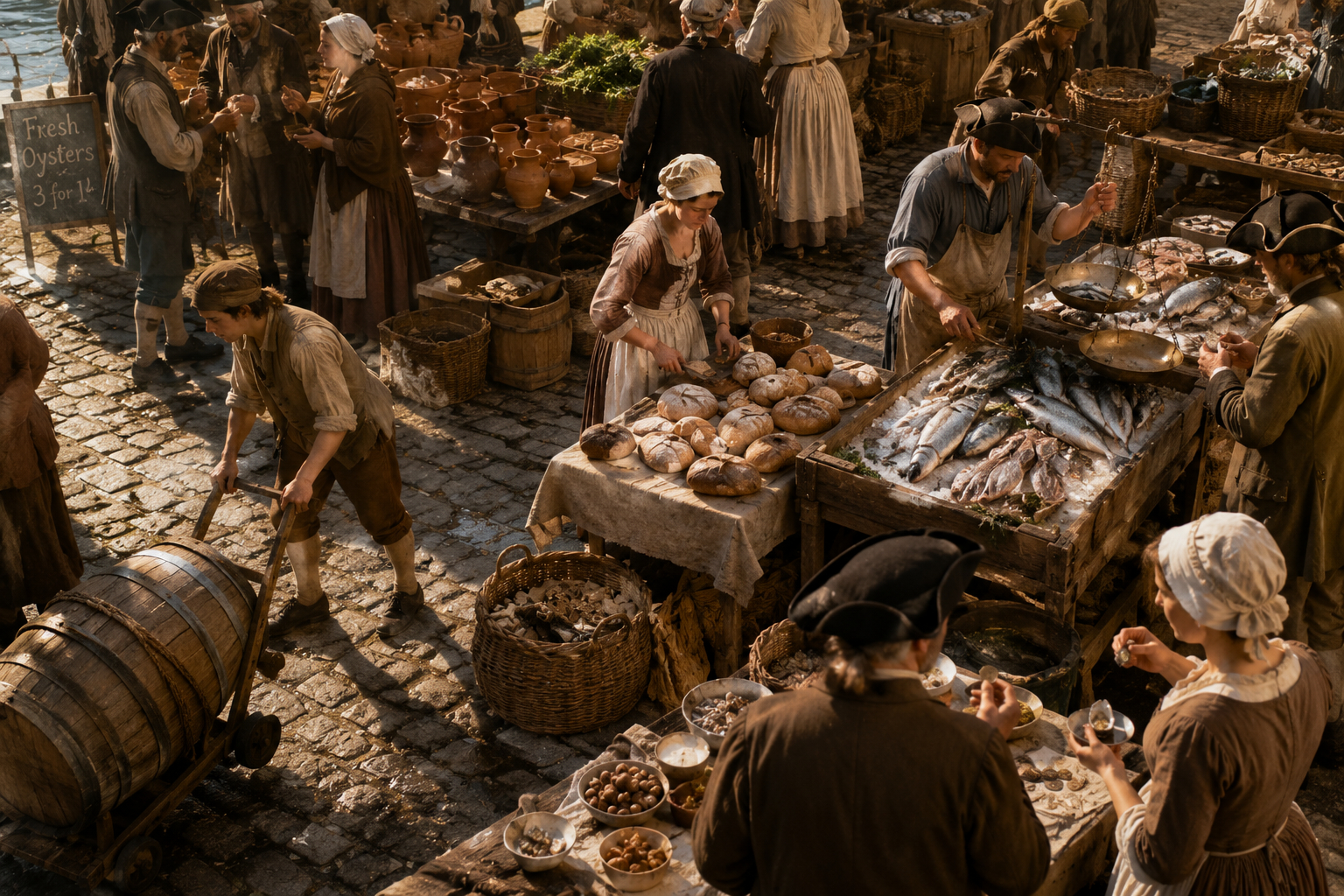
Market squares and streets functioned as theatrical settings in which food signaled status, identity, and seasonality. Stalls and booths arranged products visually and audibly, attracting buyers through sight, smell, and calls. The placement of fishmongers, bakers, and greengrocers often reflected zoning norms, customer flows, and municipal regulations. Over time these spatial arrangements shaped consumer expectations and the rhythms of daily shopping.

Producers adapted to these expectations by standardizing portions, creating recognizable displays, and aligning offerings with festival calendars. Visible practices in the market both reflected and reinforced local tastes and social hierarchies. Vendors used presentation as a form of persuasion as much as supply.

Labor and Daily Food Economies

Behind every market transaction were networks of labor spanning producers, transporters, and household cooks. Work schedules followed agricultural cycles and urban demand, producing predictable peaks and lulls in activity. Apprentices, family members, and hired hands sustained small-scale food businesses, while informal arrangements smoothed shortages. This dense labor ecology supported a flexible urban food supply even in times of scarcity.

Household economies also absorbed risk through preservation, sharing, and barter. Such strategies reveal how domestic work and market labor were mutually dependent, creating resilience within neighborhoods. Close attention to labor practices shows how communities managed daily life around food.

Social Rituals Around Food

Food exchange was braided with ritual: morning markets signaled the start of the day, while evening sales and tavern suppers marked its close. Communal meals, street vendors, and impromptu tastings created opportunities for gossip, negotiation, and neighborly care. Public festivals elevated certain foods into symbols of civic pride and seasonal continuity. These rituals reinforced social bonds and helped regulate behavior in public spaces.

Everyday rituals also mediated status and access, as elites and laborers encountered the same goods in different contexts. Observing these patterns reveals how material culture and social norms intertwined in urban settings. Foodways, in short, were a language of belonging.

Material Culture and Street Vendors

Utensils, containers, and modes of presentation mattered as much as the food itself for shaping market experience. Portable stalls, carts, and specialized tools enabled vendors to operate in tight urban streets and respond quickly to demand. Packaging practices influenced waste patterns and recycling within communities, while food-related objects circulated between market and household. Material culture thus linked consumption habits to environmental and social practices.

Street vendors, often mobile and adaptable, played a crucial role in filling temporal and spatial gaps in provision. Their presence highlights how informal economies complemented formal supply chains and supported everyday life.

Conclusion

Exploring food in market towns uncovers the connections between labor, space, and ritual that sustained urban life. Culinary practices acted as practical economies and social scripts shaping belonging and resilience. Paying attention to these ordinary exchanges enriches our understanding of historical communities and their everyday strategies.


Previous Post

Shared Spaces and Social Practice in Early Market Towns

Next Post

Portraits in Context: Writing Balanced Short Biographies

Related Posts

John Snow, the Broad Street Pump, and Cholera’s Fall
History

John Snow, the Broad Street Pump, and Cholera’s Fall

October 29, 2026
The Vasa: Sweden’s Giant Ship That Couldn’t Sail
History

The Vasa: Sweden’s Giant Ship That Couldn’t Sail

October 29, 2026
The Ghost Army: How Artists Fooled Hitler’s Front
History

The Ghost Army: How Artists Fooled Hitler’s Front

October 24, 2026
How Iceland’s 1783 Laki Fissure Eruption Chilled an Age
History

How Iceland’s 1783 Laki Fissure Eruption Chilled an Age

October 24, 2026
Next Post
Portraits in Context: Writing Balanced Short Biographies

Portraits in Context: Writing Balanced Short Biographies

Search..

No Result
View All Result

Recent Articles

1453: The Fall of Constantinople — A Brief Timeline

1453: The Fall of Constantinople — A Brief Timeline

November 2, 2026
How Penicillin Went from Petri Dish to Battlefield Medicine

How Penicillin Went from Petri Dish to Battlefield Medicine

November 2, 2026
How Carrara’s Marble Carved a Peculiar Mountain Region

How Carrara’s Marble Carved a Peculiar Mountain Region

November 1, 2026
The Great Dismal Swamp: Refuge, Labor, and a Hidden Region

The Great Dismal Swamp: Refuge, Labor, and a Hidden Region

November 1, 2026
The Salon Era: How Conversation Shaped the Enlightenment

The Salon Era: How Conversation Shaped the Enlightenment

October 31, 2026

Subscribe Us

By clicking submit, I authorize History Ours and its affiliated companies to: (1) use, sell, and share my information for marketing purposes, including cross-context behavioral advertising, as described in our Terms of Service and Privacy Policy, (2) supplement the information that I provide with additional information lawfully obtained from other sources, like demographic data from public sources, interests inferred from web page views, or other data relevant to what might interest me, like past purchase or location data, (3) contact me or enable others to contact me by email with offers for goods and services from any category at the email address provided, and (4) retain my information while I am engaging with marketing messages that I receive and for a reasonable amount of time thereafter. I understand I can opt out at any time through an email that I receive, or by clicking here

Subscribe To Our Newsletter

By clicking submit, I authorize History Ours and its affiliated companies to: (1) use, sell, and share my information for marketing purposes, including cross-context behavioral advertising, as described in our Terms of Service and Privacy Policy, (2) supplement the information that I provide with additional information lawfully obtained from other sources, like demographic data from public sources, interests inferred from web page views, or other data relevant to what might interest me, like past purchase or location data, (3) contact me or enable others to contact me by email with offers for goods and services from any category at the email address provided, and (4) retain my information while I am engaging with marketing messages that I receive and for a reasonable amount of time thereafter. I understand I can opt out at any time through an email that I receive, or by clicking here.

© 2026 History Ours | All Rights Reserved

  • Contact Us
  • Privacy Policy
  • Terms of Service
  • Unsubscribe
  • Privacy Choices
  • Contact Us
  • Privacy Policy
  • Terms of Service
  • Unsubscribe
  • Privacy Choices

© 2026 History Ours | All Rights Reserved

No Result
View All Result
  • Home
  • History
  • Biographies
  • Eras
  • Regions
  • Timeline

© 2026 History Ours | All Rights Reserved

Skip to content
Open toolbar Accessibility Tools

Accessibility Tools

  • Increase TextIncrease Text
  • Decrease TextDecrease Text
  • GrayscaleGrayscale
  • High ContrastHigh Contrast
  • Negative ContrastNegative Contrast
  • Light BackgroundLight Background
  • Links UnderlineLinks Underline
  • Readable FontReadable Font
  • Reset Reset