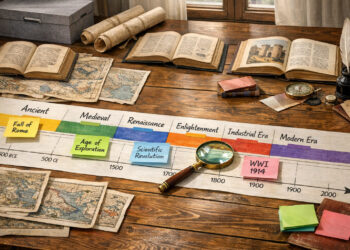


Defining historical eras is an essential step for making sense of long-term change and continuity in the past. Scholars use eras to group developments, highlight turning points, and communicate large narratives in manageable frames. Effective periodization clarifies relationships among political, social, economic, and cultural transformations without oversimplifying complexity. This article outlines practical principles for identifying meaningful eras and applying them responsibly.
Principles of Periodization
Good periodization relies on clear criteria rather than convenience or tradition alone. Analysts should ask whether a proposed boundary marks sustained shifts in institutions, technology, economy, or lived experience. Evidence must be prioritized across multiple domains and weighted for long-term impact instead of short-lived events. Consistency in methodology helps compare eras across regions and topics while acknowledging differences in scale and intensity.
Applying these principles encourages transparency about why dates and labels are chosen. Researchers should justify period boundaries with sources, indicators, and alternative interpretations. That practice makes arguments replicable and opens them to constructive critique from other scholars.
Choosing Boundaries That Reflect Change
Boundaries are most persuasive when they align with durable transformations rather than arbitrary calendar dates. Look for changes that alter institutions, production systems, legal frameworks, or cultural repertoires across generations. Transitional phases often overlap; a good era accounts for staggered change by recognizing multi-layered beginnings and endings. Cross-checking material, textual, and quantitative records helps locate moments where change becomes broadly consequential.
Flexible boundaries allow narratives to capture both gradual and rapid transitions. Rather than forcing an abrupt cutoff, define eras that permit overlap and regional variation where appropriate. That approach preserves nuance and reduces teleological bias in historical storytelling.
Common Pitfalls in Defining Eras
Simplification, presentism, and the undue authority of conventional labels can mislead periodization. Relying on a single type of evidence or privileging dramatic events risks masking continuities that shape later developments. Similarly, imposing a framework derived from one region or discipline onto disparate contexts can distort local trajectories. Scholars must remain vigilant about implicit assumptions and the limits of their sources.
Peer review and interdisciplinary dialogue are effective remedies against these pitfalls. Testing period models against counterexamples and alternative datasets strengthens their explanatory power and avoids overstated claims.
Practical Applications for Scholars and Educators
For educators, eras provide scaffolding that helps learners grasp complex sequences without losing sight of nuance. In teaching, present competing periodizations and encourage students to evaluate evidence behind different labels. Researchers can use eras as working tools—revisable frameworks that guide inquiry rather than immutable truths. Clear labeling and methodological transparency make findings more accessible to public audiences and interdisciplinary colleagues.
Using eras thoughtfully enhances both scholarship and communication. By framing time in ways that reflect meaningful patterns, historians can illuminate the past while preserving its complexity.
Conclusion
Defining historical eras combines evidence, judgement, and methodological care to capture significant patterns of change. Transparent criteria and openness to revision make periodization a robust analytical tool. Thoughtful use of eras clarifies the past without flattening its diversity.