
Uncover History’s Secrets with Daily Updates!
Daily News Entertainment
  • Home
  • History
  • Biographies
  • Eras
  • Regions
  • Timeline
No Result
View All Result
History Ours
  • Home
  • History
  • Biographies
  • Eras
  • Regions
  • Timeline
No Result
View All Result
History Ours
No Result
View All Result
Home Eras

Everyday Experience in Medieval Market Towns

in Eras
Everyday Experience in Medieval Market Towns

Medieval market towns were lively hubs where commerce, craft, and community intersected day by day.
Their streets, stalls, and guildhalls shaped rhythms of work and social life for residents and visitors alike.
Understanding these towns helps illuminate how ordinary people experienced economy, governance, and culture in their era.
This article explores the town layout, daily occupations, social interactions, and cultural practices that defined everyday life.

Market Town Structure

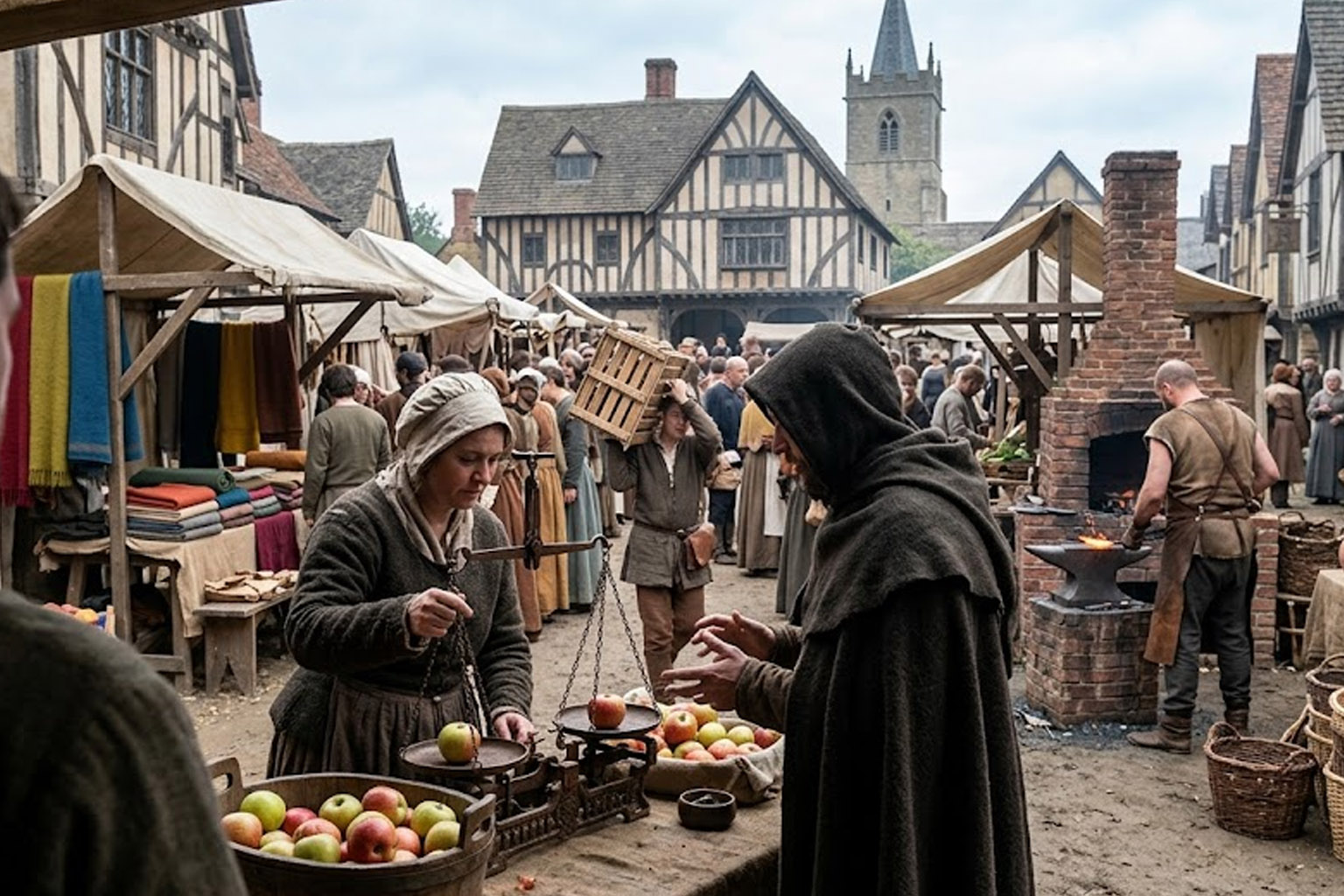
Market towns typically grew near trade routes or river crossings and developed a compact layout around a central market square. The square hosted weekly or seasonal markets where farmers, artisans, and merchants exchanged goods, news, and services. Narrow streets led to specialized quarters — tanners, bakers, weavers, and metalworkers often clustered together to share resources and customers. Civic buildings such as the guildhall, church, and tollhouse provided administrative and social anchors for the town.

This physical structure made the market square a focal point of daily life and a stage for public events and regulation. It also helped create recognizable neighborhoods where identities and local economies developed over generations.

Daily Work and Trade

Most residents engaged in occupations tied to production and commerce rather than large-scale farming. Artisans balanced workshop production with market sales, while itinerant traders brought exotic or distant goods that broadened choices. The timing of markets, fairs, and guild regulations shaped labor patterns and opportunities for apprentices and journeymen. Trade was both local and regional, dependent on seasons, transport conditions, and legal privileges granted by authorities.

For many people, economic survival required adaptability and social networks that could provide credit, information, and work. Markets reinforced ties between rural producers and urban consumers in practical and cultural ways.

Social and Cultural Life

Social life in market towns mixed work with ritual, leisure, and conflict in shared public spaces. Festivals, religious observances, and public punishments all occurred in or near the square, reinforcing communal norms and hierarchies. Guilds regulated not only production standards but also social welfare and charity for members and their families. Inns and alehouses offered informal centers for news, negotiations, and entertainment beyond formal institutions.

Everyday culture balanced communal obligations with personal advancement, often within visible and rule-bound settings. This combination of commerce and community produced identities tied closely to place and occupation.

Conclusion

Market towns were dynamic environments where economic, social, and cultural life overlapped daily.
Their structures and institutions shaped opportunities, responsibilities, and communal bonds for ordinary people.
Studying these towns offers a grounded perspective on how people lived, worked, and connected in their era.
Previous Post

Daily Life and Change During the Industrial Era

Next Post

Mapping Cultural Layers Across Distinct Regional Landscapes

Related Posts

Daily Life and Change During the Industrial Era
Eras

Daily Life and Change During the Industrial Era

August 28, 2026
How to Define Useful Periods in Historical Study
Eras

How to Define Useful Periods in Historical Study

August 28, 2026
Building Transparent Eras to Illuminate Past Change
Eras

Building Transparent Eras to Illuminate Past Change

August 28, 2026
Making Time Explain: Strategies for Defining Historical Eras
Eras

Making Time Explain: Strategies for Defining Historical Eras

August 17, 2026
Next Post
Mapping Cultural Layers Across Distinct Regional Landscapes

Mapping Cultural Layers Across Distinct Regional Landscapes

Search..

No Result
View All Result

Recent Articles

How Oysters Shaped the Chesapeake’s Past and Present

How Oysters Shaped the Chesapeake’s Past and Present

August 28, 2026
Corsica’s Rocky Turn: Genoese Towers, Paoli, and an Island’s Identity

Corsica’s Rocky Turn: Genoese Towers, Paoli, and an Island’s Identity

August 28, 2026
Mapping Cultural Layers Across Distinct Regional Landscapes

Mapping Cultural Layers Across Distinct Regional Landscapes

August 28, 2026
Everyday Experience in Medieval Market Towns

Everyday Experience in Medieval Market Towns

August 28, 2026
Daily Life and Change During the Industrial Era

Daily Life and Change During the Industrial Era

August 28, 2026

Subscribe Us

By clicking submit, I authorize History Ours and its affiliated companies to: (1) use, sell, and share my information for marketing purposes, including cross-context behavioral advertising, as described in our Terms of Service and Privacy Policy, (2) supplement the information that I provide with additional information lawfully obtained from other sources, like demographic data from public sources, interests inferred from web page views, or other data relevant to what might interest me, like past purchase or location data, (3) contact me or enable others to contact me by email with offers for goods and services from any category at the email address provided, and (4) retain my information while I am engaging with marketing messages that I receive and for a reasonable amount of time thereafter. I understand I can opt out at any time through an email that I receive, or by clicking here

Subscribe To Our Newsletter

By clicking submit, I authorize History Ours and its affiliated companies to: (1) use, sell, and share my information for marketing purposes, including cross-context behavioral advertising, as described in our Terms of Service and Privacy Policy, (2) supplement the information that I provide with additional information lawfully obtained from other sources, like demographic data from public sources, interests inferred from web page views, or other data relevant to what might interest me, like past purchase or location data, (3) contact me or enable others to contact me by email with offers for goods and services from any category at the email address provided, and (4) retain my information while I am engaging with marketing messages that I receive and for a reasonable amount of time thereafter. I understand I can opt out at any time through an email that I receive, or by clicking here.

© 2026 History Ours | All Rights Reserved

  • Contact Us
  • Privacy Policy
  • Terms of Service
  • Unsubscribe
  • Privacy Choices
  • Contact Us
  • Privacy Policy
  • Terms of Service
  • Unsubscribe
  • Privacy Choices

© 2026 History Ours | All Rights Reserved

No Result
View All Result
  • Home
  • History
  • Biographies
  • Eras
  • Regions
  • Timeline

© 2026 History Ours | All Rights Reserved

Skip to content
Open toolbar Accessibility Tools

Accessibility Tools

  • Increase TextIncrease Text
  • Decrease TextDecrease Text
  • GrayscaleGrayscale
  • High ContrastHigh Contrast
  • Negative ContrastNegative Contrast
  • Light BackgroundLight Background
  • Links UnderlineLinks Underline
  • Readable FontReadable Font
  • Reset Reset