
Uncover History’s Secrets with Daily Updates!
Daily News Entertainment
  • Home
  • History
  • Biographies
  • Eras
  • Regions
  • Timeline
No Result
View All Result
History Ours
  • Home
  • History
  • Biographies
  • Eras
  • Regions
  • Timeline
No Result
View All Result
History Ours
No Result
View All Result
Home Eras

How the Dutch Golden Age Remade Everyday Europe

in Eras
How the Dutch Golden Age Remade Everyday Europe

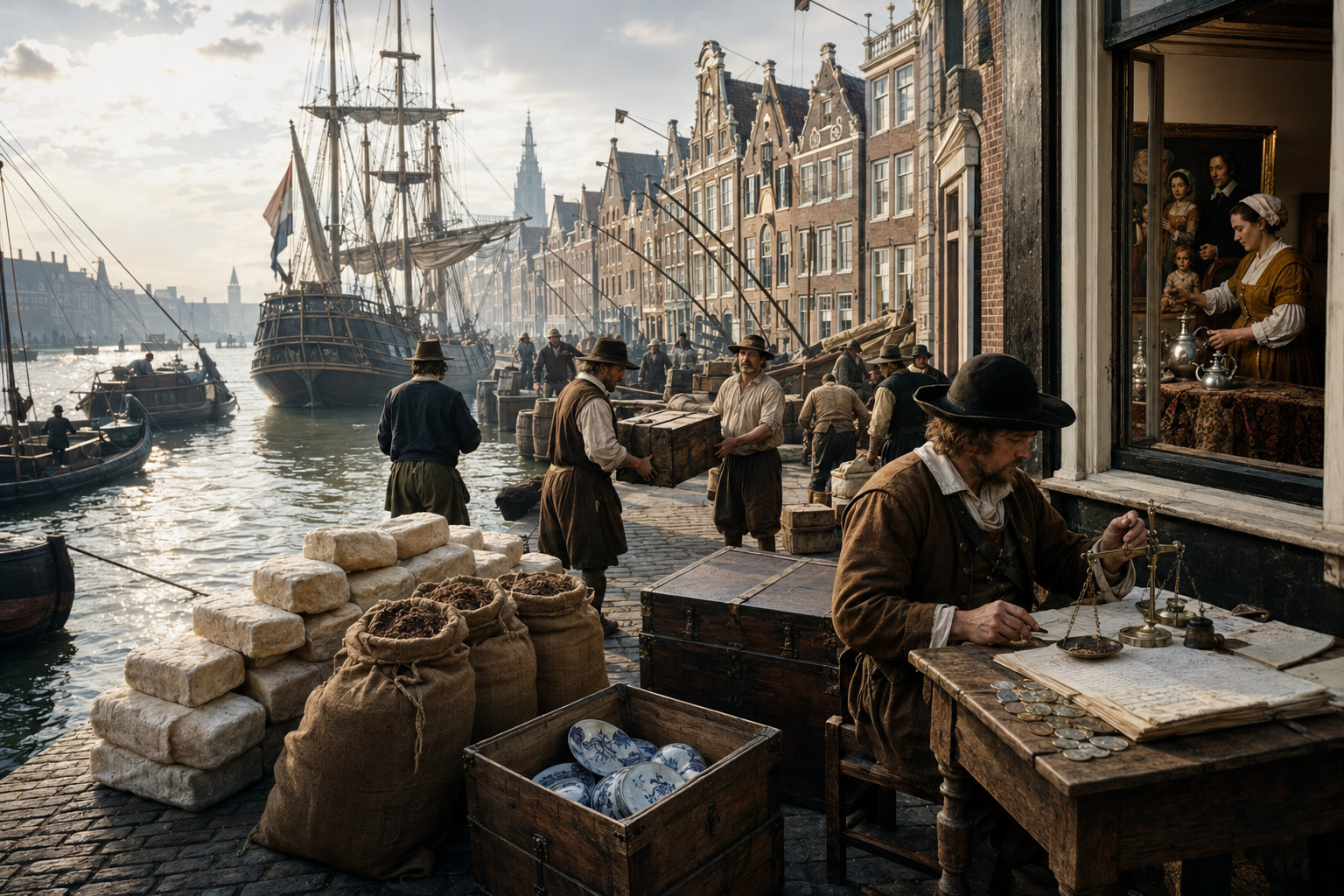
By the 1600s the low countries had turned ocean trade into a machine. Amsterdam’s merchants sailed to the Baltic for grain, to the Mediterranean for spices, and beyond the Cape of Good Hope to the East Indies. The Dutch East India Company, founded in 1602, organized fleets, shared risk through tradable shares and helped make Amsterdam a hub for goods and money. Ports, shipyards and warehouses drew labor, capital and a bewildering variety of imports: sugar and coffee, Baltic timber, Brazilian tobacco. That mix transformed not just elites but daily life across northern Europe, because luxury imports were no longer curiosities but parts of ordinary diets and fashions.

Homes, canals, and the art of looking close

The face of Dutch towns changed with prosperity. Canals threaded cities into neat halves; narrow canal houses rose tall and thin, their hooked beams visible at the roofline for hoisting trunks and barrels up cramped stairways. Interiors became a public statement—bright windows, carefully arranged tableware, thick rugs, and painted portraits of merchant families. Painters such as Rembrandt and Vermeer turned those domestic details into a new kind of fame: genre scenes that celebrated everyday objects—maps on the wall, a gleaming pewter jug, a trimmed beard. Their paintings were both advertisement and mirror: they show what people owned and what they admired about themselves.

Practical modernities and global strain

Behind the glamour were innovations that look familiar today: sophisticated bookkeeping, early stock trading, insurance contracts, and a network of credit that kept ships moving. The republic also experimented with religious tolerance, which attracted skilled refugees—Jews, Huguenots, and others—whose trades boosted urban economies. But growth brought friction. Competition on the seas led to violent clashes with England in the mid-1600s and constant pressure to protect shipping. Speculative bubbles—most famously the tulip mania that imploded around 1637—reminded citizens that the new financial tools could be unstable.

Conclusion

The Dutch Golden Age was less a single flash of riches than a cluster of changes: maritime networks, financial practices, urban architecture and a culture that turned ordinary objects into stories. Its reach was practical—coffee in a modest Dutch cup or maps tucked into a merchant’s study—but the ripple effects mattered across Europe: new tastes, new money, and a model of how a maritime, commercial society could organize itself. That mix of the intimate and the global is why 17th-century Dutch life still feels familiar and surprising at once.


Previous Post

When Winters Were Wider: Life During the Little Ice Age

Next Post

How the English Fens Were Turned into Farmland and Memory

Related Posts

When Winters Were Wider: Life During the Little Ice Age
Eras

When Winters Were Wider: Life During the Little Ice Age

September 2, 2026
Everyday Experience in Medieval Market Towns
Eras

Everyday Experience in Medieval Market Towns

August 28, 2026
Daily Life and Change During the Industrial Era
Eras

Daily Life and Change During the Industrial Era

August 28, 2026
How to Define Useful Periods in Historical Study
Eras

How to Define Useful Periods in Historical Study

August 28, 2026
Next Post
How the English Fens Were Turned into Farmland and Memory

How the English Fens Were Turned into Farmland and Memory

Search..

No Result
View All Result

Recent Articles

The Marsh Arabs: How Iraq’s Wetlands Shaped a People

The Marsh Arabs: How Iraq’s Wetlands Shaped a People

September 2, 2026
How the English Fens Were Turned into Farmland and Memory

How the English Fens Were Turned into Farmland and Memory

September 2, 2026
How the Dutch Golden Age Remade Everyday Europe

How the Dutch Golden Age Remade Everyday Europe

September 2, 2026
When Winters Were Wider: Life During the Little Ice Age

When Winters Were Wider: Life During the Little Ice Age

September 2, 2026
How Ignaz Semmelweis Saved Mothers and Was Ignored

How Ignaz Semmelweis Saved Mothers and Was Ignored

August 31, 2026

Subscribe Us

By clicking submit, I authorize History Ours and its affiliated companies to: (1) use, sell, and share my information for marketing purposes, including cross-context behavioral advertising, as described in our Terms of Service and Privacy Policy, (2) supplement the information that I provide with additional information lawfully obtained from other sources, like demographic data from public sources, interests inferred from web page views, or other data relevant to what might interest me, like past purchase or location data, (3) contact me or enable others to contact me by email with offers for goods and services from any category at the email address provided, and (4) retain my information while I am engaging with marketing messages that I receive and for a reasonable amount of time thereafter. I understand I can opt out at any time through an email that I receive, or by clicking here

Subscribe To Our Newsletter

By clicking submit, I authorize History Ours and its affiliated companies to: (1) use, sell, and share my information for marketing purposes, including cross-context behavioral advertising, as described in our Terms of Service and Privacy Policy, (2) supplement the information that I provide with additional information lawfully obtained from other sources, like demographic data from public sources, interests inferred from web page views, or other data relevant to what might interest me, like past purchase or location data, (3) contact me or enable others to contact me by email with offers for goods and services from any category at the email address provided, and (4) retain my information while I am engaging with marketing messages that I receive and for a reasonable amount of time thereafter. I understand I can opt out at any time through an email that I receive, or by clicking here.

© 2026 History Ours | All Rights Reserved

  • Contact Us
  • Privacy Policy
  • Terms of Service
  • Unsubscribe
  • Privacy Choices
  • Contact Us
  • Privacy Policy
  • Terms of Service
  • Unsubscribe
  • Privacy Choices

© 2026 History Ours | All Rights Reserved

No Result
View All Result
  • Home
  • History
  • Biographies
  • Eras
  • Regions
  • Timeline

© 2026 History Ours | All Rights Reserved

Skip to content
Open toolbar Accessibility Tools

Accessibility Tools

  • Increase TextIncrease Text
  • Decrease TextDecrease Text
  • GrayscaleGrayscale
  • High ContrastHigh Contrast
  • Negative ContrastNegative Contrast
  • Light BackgroundLight Background
  • Links UnderlineLinks Underline
  • Readable FontReadable Font
  • Reset Reset