
Uncover History’s Secrets with Daily Updates!
Daily News Entertainment
  • Home
  • History
  • Biographies
  • Eras
  • Regions
  • Timeline
No Result
View All Result
History Ours
  • Home
  • History
  • Biographies
  • Eras
  • Regions
  • Timeline
No Result
View All Result
History Ours
No Result
View All Result
Home Eras

The Age of Silver: How New World Mines Remade Trade

in Eras
The Age of Silver: How New World Mines Remade Trade

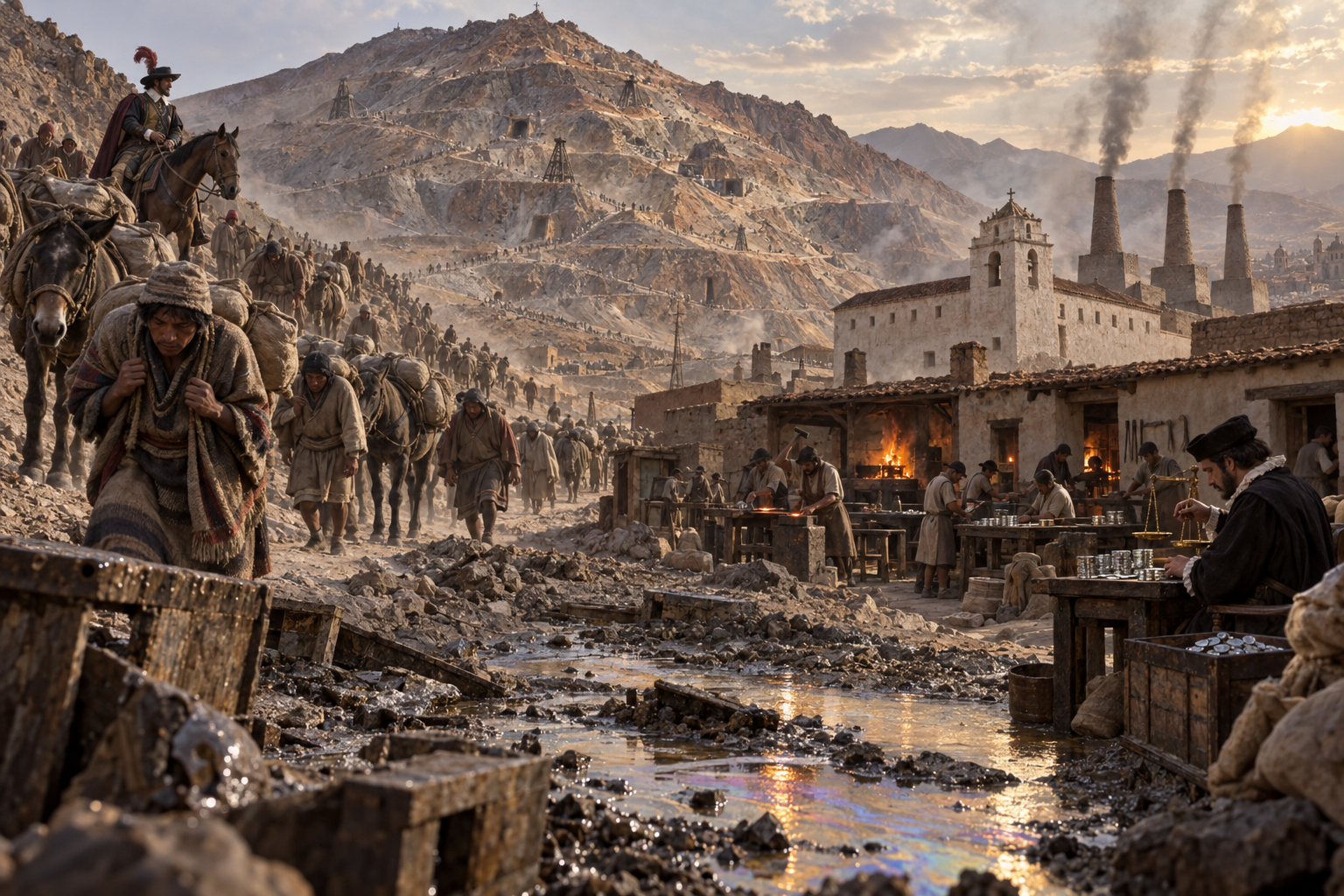
When rich veins of silver were found high in the Andes in the mid‑16th century, the effect was immediate and strange. Whole mountains like Cerro Rico at Potosí were turned into factories: shafts, smelters, and a constant procession of mule trains carrying ore down to colonial mints. The Spanish crown pumped that metal into coinage and credit, and from there it flowed outward, not just as treasure but as the lubricant of an expanding global economy.

The work that produced those coins was brutal and costly. Indigenous labor systems were repurposed into colonial drafts; mercury was used to extract silver from ore, leaving long‑lasting contamination in soils and waterways. Mines swelled into cities almost overnight. Potosí itself—squalid, glittering, dangerous—became a hub where wealth and misery coexisted in the same narrow streets.

Silver Meets the World

What made this era more than a local boom was the pattern of movement. Much of the Spanish silver did not stay in Europe. Ships carried metal across the Atlantic and then over the Pacific from Acapulco to Manila. Asian markets—especially China—absorbed vast quantities of silver in exchange for silks, porcelains, and spices. The result was a new, transoceanic circuit: American mines, European coinage, and Asian manufactures all linked by the same metal.

That circuit reordered value. European economies saw new sources of credit and consumer goods, while Asian suppliers found a steady, hard‑currency market for their wares. At the same time, the sheer influx of silver helped push prices upward in Europe, a slow inflation that historians associate with changing money supplies and consumer patterns across the continent.

Consequences Beyond Commerce

The silver era reshaped more than trade balances. It altered governance and finance: royal budgets swelled and then strained as crowns borrowed against future shipments; mercantile networks grew more complex; and financial instruments matured to move and insure that metal. Environmental change followed the miners—landscapes scarred by extraction, rivers tainted by mercury, and forests cut for charcoal.

Socially, the makeshift towns at mine mouths attracted artisans, traders, and fortune‑seekers from many lands, creating cosmopolitan but unstable communities. Meanwhile, the human cost—forced labor, high mortality in mines, and long‑term ecological harm—left legacies that lasted centuries.

Conclusion

The Age of Silver was not a neat episode but a pivot: a material force that turned local discoveries into global patterns. The metal connected distant markets, fueled state ambitions, and left visible marks on landscapes and lives. Look for it in a Spanish coin, a Ming porcelain bowl, or the ruined terraces of a Bolivian mountain—each is a small remnant of a time when a handful of ore could reorder the map of exchange.
Previous Post

The Pirate Who Built a Kingdom: Ching Shih’s Unlikely Reign

Next Post

Mamluk Cairo: How Slave-Soldiers Built an Empire

Related Posts

Mamluk Cairo: How Slave-Soldiers Built an Empire
Eras

Mamluk Cairo: How Slave-Soldiers Built an Empire

September 26, 2026
When Coal Met Neon: Cities Between the Wars
Eras

When Coal Met Neon: Cities Between the Wars

September 21, 2026
How the Gregorian Calendar Remade Europe’s Year
Eras

How the Gregorian Calendar Remade Europe’s Year

September 21, 2026
Edo: Japan’s Urban Revolution of Lanterns and Printshops
Eras

Edo: Japan’s Urban Revolution of Lanterns and Printshops

September 16, 2026
Next Post
Mamluk Cairo: How Slave-Soldiers Built an Empire

Mamluk Cairo: How Slave-Soldiers Built an Empire

Search..

No Result
View All Result

Recent Articles

Mamluk Cairo: How Slave-Soldiers Built an Empire

Mamluk Cairo: How Slave-Soldiers Built an Empire

September 26, 2026
The Age of Silver: How New World Mines Remade Trade

The Age of Silver: How New World Mines Remade Trade

September 26, 2026
The Pirate Who Built a Kingdom: Ching Shih’s Unlikely Reign

The Pirate Who Built a Kingdom: Ching Shih’s Unlikely Reign

September 25, 2026
The Spy Who Changed Yorktown: James Armistead Lafayette

The Spy Who Changed Yorktown: James Armistead Lafayette

September 25, 2026
The Strasbourg Dancing Plague: When People Couldn’t Stop Dancing

The Strasbourg Dancing Plague: When People Couldn’t Stop Dancing

September 24, 2026

Subscribe Us

By clicking submit, I authorize History Ours and its affiliated companies to: (1) use, sell, and share my information for marketing purposes, including cross-context behavioral advertising, as described in our Terms of Service and Privacy Policy, (2) supplement the information that I provide with additional information lawfully obtained from other sources, like demographic data from public sources, interests inferred from web page views, or other data relevant to what might interest me, like past purchase or location data, (3) contact me or enable others to contact me by email with offers for goods and services from any category at the email address provided, and (4) retain my information while I am engaging with marketing messages that I receive and for a reasonable amount of time thereafter. I understand I can opt out at any time through an email that I receive, or by clicking here

Subscribe To Our Newsletter

By clicking submit, I authorize History Ours and its affiliated companies to: (1) use, sell, and share my information for marketing purposes, including cross-context behavioral advertising, as described in our Terms of Service and Privacy Policy, (2) supplement the information that I provide with additional information lawfully obtained from other sources, like demographic data from public sources, interests inferred from web page views, or other data relevant to what might interest me, like past purchase or location data, (3) contact me or enable others to contact me by email with offers for goods and services from any category at the email address provided, and (4) retain my information while I am engaging with marketing messages that I receive and for a reasonable amount of time thereafter. I understand I can opt out at any time through an email that I receive, or by clicking here.

© 2026 History Ours | All Rights Reserved

  • Contact Us
  • Privacy Policy
  • Terms of Service
  • Unsubscribe
  • Privacy Choices
  • Contact Us
  • Privacy Policy
  • Terms of Service
  • Unsubscribe
  • Privacy Choices

© 2026 History Ours | All Rights Reserved

No Result
View All Result
  • Home
  • History
  • Biographies
  • Eras
  • Regions
  • Timeline

© 2026 History Ours | All Rights Reserved

Skip to content
Open toolbar Accessibility Tools

Accessibility Tools

  • Increase TextIncrease Text
  • Decrease TextDecrease Text
  • GrayscaleGrayscale
  • High ContrastHigh Contrast
  • Negative ContrastNegative Contrast
  • Light BackgroundLight Background
  • Links UnderlineLinks Underline
  • Readable FontReadable Font
  • Reset Reset