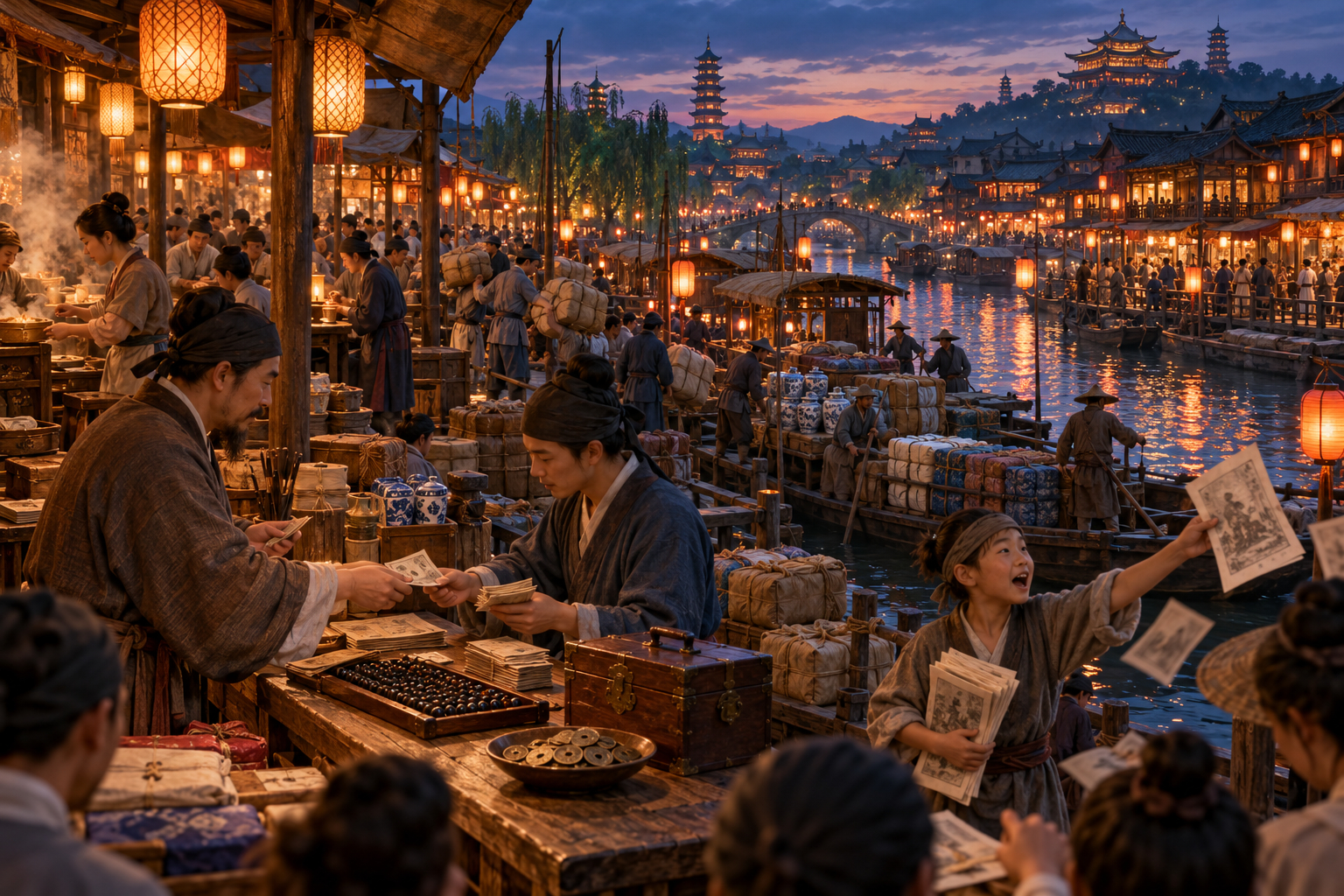
Walk into a Song dynasty market and you would find a world that looks surprisingly modern: crowded streets, shops open after dusk, teahouses filled with gossip, and printed pamphlets hawked by boys. Between 960 and 1279, China under the Song dynasty became intensely urban and commercial. Capitals like Kaifeng and, after 1127, Hangzhou swelled into cities of hundreds of thousands—by some estimates, over a million residents in the largest hubs—where artisans, clerks, and itinerant merchants created a dense public life uncommon in most contemporary societies.
Moneyed markets and a boom in trade
What made those cities hum was an economy moving faster than coins could keep up with. The Song state and private firms began using paper money and early credit instruments to speed transactions. Jiaozi and later government-issued notes allowed merchants to transfer value without lugging heavy copper cash across the countryside. Coastal trade expanded too: porcelain, tea, and silk traveled on ocean routes that increasingly linked Song ports to Southeast Asia and the Indian Ocean. Inland, canals and rivers—stretched, upgraded, and regulated during this period—kept grain and salt flowing into the cities, underpinning both population growth and the tastes of urban consumers.
Inventing new tools of power
The Song were prolific innovators. Movable type printing emerged in the eleventh century, making books cheaper and accelerating literacy among officials and merchants. The magnetic compass and improved ship construction helped merchants push farther seaward. Metallurgy and chemical experimentation produced stronger iron goods and new military technologies: gunpowder was adapted into grenades and flamethrowers long before the gun became dominant in other parts of the world. At the same time, a vast civil service—filled via competitive examinations—created a literate bureaucracy that managed markets, canals, and taxes, and produced an intense culture of scholarship. Thinkers in the Southern Song began reshaping Confucian ideas into what later historians call Neo-Confucianism, offering moral frameworks suited to an increasingly commercial society.
Conclusion
The Song era feels like a crossroad: old agrarian patterns persisted, yet a market-driven, urban future was already visible in streets and offices. Its innovations in money, transport, printing, and maritime trade rewired daily life and set precedents for later global exchanges. Military setbacks and the dynasty’s fall to Mongol forces in 1279 ended the political story, but many of the Song’s economic and cultural changes continued to shape East Asia for centuries—proof that sometimes the most consequential revolutions are quieter, happening in marketplaces and workshops rather than on battlefields.