Uncover History’s Secrets with Daily Updates!
Daily News Entertainment
  • Home
  • History
  • Biographies
  • Eras
  • Regions
  • Timeline
No Result
View All Result
History Ours
  • Home
  • History
  • Biographies
  • Eras
  • Regions
  • Timeline
No Result
View All Result
History Ours
No Result
View All Result
Home Eras

The Postwar Era: Rebuilding a Broken World

in Eras
The Postwar Era: Rebuilding a Broken World

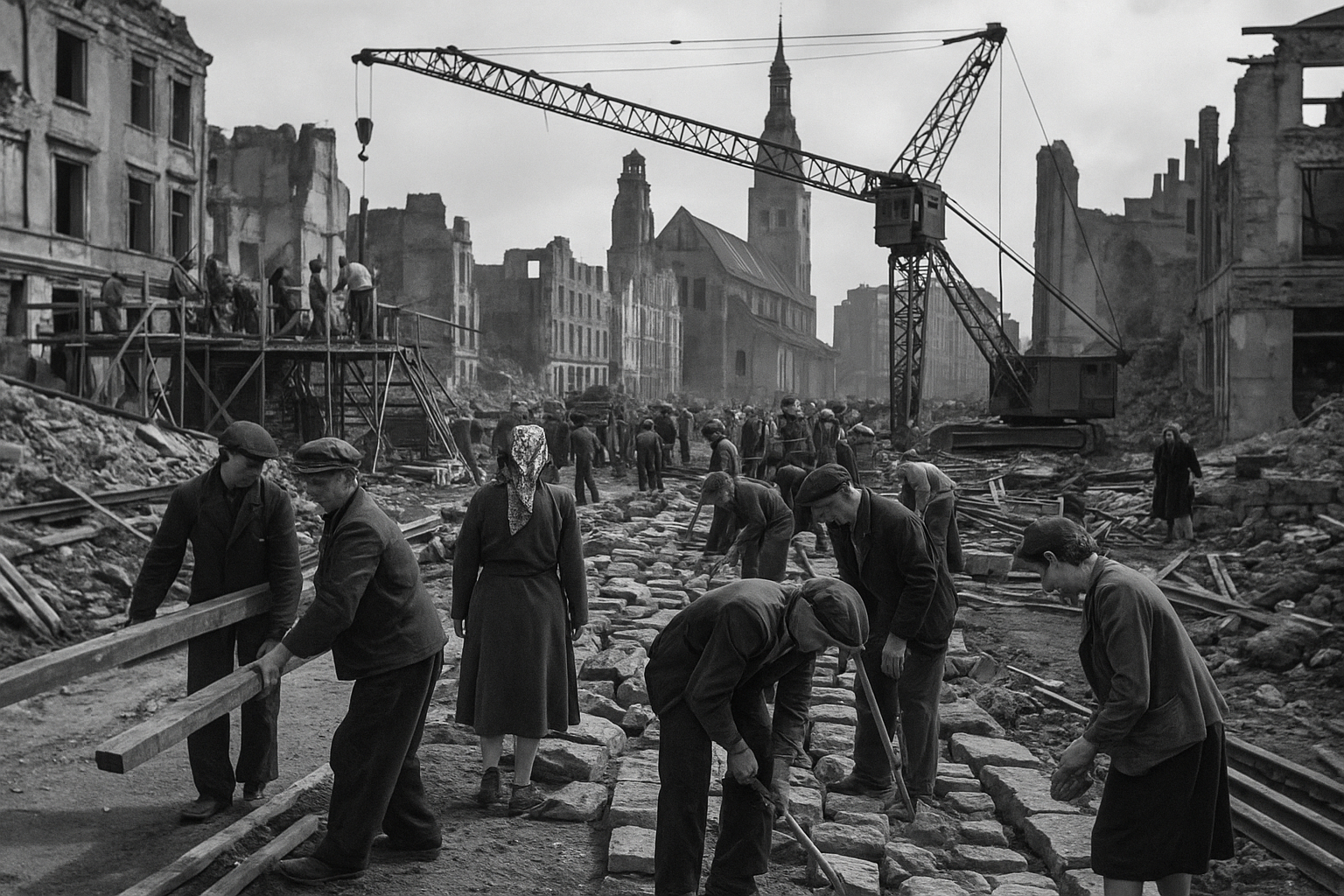
The end of World War II in 1945 marked not only the cessation of one of humanity’s darkest chapters but also the beginning of a monumental journey toward recovery. The world stood in ruins — cities destroyed, economies shattered, and societies divided. Yet, amid the devastation, nations found the resilience to rebuild, cooperate, and redefine the future. The postwar era became a period of renewal, innovation, and hope, shaping the modern world as we know it today.

Reconstruction and Recovery

The immediate aftermath of the war saw vast destruction across Europe and Asia. Millions were displaced, and infrastructure lay in ruins. In response, international efforts such as the Marshall Plan provided economic aid to rebuild war-torn nations, particularly in Western Europe. This initiative not only restored economies but also strengthened democratic institutions and promoted unity among nations.

Meanwhile, in Asia, countries like Japan and South Korea underwent rapid transformation, shifting from devastated economies to industrial powerhouses through a combination of foreign aid, reform, and innovation. These reconstruction efforts demonstrated the power of collaboration and perseverance in overcoming global adversity.

The Birth of Global Institutions

The postwar era also witnessed the creation of new international organizations designed to promote peace and cooperation. The United Nations (UN) was established in 1945 with the mission of preventing future conflicts and fostering global dialogue. Financial and economic stability were supported by institutions such as the International Monetary Fund (IMF) and the World Bank, which aimed to encourage global trade and development.

These organizations reflected humanity’s collective determination to create systems of governance that could sustain peace and prosperity on a global scale — lessons learned from the failures that preceded the war.

Social and Cultural Transformation

As nations rebuilt, societies began to change as well. The war had challenged traditional gender roles, as millions of women had entered the workforce during wartime. After the conflict, many continued to pursue employment and education, laying the foundation for future social movements.

The postwar years also saw a surge in art, music, and literature that reflected both trauma and renewal. Movements such as abstract expressionism and existentialism emerged as creative expressions of a world seeking meaning after chaos. At the same time, consumer culture began to rise, fueled by economic growth and technological progress.

The Cold War Divide

However, the postwar recovery was not without tension. As Western democracies and communist states emerged as superpowers, ideological conflict gave rise to the Cold War. The world became divided between two blocs — the U.S.-led capitalist West and the Soviet-led communist East. Despite this rivalry, competition in science, technology, and space exploration led to remarkable advancements, including the dawn of the Space Age.

This global standoff defined international relations for decades, influencing politics, military strategy, and even popular culture.

Legacy of the Postwar Era

By the 1960s, much of the industrialized world had not only recovered but had entered a period of unprecedented growth and innovation. The postwar years laid the groundwork for globalization, modern democracy, and the interconnected economies of today.

Out of the ashes of destruction, humanity had proven its capacity for renewal — driven by cooperation, resilience, and vision. The rebuilding of a broken world became a testament to hope and human ingenuity.

Conclusion

The postwar era was more than just a time of reconstruction — it was a reawakening of humanity’s collective spirit. Nations rebuilt cities, redefined identities, and reshaped the global order. From devastation emerged a renewed sense of purpose, unity, and possibility.

In rebuilding a broken world, the postwar generation did more than restore what was lost — they built a foundation for a future defined by peace, progress, and perseverance.
Previous Post

Napoleon Bonaparte: The Rise and Fall of an Emperor

Next Post

The Cold War Era: Tension, Technology, and Triumph

Related Posts

Pax Mongolica: How Mongol Rule Rewired the Old World
Eras

Pax Mongolica: How Mongol Rule Rewired the Old World

September 15, 2026
Life Under the Tokugawa: How Edo Japan Rewrote Social Order
Eras

Life Under the Tokugawa: How Edo Japan Rewrote Social Order

September 15, 2026
When Empires Fell: The Late Bronze Age Collapse
Eras

When Empires Fell: The Late Bronze Age Collapse

September 15, 2026
1816: How a Volcano Turned Summer Into Crisis
Eras

1816: How a Volcano Turned Summer Into Crisis

September 15, 2026
Next Post
The Cold War Era: Tension, Technology, and Triumph

The Cold War Era: Tension, Technology, and Triumph

Search..

No Result
View All Result

Recent Articles

The Disguise That Broke Chains: Ellen and William Craft

The Disguise That Broke Chains: Ellen and William Craft

September 15, 2026
Bass Reeves: The Marshal Who Hunted Outlaws in Indian Territory

Bass Reeves: The Marshal Who Hunted Outlaws in Indian Territory

September 15, 2026
How the Crystal Palace Turned Glass and Iron into a Modern Stage

How the Crystal Palace Turned Glass and Iron into a Modern Stage

September 15, 2026
Anne Bonny: The Pirate Who Broke Rules and Expectations

Anne Bonny: The Pirate Who Broke Rules and Expectations

September 15, 2026
How Haiti Broke Its Chains: A 1791–1804 Timeline

How Haiti Broke Its Chains: A 1791–1804 Timeline

September 15, 2026

Subscribe Us

By clicking submit, I authorize History Ours and its affiliated companies to: (1) use, sell, and share my information for marketing purposes, including cross-context behavioral advertising, as described in our Terms of Service and Privacy Policy, (2) supplement the information that I provide with additional information lawfully obtained from other sources, like demographic data from public sources, interests inferred from web page views, or other data relevant to what might interest me, like past purchase or location data, (3) contact me or enable others to contact me by email with offers for goods and services from any category at the email address provided, and (4) retain my information while I am engaging with marketing messages that I receive and for a reasonable amount of time thereafter. I understand I can opt out at any time through an email that I receive, or by clicking here

Subscribe To Our Newsletter

By clicking submit, I authorize History Ours and its affiliated companies to: (1) use, sell, and share my information for marketing purposes, including cross-context behavioral advertising, as described in our Terms of Service and Privacy Policy, (2) supplement the information that I provide with additional information lawfully obtained from other sources, like demographic data from public sources, interests inferred from web page views, or other data relevant to what might interest me, like past purchase or location data, (3) contact me or enable others to contact me by email with offers for goods and services from any category at the email address provided, and (4) retain my information while I am engaging with marketing messages that I receive and for a reasonable amount of time thereafter. I understand I can opt out at any time through an email that I receive, or by clicking here.

© 2026 History Ours | All Rights Reserved

  • Contact Us
  • Privacy Policy
  • Terms of Service
  • Unsubscribe
  • Privacy Choices
  • Contact Us
  • Privacy Policy
  • Terms of Service
  • Unsubscribe
  • Privacy Choices

© 2026 History Ours | All Rights Reserved

No Result
View All Result
  • Home
  • History
  • Biographies
  • Eras
  • Regions
  • Timeline

© 2026 History Ours | All Rights Reserved

Skip to content
Open toolbar Accessibility Tools

Accessibility Tools

  • Increase TextIncrease Text
  • Decrease TextDecrease Text
  • GrayscaleGrayscale
  • High ContrastHigh Contrast
  • Negative ContrastNegative Contrast
  • Light BackgroundLight Background
  • Links UnderlineLinks Underline
  • Readable FontReadable Font
  • Reset Reset