Uncover History’s Secrets with Daily Updates!
Daily News Entertainment
  • Home
  • History
  • Biographies
  • Eras
  • Regions
  • Timeline
No Result
View All Result
History Ours
  • Home
  • History
  • Biographies
  • Eras
  • Regions
  • Timeline
No Result
View All Result
History Ours
No Result
View All Result
Home History

Networks of Inland Trade: Roads, Rivers, and Markets

in History
Networks of Inland Trade: Roads, Rivers, and Markets

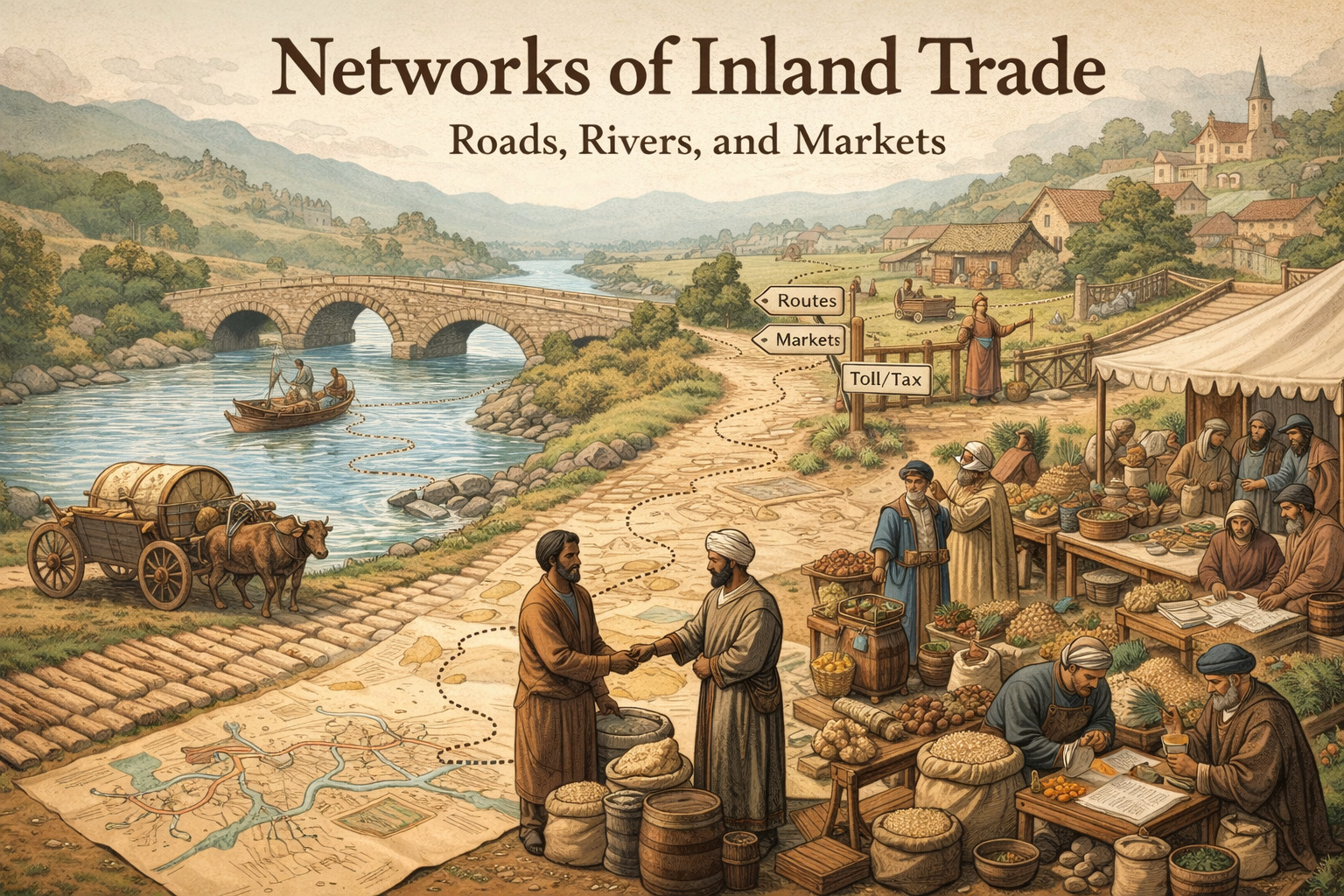
Networks of inland trade created the connective tissue between settlements long before modern transport systems emerged. They combined engineered roads, navigable rivers, and seasonal tracks that responded to local terrain and climate. Merchants, carriers, and municipal authorities negotiated rights, tolls, and safe passage to keep goods moving. Studying these pathways helps explain how modest exchanges scaled into regional economies and social systems.

Routes and infrastructure

Early trade routes were pragmatic adaptations to geography, using river corridors where possible and improving overland tracks with simple engineering. Communities invested in bridges, causeways, and waystations to reduce travel time and risk, often relying on local labor and materials. Corduroy roads, packed gravel, and maintained river channels show a spectrum of low-cost interventions that mattered to everyday users. The continuity of a route depended as much on maintenance and local cooperation as on initial construction.

Marketplaces and social exchange

Markets acted as predictable nodes where producers and consumers met, and they shaped settlement patterns and seasonal rhythms. These marketplaces were venues for price formation, credit arrangements, and the exchange of news and customs, not just merchandise. Many towns developed legal frameworks around weekly markets and annual fairs to regulate weights, to resolve disputes, and to attract long-distance trade. Over time, markets fostered specialization and encouraged artisans and providers to cluster near trade nodes.

– Markets often followed agricultural cycles and pilgrimage routes, maximizing attendance.
– Local authorities collected tolls or fees that funded infrastructure and security.
– Merchant networks used informal credit and reputation systems before formal banking arose.

These practical arrangements reinforced trust while smoothing transactions across linguistic and cultural boundaries. Even modest market towns could amplify regional production by linking smallholders to broader demand.

Statecraft, technology, and regulation

States and authorities shaped inland trade through road-building programs, river control works, and tariff policies that incentivized or restricted movement. Technological shifts, such as improved cart design or better boat hulls, reduced transport costs and extended market reach. Regulation ranged from standardizing measures to policing routes against banditry, and effective enforcement often determined a corridor’s viability. The interplay of innovation, investment, and governance produced durable advantages for regions that coordinated these elements well.

Conclusion

Inland trade networks reflect choices about infrastructure, markets, and governance that accumulate over generations. Small investments in roads, riverworks, and marketplaces produced outsized economic and social returns across regions. Understanding these networks gives a clearer view of how everyday exchange shaped historical development.


Previous Post

From Fires to Fiber: Stages in Human Communication Systems

Next Post

Practices of Message Delivery Before Modern Postal Systems

Related Posts

How the Crystal Palace Turned Glass and Iron into a Modern Stage
History

How the Crystal Palace Turned Glass and Iron into a Modern Stage

September 15, 2026
Anne Bonny: The Pirate Who Broke Rules and Expectations
History

Anne Bonny: The Pirate Who Broke Rules and Expectations

September 15, 2026
Mary Anning and the Coast That Revealed Lost Worlds
History

Mary Anning and the Coast That Revealed Lost Worlds

September 15, 2026
When Mount Pelée Erased Saint-Pierre, 1902
History

When Mount Pelée Erased Saint-Pierre, 1902

September 15, 2026
Next Post
Practices of Message Delivery Before Modern Postal Systems

Practices of Message Delivery Before Modern Postal Systems

Search..

No Result
View All Result

Recent Articles

The Disguise That Broke Chains: Ellen and William Craft

The Disguise That Broke Chains: Ellen and William Craft

September 15, 2026
Bass Reeves: The Marshal Who Hunted Outlaws in Indian Territory

Bass Reeves: The Marshal Who Hunted Outlaws in Indian Territory

September 15, 2026
How the Crystal Palace Turned Glass and Iron into a Modern Stage

How the Crystal Palace Turned Glass and Iron into a Modern Stage

September 15, 2026
Anne Bonny: The Pirate Who Broke Rules and Expectations

Anne Bonny: The Pirate Who Broke Rules and Expectations

September 15, 2026
How Haiti Broke Its Chains: A 1791–1804 Timeline

How Haiti Broke Its Chains: A 1791–1804 Timeline

September 15, 2026

Subscribe Us

By clicking submit, I authorize History Ours and its affiliated companies to: (1) use, sell, and share my information for marketing purposes, including cross-context behavioral advertising, as described in our Terms of Service and Privacy Policy, (2) supplement the information that I provide with additional information lawfully obtained from other sources, like demographic data from public sources, interests inferred from web page views, or other data relevant to what might interest me, like past purchase or location data, (3) contact me or enable others to contact me by email with offers for goods and services from any category at the email address provided, and (4) retain my information while I am engaging with marketing messages that I receive and for a reasonable amount of time thereafter. I understand I can opt out at any time through an email that I receive, or by clicking here

Subscribe To Our Newsletter

By clicking submit, I authorize History Ours and its affiliated companies to: (1) use, sell, and share my information for marketing purposes, including cross-context behavioral advertising, as described in our Terms of Service and Privacy Policy, (2) supplement the information that I provide with additional information lawfully obtained from other sources, like demographic data from public sources, interests inferred from web page views, or other data relevant to what might interest me, like past purchase or location data, (3) contact me or enable others to contact me by email with offers for goods and services from any category at the email address provided, and (4) retain my information while I am engaging with marketing messages that I receive and for a reasonable amount of time thereafter. I understand I can opt out at any time through an email that I receive, or by clicking here.

© 2026 History Ours | All Rights Reserved

  • Contact Us
  • Privacy Policy
  • Terms of Service
  • Unsubscribe
  • Privacy Choices
  • Contact Us
  • Privacy Policy
  • Terms of Service
  • Unsubscribe
  • Privacy Choices

© 2026 History Ours | All Rights Reserved

No Result
View All Result
  • Home
  • History
  • Biographies
  • Eras
  • Regions
  • Timeline

© 2026 History Ours | All Rights Reserved

Skip to content
Open toolbar Accessibility Tools

Accessibility Tools

  • Increase TextIncrease Text
  • Decrease TextDecrease Text
  • GrayscaleGrayscale
  • High ContrastHigh Contrast
  • Negative ContrastNegative Contrast
  • Light BackgroundLight Background
  • Links UnderlineLinks Underline
  • Readable FontReadable Font
  • Reset Reset