

Uncover History’s Secrets with Daily Updates!
Daily News Entertainment
  • Home
  • History
  • Biographies
  • Eras
  • Regions
  • Timeline
No Result
View All Result
History Ours
  • Home
  • History
  • Biographies
  • Eras
  • Regions
  • Timeline
No Result
View All Result
History Ours
No Result
View All Result
Home History

Small Town Marketwomen and the Making of Urban Society

in History
Small Town Marketwomen and the Making of Urban Society

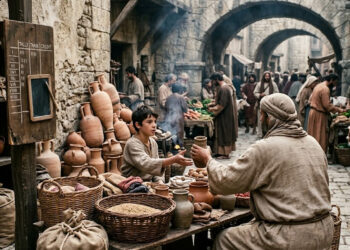
In many small towns, marketwomen composed a visible and essential workforce whose labor structured daily life and exchange. They managed stalls, negotiated supply, and mediated relationships between producers and consumers. Their presence shaped rhythms of work, gossip, and civic visibility in public spaces. Understanding these women illuminates how informal economies sustained urban society beyond formal institutions.

Daily Roles and Economic Impact

Marketwomen offered a range of services from selling produce to coordinating deliveries and credit arrangements with regular clients. Their activities were not only commercial but also social: they shared news, organized help for neighbors, and regulated standards through reputation. Economic historians argue that these practices reduced transaction costs and smoothed seasonal scarcity in ways formal markets often could not. Through barter, small loans, and measured trust, marketwomen sustained household consumption and local supply chains.

These daily roles made marketwomen indispensable to town resilience. Their economic impact extended beyond simple sales to the maintenance of social order and provision.

Networks, Authority, and Informal Governance

Beyond stalls, marketwomen formed dense networks that functioned as a form of informal governance. Senior sellers often arbitrated disputes, monitored quality, and enforced unwritten norms among peers and customers. Their authority rested on experience, personal relationships, and the visibility of public trade rather than formal office. This networked power allowed women to influence pricing, supply routes, and seasonal labor distribution.

By exercising such authority, marketwomen shaped how markets adapted to shocks like crop failures or shifting demand. Their coordination made towns more adaptable and socially cohesive.

Spaces, Visibility, and Everyday Culture

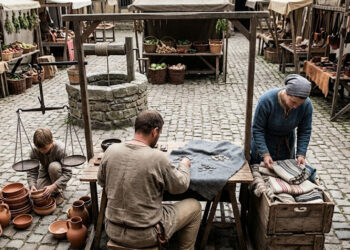
Physical places — market squares, lanes, and thresholds — were organized around female labor and the goods they sold. Stalls and shopfronts became stages of negotiation where customs, culinary tastes, and fashions circulated. The visibility of marketwomen also created occasions for political expression and collective action, from petitions to charitable drives. Material culture such as scales, baskets, and price lists reflected a practical literacy central to urban life.

Spatial practices reinforced social ties and gave the market a cultural identity recognized across neighborhoods. The everyday culture cultivated at these sites influenced broader civic life and memory.

Legacies and Sources

Historians draw on court records, account books, and travelers’ journals to reconstruct the lives of marketwomen, but material traces also matter: kitchens, stalls, and objects preserve evidence of practice. Oral histories and local chronicles can reveal nicknames, reputations, and networks that formal archives overlook. Interdisciplinary approaches combining archaeology, anthropology, and economic history help recover the everyday strategies these women used. Such sources show continuity in gendered labor practices and the adaptability of market economies over time.

Recognizing these legacies encourages more inclusive histories of urban life. It also challenges assumptions about where authority and innovation originated in small towns.

Conclusion

Recognizing the centrality of marketwomen reshapes our understanding of historic towns and economies. Their blend of commerce, care, and local governance underpinned community stability. Studying their work reveals the informal mechanisms that kept urban life functioning.

Previous Post

Trades, Taverns, and Neighborhood Life in Early Towns

Next Post

Biographical Timelines: Building Lives Through Everyday Details

Related Posts

Trades, Taverns, and Neighborhood Life in Early Towns
History

Trades, Taverns, and Neighborhood Life in Early Towns

August 28, 2026
Urban Markets and the Making of Early Communities
History

Urban Markets and the Making of Early Communities

August 28, 2026
Hidden Networks: How Local Trade Shaped Early Cities
History

Hidden Networks: How Local Trade Shaped Early Cities

August 28, 2026
Routes, Routines, and Community on Historic Market Streets
History

Routes, Routines, and Community on Historic Market Streets

August 15, 2026
Next Post
Biographical Timelines: Building Lives Through Everyday Details

Biographical Timelines: Building Lives Through Everyday Details

Search..

No Result
View All Result

Recent Articles

How Oysters Shaped the Chesapeake’s Past and Present

How Oysters Shaped the Chesapeake’s Past and Present

August 28, 2026
Corsica’s Rocky Turn: Genoese Towers, Paoli, and an Island’s Identity

Corsica’s Rocky Turn: Genoese Towers, Paoli, and an Island’s Identity

August 28, 2026
Mapping Cultural Layers Across Distinct Regional Landscapes

Mapping Cultural Layers Across Distinct Regional Landscapes

August 28, 2026
Everyday Experience in Medieval Market Towns

Everyday Experience in Medieval Market Towns

August 28, 2026
Daily Life and Change During the Industrial Era

Daily Life and Change During the Industrial Era

August 28, 2026

Subscribe Us

By clicking submit, I authorize History Ours and its affiliated companies to: (1) use, sell, and share my information for marketing purposes, including cross-context behavioral advertising, as described in our Terms of Service and Privacy Policy, (2) supplement the information that I provide with additional information lawfully obtained from other sources, like demographic data from public sources, interests inferred from web page views, or other data relevant to what might interest me, like past purchase or location data, (3) contact me or enable others to contact me by email with offers for goods and services from any category at the email address provided, and (4) retain my information while I am engaging with marketing messages that I receive and for a reasonable amount of time thereafter. I understand I can opt out at any time through an email that I receive, or by clicking here

Subscribe To Our Newsletter

By clicking submit, I authorize History Ours and its affiliated companies to: (1) use, sell, and share my information for marketing purposes, including cross-context behavioral advertising, as described in our Terms of Service and Privacy Policy, (2) supplement the information that I provide with additional information lawfully obtained from other sources, like demographic data from public sources, interests inferred from web page views, or other data relevant to what might interest me, like past purchase or location data, (3) contact me or enable others to contact me by email with offers for goods and services from any category at the email address provided, and (4) retain my information while I am engaging with marketing messages that I receive and for a reasonable amount of time thereafter. I understand I can opt out at any time through an email that I receive, or by clicking here.

© 2026 History Ours | All Rights Reserved

  • Contact Us
  • Privacy Policy
  • Terms of Service
  • Unsubscribe
  • Privacy Choices
  • Contact Us
  • Privacy Policy
  • Terms of Service
  • Unsubscribe
  • Privacy Choices

© 2026 History Ours | All Rights Reserved

No Result
View All Result
  • Home
  • History
  • Biographies
  • Eras
  • Regions
  • Timeline

© 2026 History Ours | All Rights Reserved

Skip to content
Open toolbar Accessibility Tools

Accessibility Tools

  • Increase TextIncrease Text
  • Decrease TextDecrease Text
  • GrayscaleGrayscale
  • High ContrastHigh Contrast
  • Negative ContrastNegative Contrast
  • Light BackgroundLight Background
  • Links UnderlineLinks Underline
  • Readable FontReadable Font
  • Reset Reset