
Uncover History’s Secrets with Daily Updates!
Daily News Entertainment
  • Home
  • History
  • Biographies
  • Eras
  • Regions
  • Timeline
No Result
View All Result
History Ours
  • Home
  • History
  • Biographies
  • Eras
  • Regions
  • Timeline
No Result
View All Result
History Ours
No Result
View All Result
Home History

The Halifax Explosion: The Blast That Shattered a City

in History
The Halifax Explosion: The Blast That Shattered a City

The Day the Harbor Turned to Fire

On the morning of December 6, 1917, Halifax’s busy harbor looked like any wartime port: convoys, tugs, and freighters threading a narrow entrance. Two ships misread each other’s moves. The Norwegian vessel Imo and the French munitions ship Mont‑Blanc collided in the Narrows. The Mont‑Blanc was not carrying ordinary cargo. Within minutes a fire broke out on her decks. Dockworkers and passing sailors fled as the blaze ran up amid crates and drums of explosives.

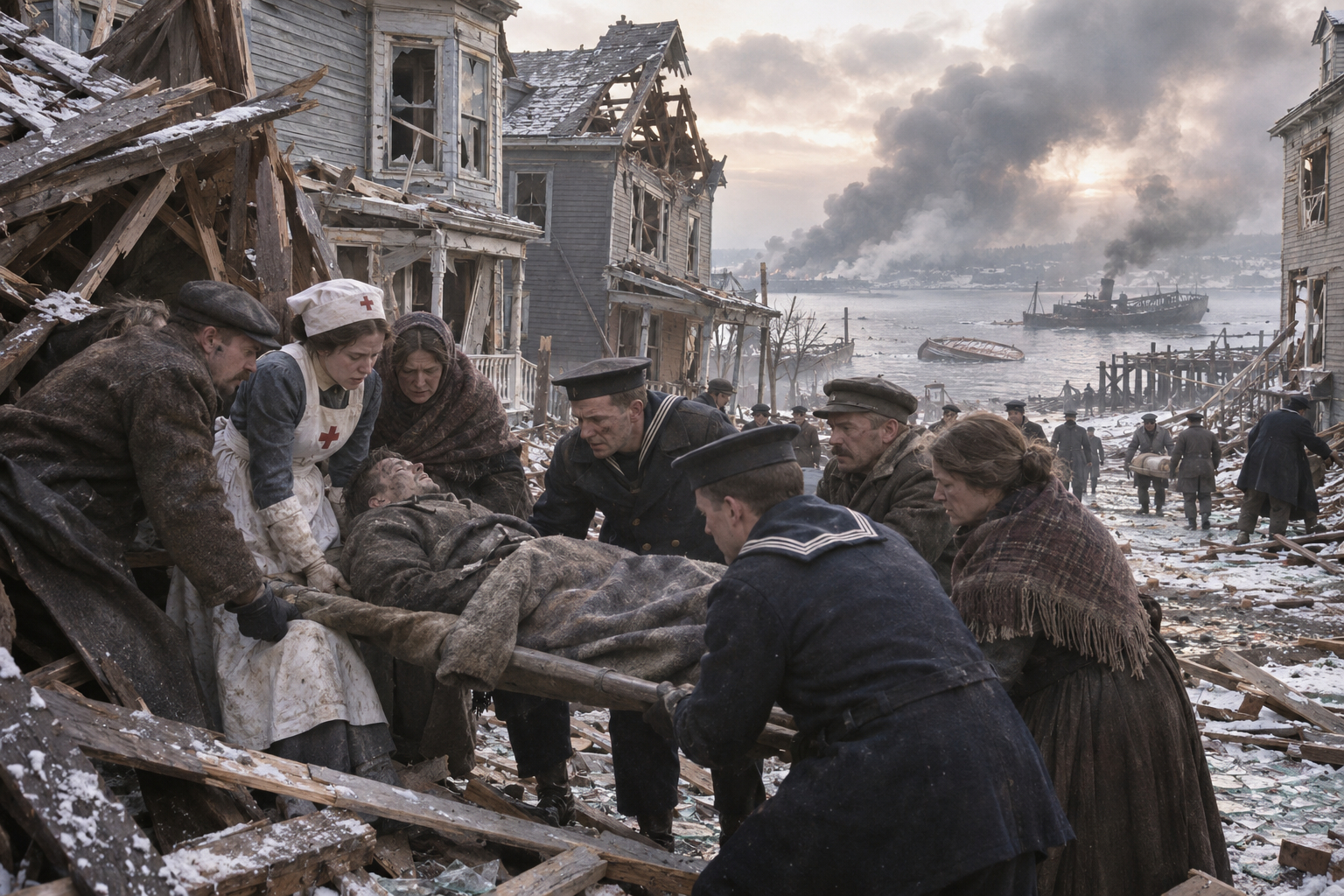
At 9:04 a.m. the ship detonated. A single blast leveled neighborhoods in the Richmond district, sent a shock wave across the harbor, and blew windows out for miles. Buildings that had stood for decades were reduced to splinters. The initial count is grim: roughly 2,000 people were killed and about 9,000 injured. Thousands more were left homeless overnight; entire streets became scenes of ruin and confusion.

Why One Ship Could Devastate a City

The destructive power lay in what the Mont‑Blanc carried: high explosives and volatile chemicals packed for war. TNT, picric acid, guncotton and barrels of benzol fed a blast and ensuing fires unlike anything Halifax had seen. The explosion’s force hurled heavy timbers and metal through the air and produced a wave in the harbor that swept people and debris ashore.

Contemporaries and later investigators noted the scale: until the atomic age, this was likely the largest human-made explosion. It was not just the blast but its combination with fire, flying shrapnel, collapsing buildings and the cold December weather that turned rescue into chaos. Many victims were cut by glass; others suffocated under timbers. Emergency facilities were overwhelmed within minutes.

Rescue, Censorship, and an Unlikely Lifeline from Boston

Wartime conditions complicated the response. Authorities immediately controlled information and movement, worried that news of the harbor disaster would aid enemy submarines. That censorship delayed wider reporting but did not stop neighbors from pulling survivors from the wreckage or the hospitals from filling with the injured.

One of the clearest human stories after the blast was the swift help from Boston. Within hours volunteers organized relief trains carrying doctors, nurses, food and blankets. The generosity—treating people who had lost everything in freezing weather—helped bind the two cities’ histories together. Halifax rebuilt, particularly the North End, which rose again with straighter streets and new brick houses.

Conclusion

More than a century later the Halifax Explosion remains a touchstone for urban disasters: an accident that exposed how fragile a modern, industrial city could be when explosive materials met a crowded waterfront. Plaques and museum exhibits mark the places and names, but the memory endures most sharply in the stories of neighbors who reached into the smoke to pull each other free.


Previous Post

The Dhow Age: How Lateen Sails Connected the Indian Ocean

Related Posts

The Trent Affair: How a Diplomatic Snag Nearly Brought Britain In
History

The Trent Affair: How a Diplomatic Snag Nearly Brought Britain In

November 21, 2026
The Matchgirls’ Revolt: Women Who Struck Back in 1888
History

The Matchgirls’ Revolt: Women Who Struck Back in 1888

November 18, 2026
Tulipmania: How a Flower Became Holland’s First Bubble
History

Tulipmania: How a Flower Became Holland’s First Bubble

November 18, 2026
The Defenestration That Ignited the Thirty Years’ War
History

The Defenestration That Ignited the Thirty Years’ War

November 13, 2026

Search..

No Result
View All Result

Recent Articles

The Halifax Explosion: The Blast That Shattered a City

The Halifax Explosion: The Blast That Shattered a City

November 23, 2026
The Dhow Age: How Lateen Sails Connected the Indian Ocean

The Dhow Age: How Lateen Sails Connected the Indian Ocean

November 23, 2026
Isabella Stewart Gardner: Boston’s Provocative Collector and Her Museum

Isabella Stewart Gardner: Boston’s Provocative Collector and Her Museum

November 22, 2026
The Erie Canal: A Waterway That Built New York

The Erie Canal: A Waterway That Built New York

November 22, 2026
The Trent Affair: How a Diplomatic Snag Nearly Brought Britain In

The Trent Affair: How a Diplomatic Snag Nearly Brought Britain In

November 21, 2026

Subscribe Us

By clicking submit, I authorize History Ours and its affiliated companies to: (1) use, sell, and share my information for marketing purposes, including cross-context behavioral advertising, as described in our Terms of Service and Privacy Policy, (2) supplement the information that I provide with additional information lawfully obtained from other sources, like demographic data from public sources, interests inferred from web page views, or other data relevant to what might interest me, like past purchase or location data, (3) contact me or enable others to contact me by email with offers for goods and services from any category at the email address provided, and (4) retain my information while I am engaging with marketing messages that I receive and for a reasonable amount of time thereafter. I understand I can opt out at any time through an email that I receive, or by clicking here

Subscribe To Our Newsletter

By clicking submit, I authorize History Ours and its affiliated companies to: (1) use, sell, and share my information for marketing purposes, including cross-context behavioral advertising, as described in our Terms of Service and Privacy Policy, (2) supplement the information that I provide with additional information lawfully obtained from other sources, like demographic data from public sources, interests inferred from web page views, or other data relevant to what might interest me, like past purchase or location data, (3) contact me or enable others to contact me by email with offers for goods and services from any category at the email address provided, and (4) retain my information while I am engaging with marketing messages that I receive and for a reasonable amount of time thereafter. I understand I can opt out at any time through an email that I receive, or by clicking here.

© 2026 History Ours | All Rights Reserved

  • Contact Us
  • Privacy Policy
  • Terms of Service
  • Unsubscribe
  • Privacy Choices
  • Contact Us
  • Privacy Policy
  • Terms of Service
  • Unsubscribe
  • Privacy Choices

© 2026 History Ours | All Rights Reserved

No Result
View All Result
  • Home
  • History
  • Biographies
  • Eras
  • Regions
  • Timeline

© 2026 History Ours | All Rights Reserved

Skip to content
Open toolbar Accessibility Tools

Accessibility Tools

  • Increase TextIncrease Text
  • Decrease TextDecrease Text
  • GrayscaleGrayscale
  • High ContrastHigh Contrast
  • Negative ContrastNegative Contrast
  • Light BackgroundLight Background
  • Links UnderlineLinks Underline
  • Readable FontReadable Font
  • Reset Reset