
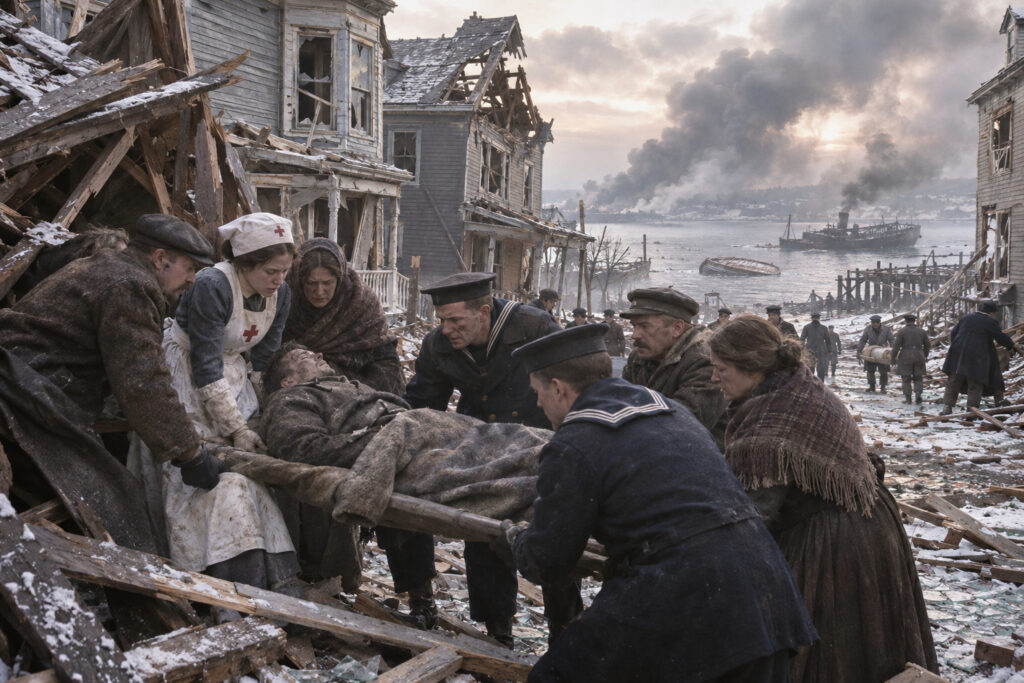
The Day the Harbor Turned to Fire
On the morning of December 6, 1917, Halifax’s busy harbor looked like any wartime port: convoys, tugs, and freighters threading a narrow entrance. Two ships misread each other’s moves. The Norwegian vessel Imo and the French munitions ship Mont‑Blanc collided in the Narrows. The Mont‑Blanc was not carrying ordinary cargo. Within minutes a fire broke out on her decks. Dockworkers and passing sailors fled as the blaze ran up amid crates and drums of explosives.
At 9:04 a.m. the ship detonated. A single blast leveled neighborhoods in the Richmond district, sent a shock wave across the harbor, and blew windows out for miles. Buildings that had stood for decades were reduced to splinters. The initial count is grim: roughly 2,000 people were killed and about 9,000 injured. Thousands more were left homeless overnight; entire streets became scenes of ruin and confusion.
Why One Ship Could Devastate a City
The destructive power lay in what the Mont‑Blanc carried: high explosives and volatile chemicals packed for war. TNT, picric acid, guncotton and barrels of benzol fed a blast and ensuing fires unlike anything Halifax had seen. The explosion’s force hurled heavy timbers and metal through the air and produced a wave in the harbor that swept people and debris ashore.
Contemporaries and later investigators noted the scale: until the atomic age, this was likely the largest human-made explosion. It was not just the blast but its combination with fire, flying shrapnel, collapsing buildings and the cold December weather that turned rescue into chaos. Many victims were cut by glass; others suffocated under timbers. Emergency facilities were overwhelmed within minutes.
Rescue, Censorship, and an Unlikely Lifeline from Boston
Wartime conditions complicated the response. Authorities immediately controlled information and movement, worried that news of the harbor disaster would aid enemy submarines. That censorship delayed wider reporting but did not stop neighbors from pulling survivors from the wreckage or the hospitals from filling with the injured.
One of the clearest human stories after the blast was the swift help from Boston. Within hours volunteers organized relief trains carrying doctors, nurses, food and blankets. The generosity—treating people who had lost everything in freezing weather—helped bind the two cities’ histories together. Halifax rebuilt, particularly the North End, which rose again with straighter streets and new brick houses.
Conclusion
More than a century later the Halifax Explosion remains a touchstone for urban disasters: an accident that exposed how fragile a modern, industrial city could be when explosive materials met a crowded waterfront. Plaques and museum exhibits mark the places and names, but the memory endures most sharply in the stories of neighbors who reached into the smoke to pull each other free.