
Uncover History’s Secrets with Daily Updates!
Daily News Entertainment
  • Home
  • History
  • Biographies
  • Eras
  • Regions
  • Timeline
No Result
View All Result
History Ours
  • Home
  • History
  • Biographies
  • Eras
  • Regions
  • Timeline
No Result
View All Result
History Ours
No Result
View All Result
Home History

The Infrastructure of Preindustrial Supply and Movement

in History
The Infrastructure of Preindustrial Supply and Movement

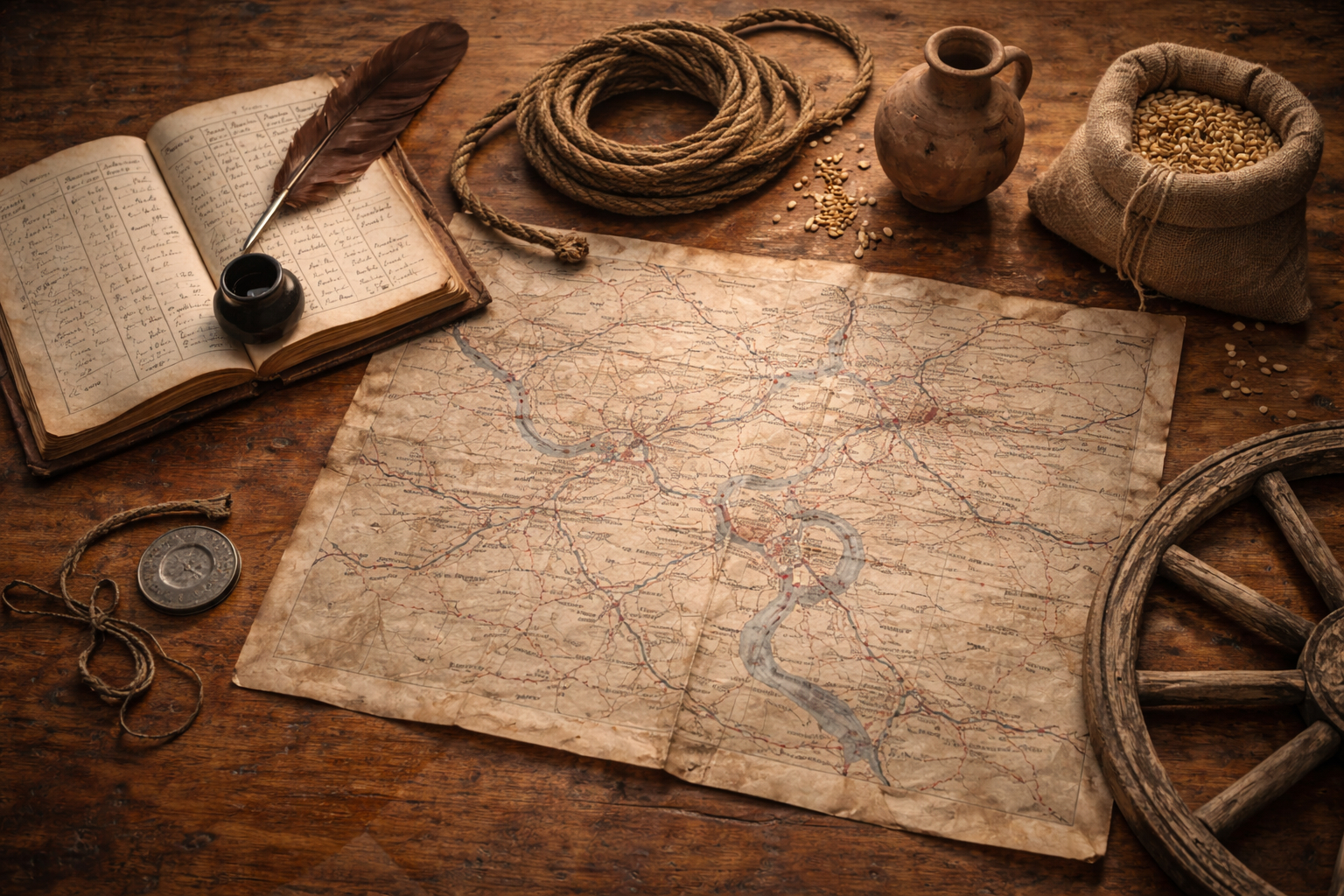
Preindustrial societies depended on networks of roads, rivers, and cities to move goods and people.
These systems were the backbone of taxation, provisioning armies, and sustaining urban life.
Over time, infrastructure adapted to geographic constraints and political priorities.
Local customs and seasonal rhythms often determined when and how resources travelled.
Studying these patterns reveals logistics as a driver of economic and social change.

Overland Routes and Road Maintenance

Long-distance movement on land relied on a patchwork of tracks, cartways, and managed roads that varied greatly in quality and control. States and local communities invested in road upkeep unevenly, responding to trade volume, military needs, and available labor. Where formal maintenance was lacking, travelers depended on inns, waystations, and community obligations to bridge gaps. The physical condition of roads directly influenced the cost and speed of moving bulky commodities.

Waterways, Ports, and Seasonal Calendars

Rivers and coastal routes carried heavy loads more efficiently than roads, but they also imposed their own seasonal limits because of floods and freezes. Ports functioned as nodes where maritime, riverine, and overland systems met, and governance at those nodes often determined tariff and storage practices. Seasonal calendars shaped harvest timing, market fairs, and long-distance convoy schedules to align supply with demand. Adaptations such as river dredging, canal cuts, and port quays emerged where traffic justified the investment.

Urban Hubs, Warehousing, and Market Rhythms

Towns and cities concentrated demand and provided storage, credit, and labor that smoothed temporal mismatches between production and consumption. Granaries, warehouses, and bonded stores enabled merchants and officials to manage surpluses and stabilize prices across lean seasons. Market regulations, weights and measures, and local fairs structured commercial expectations and reduced transaction frictions. The presence of reliable storage and market institutions often determined whether a settlement became a regional redistribution center.

Administration, Security, and Informal Networks

Beyond physical infrastructure, administration and security shaped the throughput of goods, with officials collecting tolls, licensing carriers, and organizing convoys where banditry or warfare threatened movement. Informal networks of kinship, guilds, and trusted middlemen often complemented formal mechanisms, allowing goods to bypass bottlenecks or find alternative routes. Communication systems, from messengers to signals, oriented decisions about routing and timing and provided the information necessary for coordinating supply. Together, governance and social capital defined the resilience and reach of preindustrial supply chains.

Conclusion

Preindustrial supply systems were complex hybrids of engineered routes, natural corridors, and local practices.
Their efficiency depended as much on institutions, trust, and seasonality as on roads and rivers.
Understanding this interplay sheds light on how past societies mobilized resources and sustained economies.


Previous Post

Taxation and Toll Networks That Funded Empires

Next Post

The Life and Craft of Isabella Bird, Traveler and Writer

Related Posts

How the Crystal Palace Turned Glass and Iron into a Modern Stage
History

How the Crystal Palace Turned Glass and Iron into a Modern Stage

September 15, 2026
Anne Bonny: The Pirate Who Broke Rules and Expectations
History

Anne Bonny: The Pirate Who Broke Rules and Expectations

September 15, 2026
Mary Anning and the Coast That Revealed Lost Worlds
History

Mary Anning and the Coast That Revealed Lost Worlds

September 15, 2026
When Mount Pelée Erased Saint-Pierre, 1902
History

When Mount Pelée Erased Saint-Pierre, 1902

September 15, 2026
Next Post
The Life and Craft of Isabella Bird, Traveler and Writer

The Life and Craft of Isabella Bird, Traveler and Writer

Search..

No Result
View All Result

Recent Articles

Edo: Japan’s Urban Revolution of Lanterns and Printshops

Edo: Japan’s Urban Revolution of Lanterns and Printshops

September 16, 2026
How the Little Ice Age Changed Everyday Life in Europe

How the Little Ice Age Changed Everyday Life in Europe

September 16, 2026
The Disguise That Broke Chains: Ellen and William Craft

The Disguise That Broke Chains: Ellen and William Craft

September 15, 2026
Bass Reeves: The Marshal Who Hunted Outlaws in Indian Territory

Bass Reeves: The Marshal Who Hunted Outlaws in Indian Territory

September 15, 2026
How the Crystal Palace Turned Glass and Iron into a Modern Stage

How the Crystal Palace Turned Glass and Iron into a Modern Stage

September 15, 2026

Subscribe Us

By clicking submit, I authorize History Ours and its affiliated companies to: (1) use, sell, and share my information for marketing purposes, including cross-context behavioral advertising, as described in our Terms of Service and Privacy Policy, (2) supplement the information that I provide with additional information lawfully obtained from other sources, like demographic data from public sources, interests inferred from web page views, or other data relevant to what might interest me, like past purchase or location data, (3) contact me or enable others to contact me by email with offers for goods and services from any category at the email address provided, and (4) retain my information while I am engaging with marketing messages that I receive and for a reasonable amount of time thereafter. I understand I can opt out at any time through an email that I receive, or by clicking here

Subscribe To Our Newsletter

By clicking submit, I authorize History Ours and its affiliated companies to: (1) use, sell, and share my information for marketing purposes, including cross-context behavioral advertising, as described in our Terms of Service and Privacy Policy, (2) supplement the information that I provide with additional information lawfully obtained from other sources, like demographic data from public sources, interests inferred from web page views, or other data relevant to what might interest me, like past purchase or location data, (3) contact me or enable others to contact me by email with offers for goods and services from any category at the email address provided, and (4) retain my information while I am engaging with marketing messages that I receive and for a reasonable amount of time thereafter. I understand I can opt out at any time through an email that I receive, or by clicking here.

© 2026 History Ours | All Rights Reserved

  • Contact Us
  • Privacy Policy
  • Terms of Service
  • Unsubscribe
  • Privacy Choices
  • Contact Us
  • Privacy Policy
  • Terms of Service
  • Unsubscribe
  • Privacy Choices

© 2026 History Ours | All Rights Reserved

No Result
View All Result
  • Home
  • History
  • Biographies
  • Eras
  • Regions
  • Timeline

© 2026 History Ours | All Rights Reserved

Skip to content
Open toolbar Accessibility Tools

Accessibility Tools

  • Increase TextIncrease Text
  • Decrease TextDecrease Text
  • GrayscaleGrayscale
  • High ContrastHigh Contrast
  • Negative ContrastNegative Contrast
  • Light BackgroundLight Background
  • Links UnderlineLinks Underline
  • Readable FontReadable Font
  • Reset Reset