
From a Yunnan boy to the emperor’s eunuch-admiral
Born around 1371 in Yunnan as Ma He, the future Zheng He arrived at the Ming court under circumstances typical of the turbulent founding years of the dynasty: captured, castrated, and raised within the inner service. He entered the household of Zhu Di, the prince who would seize the throne as the Yongle Emperor. Yongle trusted Zheng He. He was literate, physically imposing, and skilled in administration — qualities that turned a court eunuch into the commander of Asia’s most ambitious maritime armada.
Seven voyages across the Indian Ocean (1405–1433)
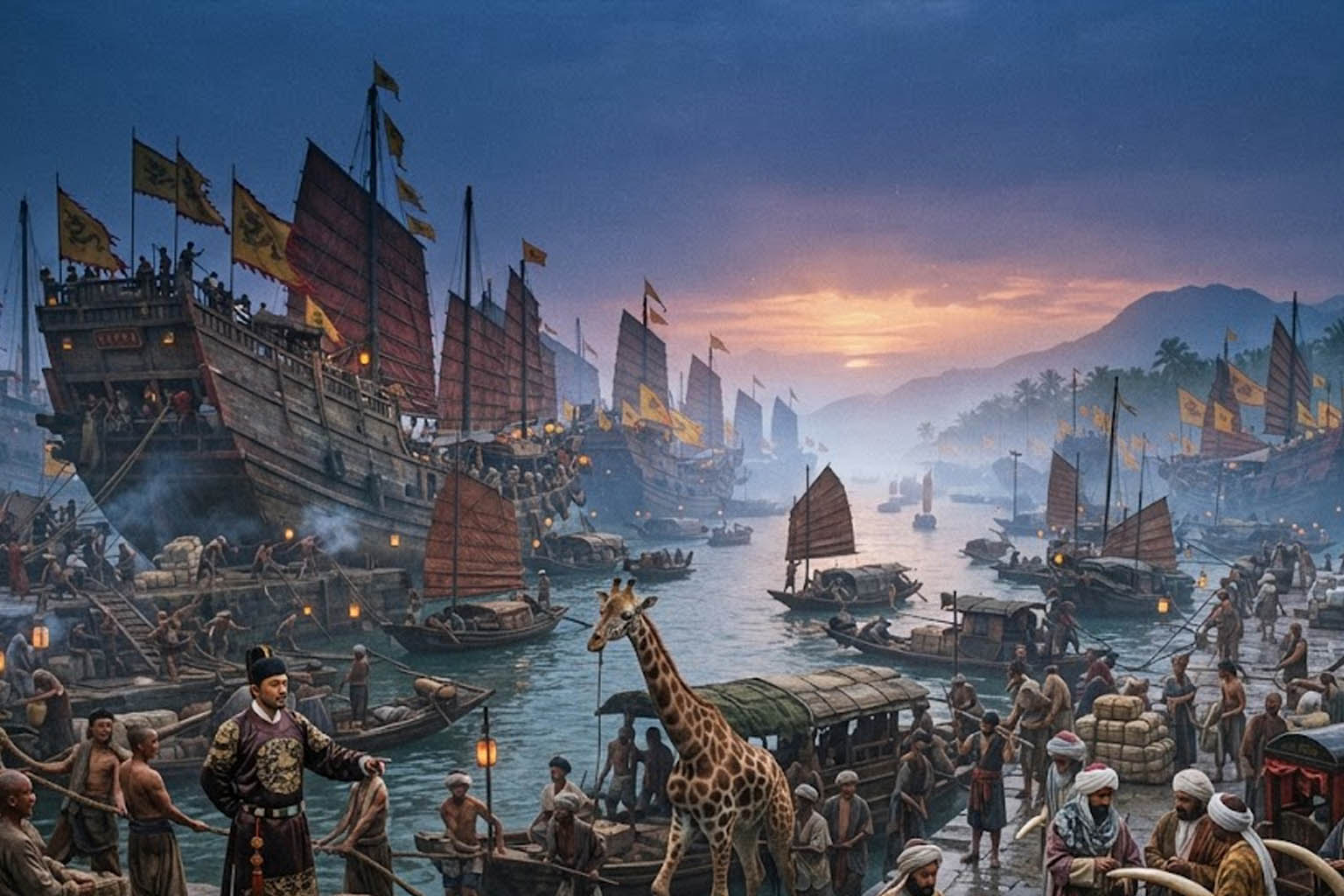
Between 1405 and 1433 Zheng He led seven state-sponsored expeditions that carried tribute, envoys, and vast cargoes from China to ports across Southeast Asia, South Asia, the Persian Gulf and the East African coast. Ming records describe fleets of hundreds of ships and thousands of men: sailors, soldiers, interpreters, craftsmen and pilgrims. Ships called “treasure ships” (bao chuan) carried silks, porcelain and coins to be exchanged for spices, ivory and exotic animals. The fleets visited Malacca, Calicut, Hormuz, Aden and trading towns along the Swahili coast; they landed envoys, erected inscriptions and exchanged gifts — evidence of a diplomacy aimed at projecting imperial prestige rather than colonizing territory.
Contemporary court annals record the arrival of strange cargoes: rare woods, pearls, and living animals. Among the most memorable was a giraffe — presented as a sign of distant ties and interpreted by courtiers as an auspicious creature from afar.
Why the voyages stopped and what followed
The expeditions required enormous resources and court backing. When Yongle died in 1424, the political wind shifted. New emperors and influential Confucian ministers prioritized rebuilding the agricultural economy and defending the northern borders. Naval expenditures and the imperial escort of foreign envoys lost favor. Zheng He died around 1433, and the seventh voyage marked the fleet’s last grand departure. Shipyards were repurposed, shipbuilding knowledge dissipated, and an official maritime retrenchment followed. Over generations, China’s sea power receded while maritime networks in the Indian Ocean continued under diverse regional actors.
Conclusion
Zheng He’s voyages were brief but spectacular: a state-driven spectacle of navigation, gift exchange, and cross-cultural encounter that put Ming China into direct contact with ports from Java to Mogadishu. They reshaped perceptions—both abroad and at home—showing that early 15th-century China could marshal vast resources for projection of soft power. When the fleets were mothballed, the memory of those voyages persisted in inscriptions, court records and later myths. Today they remain a vivid chapter in the history of global maritime exchange: a reminder that connections between Asia and the wider Indian Ocean world ran deep long before modern navies and steamships.