

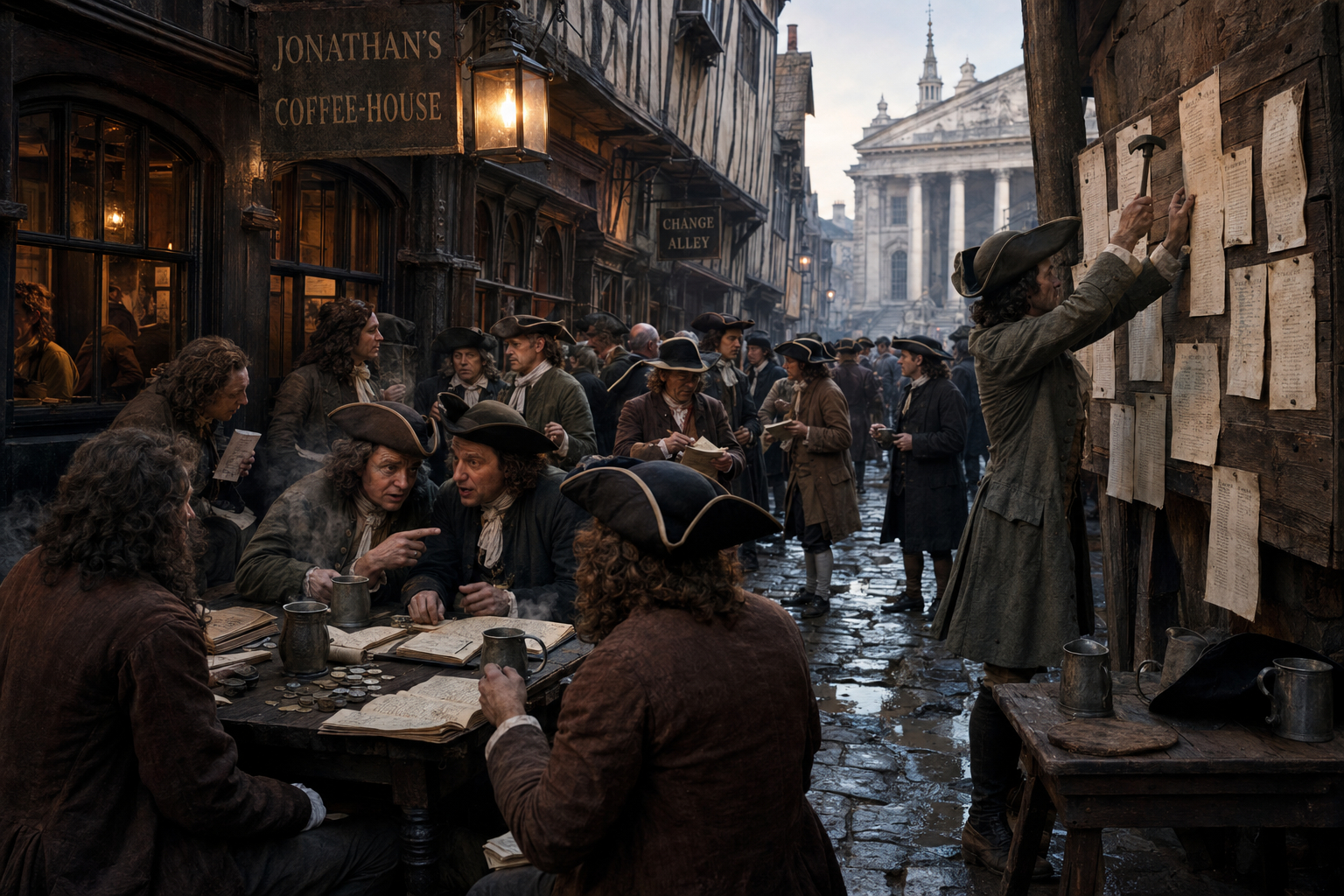
In the narrow lanes off Cornhill, a plain coffeehouse in Change Alley quietly did something remarkable: it turned conversation into commerce. Jonathan’s Coffee-House—one of several cafés clustered near the Royal Exchange in the late 17th century—was a place where merchants, clerks, and speculators bumped into one another over small tables and thick cups of coffee. News of ship arrivals, commodity prices, government loans and company charters moved faster there than through formal offices. That gossip was rarely idle; it became the raw material of bargains struck on the spot.
Numbers on a notice board: the birth of public prices
The shift from chat to market had a visible sign. Around 1698 a clerk named John Castaing began posting regular lists of prices—shares, commodities and exchange rates—outside Jonathan’s. These sheets, sometimes called “The Course of the Exchange,” gave traders a common reference and turned scattered deals into a recognizable market. The lists made prices public, compared offers, and let more people join in the business of buying and selling claims on ships, loans, and corporate ventures. Coffeehouses had long been hubs for printed news and correspondence; once price sheets were tacked to a wall, the room became, for many purposes, a market floor.
Speculation, scandal, and the move to a formal institution
Public pricing amplified appetite for risk. Coffeehouse chatter helped fuel speculative frenzies—most famously the South Sea Bubble of 1720—when feverish buying and face-to-face bargaining produced fortunes one week and ruin the next. The gatherings in Change Alley made clear that financial transactions needed rules, records and a measure of stability. Over the 18th century the crowd thinned as dealers and “stockjobbers” moved their dealings into more exclusive clubs and rooms, and by the turn of the 19th century those informal practices had coalesced into a formal body of brokers and an institution we recognize as the London Stock Exchange.
Conclusion
Jonathan’s and its neighbors did more than serve coffee; they taught London how to price risk in public and how to turn information into trade. A wooden table, a posted list and a rumor could, in the right swirl of commerce and credit, become the foundation of an entire financial system. The modern stock market still owes something to that awkward, energetic space in an old alley—where strangers traded news, a clerk posted a list, and the very idea of a public market took shape.