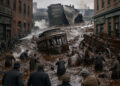


On the afternoon of January 15, 1919, a steel tank in Boston’s North End burst and released a flood that reads like an absurdist nightmare. Roughly 2.3 million gallons of molasses—dark, heavy, syrupy—rushed from the storage tank and barreled into streets, railroad tracks, and buildings. Witnesses described a wave as high as 15 feet moving at an estimated 30–35 miles per hour. Horses, carts, and a streetcar were swept along. People caught in the surge were crushed or drowned in the viscous mass; twenty-one bodies were later recovered and about 150 people injured.
The molasses didn’t behave like water. It clung, it stuck, and it trapped. First responders and neighbors hacked at the goo with shovels and crowbars; firefighters pumped salt water into the flow to thin it. Cleanup took weeks, and the smell lingered in the neighborhood for months. The scene left a scar on the city’s memory—an ordinary industrial corner transformed in an instant into something grotesquely familiar and terrible.
How a storage tank became a weapon
The tank belonged to the Purity Distilling Company and stood next to a railroad to speed shipments. Built less than a year before the disaster, it had shown signs of trouble: leaks, rumbling noises when filled, and patchwork repairs. After the collapse, a state-appointed investigation found that the tank’s steel shell was too thin and poorly riveted to bear the pressure of its contents. Tests also suggested the company had failed to properly test the vessel under working conditions.
Some popular explanations—fermentation, temperature swings, or deliberate sabotage—circulated in the days after the flood. Investigators noted that warm molasses stored in winter could be more fluid, and heating for pumpability might have increased pressure on a flawed structure. But the core finding was simpler and grimmer: a hurried, under-engineered industrial installation met the ordinary weight of commerce and gave way.
Cleanup, courtrooms, and lasting changes
Removing molasses from the cobbles and basements proved maddeningly difficult. Crews relied on salt water, steam, and teams of laborers; the molasses clogged catch basins and fouled the harbor for weeks. Families lost possessions; businesses were disrupted. More consequentially, the legal fallout dragged on for years. Hundreds of plaintiffs sued Purity Distilling; a prolonged jury trial eventually found the company negligent and awarded damages.
Regulatory consequences followed. The disaster exposed how factory installations could be built and operated without adequate oversight, and it helped push local authorities toward stricter inspection practices for tanks and industrial vessels. The event remains a cautionary tale about the human cost of cutting corners, and an odd chapter in Boston’s industrial past that turns a commonplace foodstuff into a force of sudden calamity.
Conclusion
The Great Molasses Flood is memorable because it is both bizarre and unmistakably ordinary: a routine storage tank, a common commodity, and ordinary people caught where industry met the street. Its legacy is practical—safer building practices—and eerie: the image of a syrupy tide forever seared into the city’s story.