
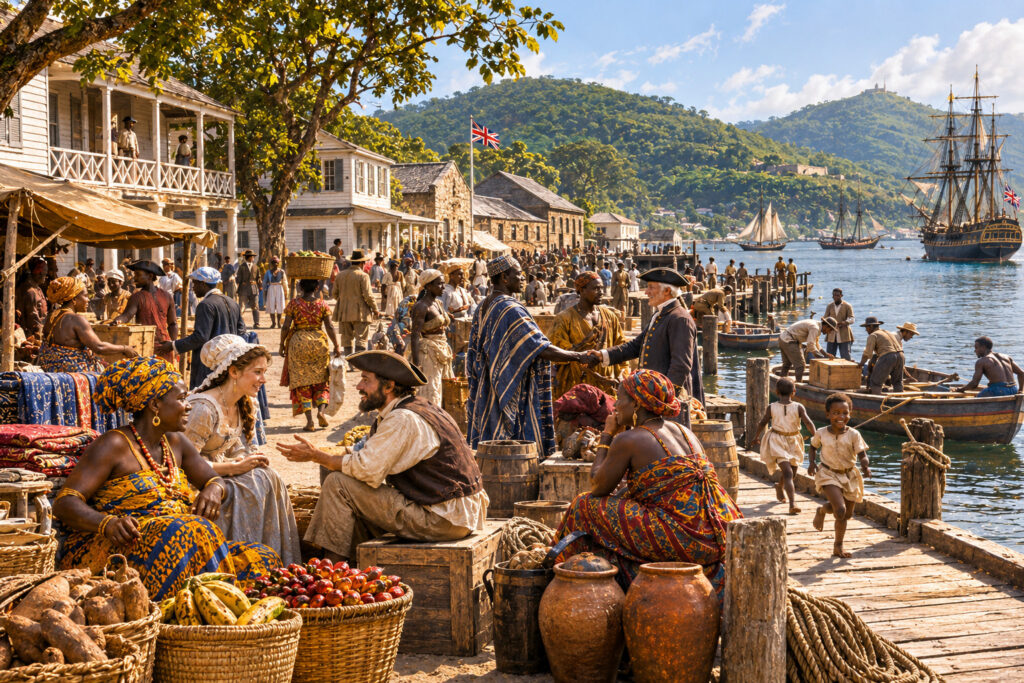
Freetown began not as an inevitable capital but as an idea hatched in London in the 1780s: a place where poor, formerly enslaved Black people might build a new life on the West African coast. In 1787 a small group of London’s “Black Poor” sailed to a sheltered estuary on the Sierra Leone River. That first settlement, later called Granville Town, struggled with disease, supply problems, and conflict with neighboring communities—hard lessons that would shape the city that followed.
What transformed the site into something larger was a second wave: in 1792 nearly twelve hundred Black Loyalists who had been promised land in Nova Scotia after fighting for Britain in the American Revolution arrived to found Freetown proper. They brought different rituals, material culture, and English-based dialects that mixed with earlier settlers and, later, with people freed from slave ships. The harbor—deep, broad, and tucked among rising hills—gave them a defensible, practical base for trade, resupply, and communication across the Atlantic.
A berth for the abolitionist world
The British abolition of the slave trade in 1807 changed Freetown’s destiny. The Royal Navy’s West Africa Squadron used the port as a staging ground to intercept illegal slavers. Thousands of people liberated from seized ships—known in colonial records as “recaptives” or “liberated Africans”—were brought to Freetown. They arrived speaking dozens of languages and carrying different cultural practices; over time many found common ground in Christianity, schooling, and English-derived creole speech.
By 1808 Freetown became a Crown Colony. Missionary societies and colonial officials invested in schools, printing presses, and churches. That infrastructure, imperfect and often paternalistic, produced disproportionate literacy and a cadre of educated clerks, traders, and interpreters who linked the city to commerce and diplomacy across West Africa and the Atlantic world.
Culture at the crossroads
Freetown’s strength was its mixture. The people who called it home—Nova Scotian settlers, West Indian settlers, liberated Africans, European administrators, and neighbouring Temne and Mende communities—created what is now called Krio culture. The Krio language, an English-based creole, became the urban lingua franca, carrying songs, oral histories, recipes, and legal practices. Architects and merchants adapted Atlantic patterns to local climates: clapboard houses with verandas, warehouses near the wharves, and market rhythms that combined African goods with products from Europe and the Americas.
The city was never free of tensions—land disputes, economic competition, and colonial hierarchies left scars—but its role as a refuge and a hub gave Freetown a distinctive place in the Black Atlantic: a port where the legacies of enslavement, emancipation, migration, and empire met on a shoreline.
Conclusion
Freetown’s story is not only about policy or philanthropy. It’s about people repeatedly remaking a place—on ships, in schools, at market stalls—until a harbor on West Africa’s edge became a city with transatlantic reach. Today, the contours of that history remain visible in language, architecture, and the persistent role of Freetown as a crossroads of cultures born of motion and survival.