Uncover History’s Secrets with Daily Updates!
Daily News Entertainment
  • Home
  • History
  • Biographies
  • Eras
  • Regions
  • Timeline
No Result
View All Result
History Ours
  • Home
  • History
  • Biographies
  • Eras
  • Regions
  • Timeline
No Result
View All Result
History Ours
No Result
View All Result
Home Regions

After the Quake: How 1755 Lisbon Reshaped an Empire

in Regions
After the Quake: How 1755 Lisbon Reshaped an Empire

On All Saints’ Day 1755, worshippers crowded Lisbon’s churches and shoppers packed markets when a violent earthquake tore through the city. The ground shook for minutes; grand churches and narrow alleys collapsed into clouds of dust. Fires ignited across neighborhoods and a tsunami raced up the Tagus, smashing vessels and carrying destruction into harbors and across the Atlantic. Contemporary accounts speak of whole quarters reduced to ruin and of tens of thousands of dead. Modern seismologists generally estimate the event among the strongest in European history, with effects felt from North Africa to the Caribbean.

Pombal’s city: timber frames and a rational grid

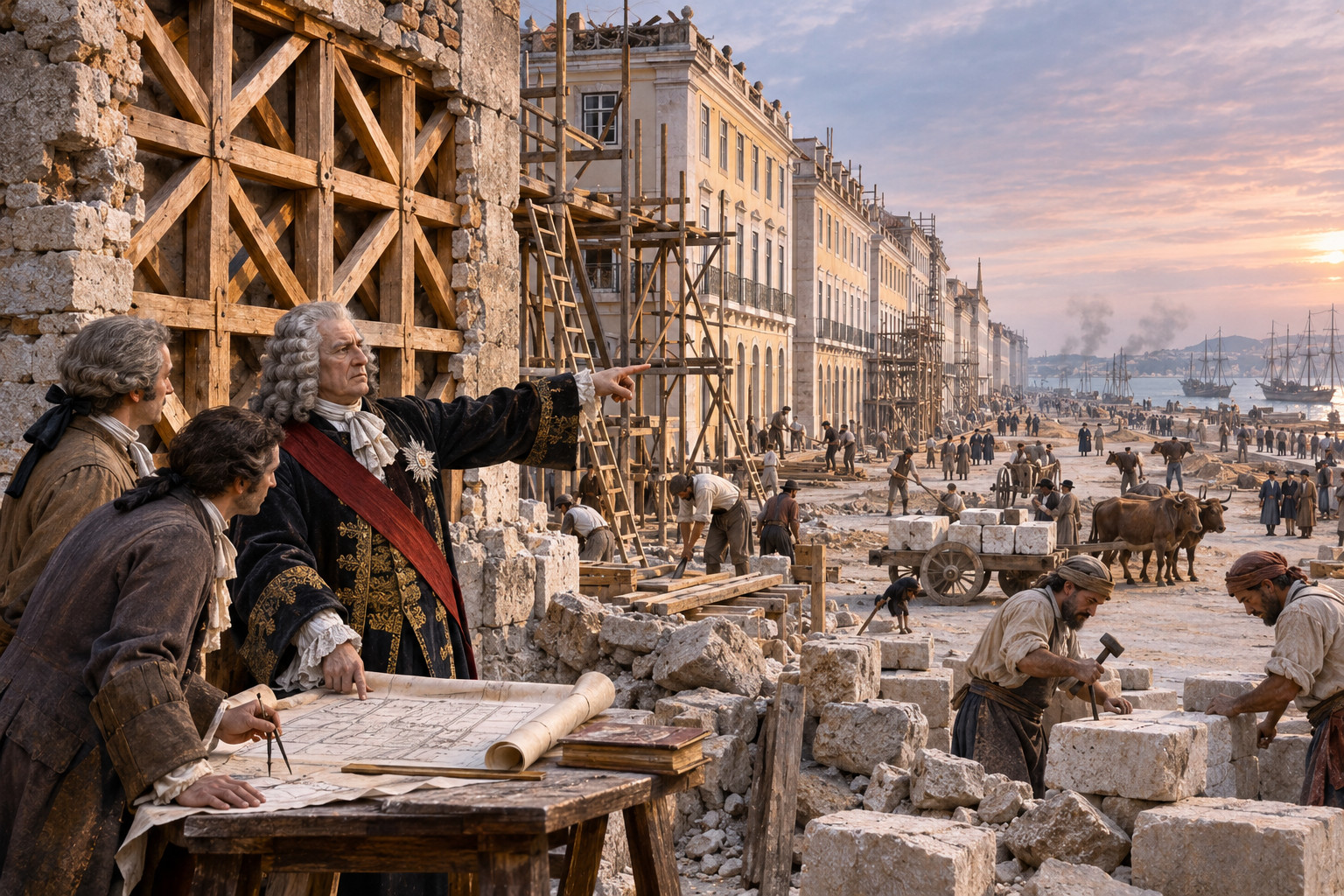
The immediate political response shaped what Lisbon would become. The Marquês de Pombal, the kingdom’s chief minister, asserted central control: he organized rescue, cleared debris, regulated food and supply distribution, and directed the reconstruction of the downtown district now called the Baixa Pombalina. The new plan favored straight, wide streets and uniform building heights—an early example of state-directed urban planning in Europe.

Technological choices mattered. Engineers introduced a timber-lattice anti-seismic system known as the “gaiola” (cage), a braced wooden framework built into masonry walls to absorb shock. Buildings were standardized, inspected, and raised on level foundations. The result was not only a faster rebuild but a visible statement: a modern, ordered city rising from catastrophe.

A shock to minds, markets, and empires

The disaster radiated beyond masonry and mortar. Lisbon was one of Europe’s busiest Atlantic ports; its sudden paralysis disrupted trade, insurance, and shipping networks. Merchants scrambled to reroute cargoes and reassess the risks of maritime insurance. Colonial administrators felt the strain of lost revenues and emergency expenditures, influencing fiscal choices in the Portuguese empire for years to come.

Intellectually, the quake unsettled received wisdom. European thinkers debated the theological meaning of such a calamity and probed natural causes with renewed urgency. Writers and philosophers used the event to question optimistic assumptions about providence and progress, and natural philosophers began collecting observations that would feed early seismological inquiry. In short, the catastrophe bridged practical urban innovation and shifting ideas about nature and society.

Conclusion

Lisbon’s 1755 earthquake was cataclysm and catalyst. It killed and displaced, but it also accelerated centralized planning, introduced building techniques aimed at resilience, and nudged debates about science and the state. Walk the rebuilt Baixa today and the grid, the facades, and the hidden timber frames still testify to a city forced to reinvent itself—and, in doing so, to reshape how an empire managed crisis and modernity.
Previous Post

The Jazz Age: Sound, Speakeasies, and Urban Style

Next Post

The Trent Affair: How a Diplomatic Snag Nearly Brought Britain In

Related Posts

Baku: Oil, Ports, and the Birth of a Caspian Metropolis
Regions

Baku: Oil, Ports, and the Birth of a Caspian Metropolis

November 16, 2026
How Kraków’s Cloth Hall Knit a Central European Region
Regions

How Kraków’s Cloth Hall Knit a Central European Region

November 16, 2026
How Cotton Turned the Aral Sea into a Desert
Regions

How Cotton Turned the Aral Sea into a Desert

November 11, 2026
When the Zuiderzee Became the IJsselmeer and Remade Holland
Regions

When the Zuiderzee Became the IJsselmeer and Remade Holland

November 11, 2026
Next Post
The Trent Affair: How a Diplomatic Snag Nearly Brought Britain In

The Trent Affair: How a Diplomatic Snag Nearly Brought Britain In

Search..

No Result
View All Result

Recent Articles

Isabella Stewart Gardner: Boston’s Provocative Collector and Her Museum

Isabella Stewart Gardner: Boston’s Provocative Collector and Her Museum

November 22, 2026
The Erie Canal: A Waterway That Built New York

The Erie Canal: A Waterway That Built New York

November 22, 2026
The Trent Affair: How a Diplomatic Snag Nearly Brought Britain In

The Trent Affair: How a Diplomatic Snag Nearly Brought Britain In

November 21, 2026
After the Quake: How 1755 Lisbon Reshaped an Empire

After the Quake: How 1755 Lisbon Reshaped an Empire

November 21, 2026
The Jazz Age: Sound, Speakeasies, and Urban Style

The Jazz Age: Sound, Speakeasies, and Urban Style

November 20, 2026

Subscribe Us

By clicking submit, I authorize History Ours and its affiliated companies to: (1) use, sell, and share my information for marketing purposes, including cross-context behavioral advertising, as described in our Terms of Service and Privacy Policy, (2) supplement the information that I provide with additional information lawfully obtained from other sources, like demographic data from public sources, interests inferred from web page views, or other data relevant to what might interest me, like past purchase or location data, (3) contact me or enable others to contact me by email with offers for goods and services from any category at the email address provided, and (4) retain my information while I am engaging with marketing messages that I receive and for a reasonable amount of time thereafter. I understand I can opt out at any time through an email that I receive, or by clicking here

Subscribe To Our Newsletter

By clicking submit, I authorize History Ours and its affiliated companies to: (1) use, sell, and share my information for marketing purposes, including cross-context behavioral advertising, as described in our Terms of Service and Privacy Policy, (2) supplement the information that I provide with additional information lawfully obtained from other sources, like demographic data from public sources, interests inferred from web page views, or other data relevant to what might interest me, like past purchase or location data, (3) contact me or enable others to contact me by email with offers for goods and services from any category at the email address provided, and (4) retain my information while I am engaging with marketing messages that I receive and for a reasonable amount of time thereafter. I understand I can opt out at any time through an email that I receive, or by clicking here.

© 2026 History Ours | All Rights Reserved

  • Contact Us
  • Privacy Policy
  • Terms of Service
  • Unsubscribe
  • Privacy Choices
  • Contact Us
  • Privacy Policy
  • Terms of Service
  • Unsubscribe
  • Privacy Choices

© 2026 History Ours | All Rights Reserved

No Result
View All Result
  • Home
  • History
  • Biographies
  • Eras
  • Regions
  • Timeline

© 2026 History Ours | All Rights Reserved

Skip to content
Open toolbar Accessibility Tools

Accessibility Tools

  • Increase TextIncrease Text
  • Decrease TextDecrease Text
  • GrayscaleGrayscale
  • High ContrastHigh Contrast
  • Negative ContrastNegative Contrast
  • Light BackgroundLight Background
  • Links UnderlineLinks Underline
  • Readable FontReadable Font
  • Reset Reset