
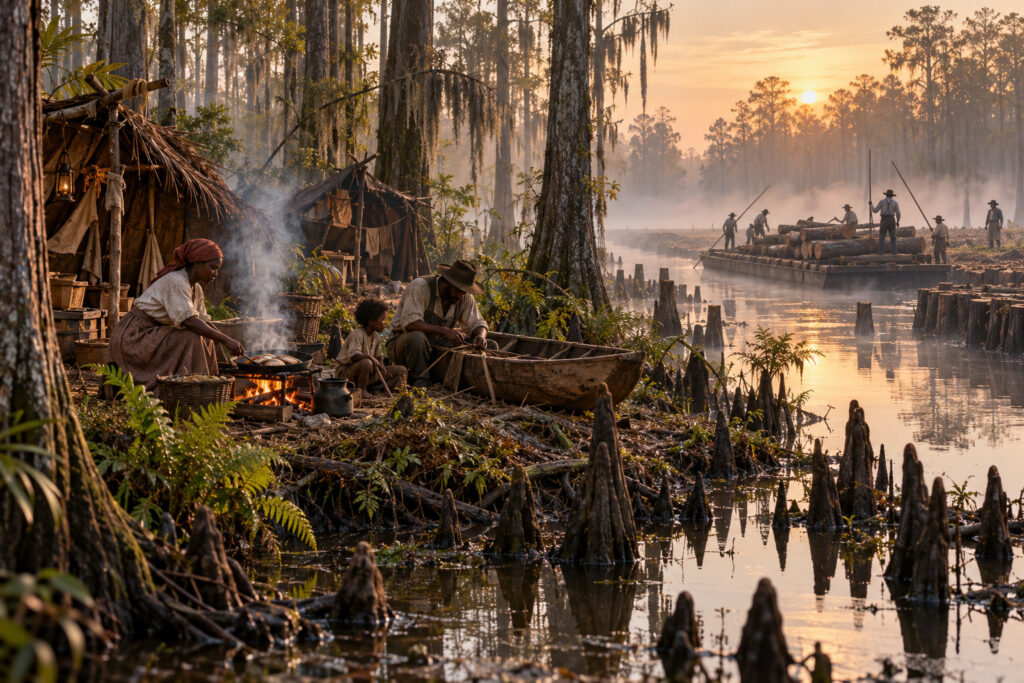
Stretching across southeastern Virginia and northeastern North Carolina, the Great Dismal Swamp is the kind of landscape that refuses neat categories. To Europeans it was an obstacle — dense stands of cypress and Atlantic white cedar rising out of peat, miles of black water and hummocks of hemlock and pine. To the peoples who lived with it for centuries, the swamp was usable land: a source of game and medicinal plants, a place of trade, and a stubborn frontier that shaped travel and settlement patterns along the Atlantic seaboard.
Refuge and hidden communities
One of the swamp’s most consequential roles was as refuge. For Native American groups displaced by European expansion, and for hundreds—perhaps thousands—of enslaved people who fled plantations, the swamp offered concealment and a chance at new, hybrid lives. These maroon communities avoided direct confrontation with planters and often eked out livelihoods from fishing, small-scale farming on raised hummocks, and harvesting peat and timber. They were neither isolated nor wholly cut off: archaeological traces and contemporary accounts indicate furtive trade with nearby towns, occasional laboring for wages, and a fluid exchange of knowledge about the swamp’s paths and hazards.
Extraction, canals, and contested control
By the late eighteenth and nineteenth centuries, the region’s economic logic changed. Timber companies prized the swamp’s cypress and pine; entrepreneurs and state governments pushed canals and drainage projects to move logs and link inland waterways with ports. Cutting and dredging transformed sections of peatland into transport corridors, and what had been a shelter for hidden communities became a contested industrial landscape. Laborers — free and enslaved — toiled on these projects, and the very features that made the swamp a refuge were altered: drier patches expanded, roads opened lines of surveillance, and legal pressure from nearby counties increased the risk for those hiding in the bog.
Conclusion
Today the Great Dismal Swamp reads as a palimpsest. Remnants of maroon settlements sit beside canal cuts and logging scars; wildlife and flooded peatlands reclaim industrial scars even as fragments of the swamp’s layered human history persist in place names and family stories. The region’s story complicates simple oppositions of wilderness versus civilization: the swamp was a living borderland where refuge, work, coercion, and survival braided together. Visiting it now, you find boardwalks and interpretive signs — attempts to untangle a hard, damp past that shaped the lives, labor, and landscapes of a distinct American region.