
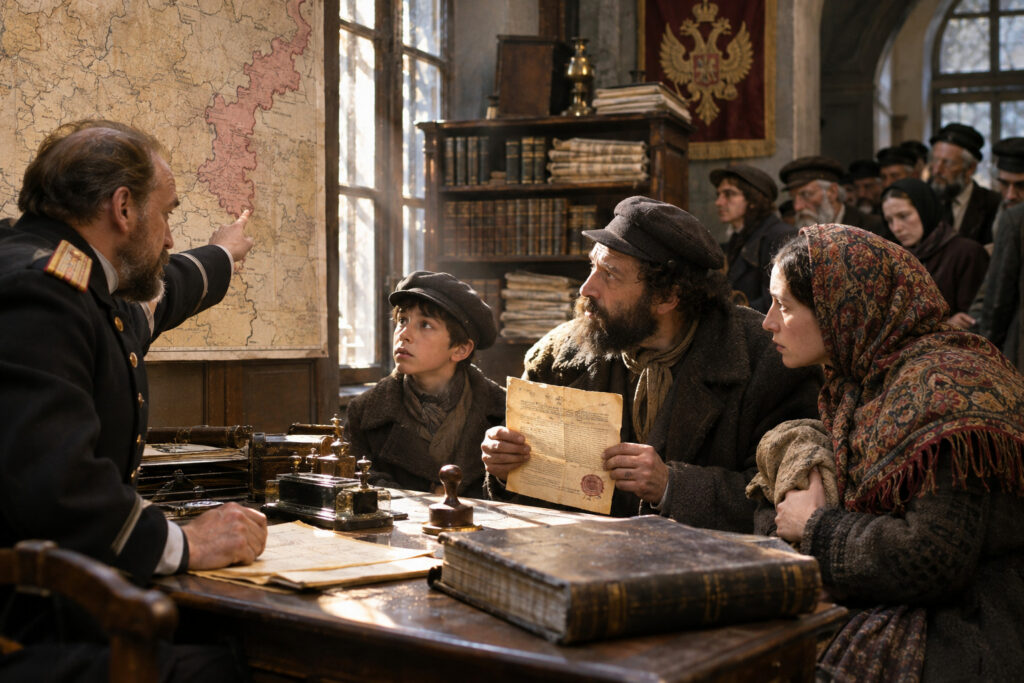
When the Russian Empire swallowed swathes of the old Polish–Lithuanian Commonwealth in the late 18th century, it inherited large Jewish communities. Rather than integrate those communities across the empire, tsarist authorities drew a zone where Jews were officially allowed to live: the Pale of Settlement. Its boundaries shifted over decades, but it generally included much of modern-day Poland, Lithuania, Belarus, Ukraine and parts of Moldova. Outside that belt, residence required special permission.
Everyday life inside the Pale
The Pale was not a single experience. In some cities—Vilna (Vilnius), Lviv, and Grodno—Jews formed vital urban cohorts: shopkeepers, artisans, lawyers and scholars. Elsewhere they clustered in shtetls—small market towns where Yiddish was the common language, synagogues marked the skyline, and the rhythm of the week and the holidays organized social life. Land ownership was rare; many Jews worked as traders, innkeepers, artisans, or leaseholders for nobility. A dense network of markets, credit arrangements and communal institutions kept these economies running.
Legal restrictions shaped cultural forms. Quotas and barriers in higher education and certain professions pushed energy into religious study, communal charity, the press and political organizing. Yiddish literature and theater blossomed in the Pale because the language was the region’s vernacular; so too did movements as varied as Hasidism and the Jewish Labour Bund, each answering local conditions in different ways.
Politics, pogroms, and migration
The Pale also concentrated vulnerability. After the assassination of Alexander II in 1881, waves of violent attacks on Jews—pogroms—rippleed through the Pale, and the 1882 May Laws tightened residence rules further. Restrictions barred Jews from buying land in rural areas and limited settlement in many towns, intensifying crowding and economic pressure in permitted zones. Those pressures, along with political repression and recurring violence, fed mass migration. Between the 1880s and the early 20th century, millions left the Pale for the United States, South America, Palestine and elsewhere.
At the same time, the Pale served as a cultural crucible. Its crowded towns produced a disproportionate share of Jewish writers, political activists, rabbis and entrepreneurs who would shape global Jewish life. The boundaries may have been drawn by imperial decree, but the networks inside them radiated far beyond.
Conclusion
The Pale of Settlement was more than an administrative line on a map. It concentrated populations, constrained mobility, and forced communities to improvise institutions and economies. Living within those limits made modern Jewish politics, culture, languages and diasporic routes more visible and more urgent. When the Russian revolutions of 1917 swept away legal residence restrictions, the legacy of the Pale remained: a shaped geography of memory, migration and creativity that continues to explain why so many Jewish stories begin in those towns and cities of eastern Europe.