
Uncover History’s Secrets with Daily Updates!
Daily News Entertainment
  • Home
  • History
  • Biographies
  • Eras
  • Regions
  • Timeline
No Result
View All Result
History Ours
  • Home
  • History
  • Biographies
  • Eras
  • Regions
  • Timeline
No Result
View All Result
History Ours
No Result
View All Result
Home Regions

Freetown: How a Harbor Forged a Black Atlantic City

in Regions
Freetown: How a Harbor Forged a Black Atlantic City

Freetown began not as an inevitable capital but as an idea hatched in London in the 1780s: a place where poor, formerly enslaved Black people might build a new life on the West African coast. In 1787 a small group of London’s “Black Poor” sailed to a sheltered estuary on the Sierra Leone River. That first settlement, later called Granville Town, struggled with disease, supply problems, and conflict with neighboring communities—hard lessons that would shape the city that followed.

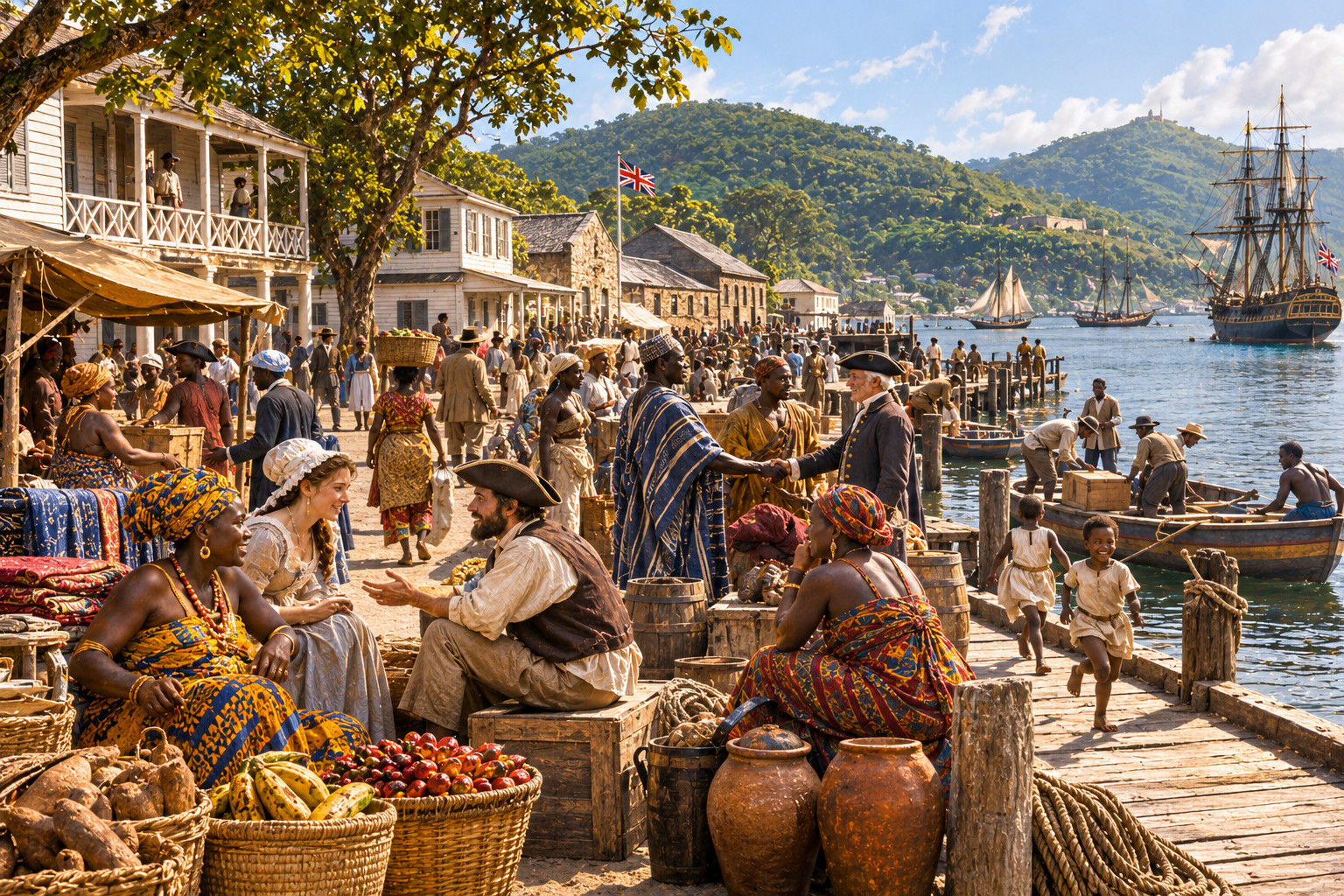
What transformed the site into something larger was a second wave: in 1792 nearly twelve hundred Black Loyalists who had been promised land in Nova Scotia after fighting for Britain in the American Revolution arrived to found Freetown proper. They brought different rituals, material culture, and English-based dialects that mixed with earlier settlers and, later, with people freed from slave ships. The harbor—deep, broad, and tucked among rising hills—gave them a defensible, practical base for trade, resupply, and communication across the Atlantic.

A berth for the abolitionist world

The British abolition of the slave trade in 1807 changed Freetown’s destiny. The Royal Navy’s West Africa Squadron used the port as a staging ground to intercept illegal slavers. Thousands of people liberated from seized ships—known in colonial records as “recaptives” or “liberated Africans”—were brought to Freetown. They arrived speaking dozens of languages and carrying different cultural practices; over time many found common ground in Christianity, schooling, and English-derived creole speech.

By 1808 Freetown became a Crown Colony. Missionary societies and colonial officials invested in schools, printing presses, and churches. That infrastructure, imperfect and often paternalistic, produced disproportionate literacy and a cadre of educated clerks, traders, and interpreters who linked the city to commerce and diplomacy across West Africa and the Atlantic world.

Culture at the crossroads

Freetown’s strength was its mixture. The people who called it home—Nova Scotian settlers, West Indian settlers, liberated Africans, European administrators, and neighbouring Temne and Mende communities—created what is now called Krio culture. The Krio language, an English-based creole, became the urban lingua franca, carrying songs, oral histories, recipes, and legal practices. Architects and merchants adapted Atlantic patterns to local climates: clapboard houses with verandas, warehouses near the wharves, and market rhythms that combined African goods with products from Europe and the Americas.

The city was never free of tensions—land disputes, economic competition, and colonial hierarchies left scars—but its role as a refuge and a hub gave Freetown a distinctive place in the Black Atlantic: a port where the legacies of enslavement, emancipation, migration, and empire met on a shoreline.

Conclusion

Freetown’s story is not only about policy or philanthropy. It’s about people repeatedly remaking a place—on ships, in schools, at market stalls—until a harbor on West Africa’s edge became a city with transatlantic reach. Today, the contours of that history remain visible in language, architecture, and the persistent role of Freetown as a crossroads of cultures born of motion and survival.
Previous Post

How Haussmann Remade Paris: Boulevards, Sewers, and Society

Related Posts

How the Sound Dues Shaped the Baltic’s Map of Power
Regions

How the Sound Dues Shaped the Baltic’s Map of Power

November 24, 2026
After the Quake: How 1755 Lisbon Reshaped an Empire
Regions

After the Quake: How 1755 Lisbon Reshaped an Empire

November 21, 2026
Baku: Oil, Ports, and the Birth of a Caspian Metropolis
Regions

Baku: Oil, Ports, and the Birth of a Caspian Metropolis

November 16, 2026
How Kraków’s Cloth Hall Knit a Central European Region
Regions

How Kraków’s Cloth Hall Knit a Central European Region

November 16, 2026

Search..

No Result
View All Result

Recent Articles

Freetown: How a Harbor Forged a Black Atlantic City

Freetown: How a Harbor Forged a Black Atlantic City

November 26, 2026
How Haussmann Remade Paris: Boulevards, Sewers, and Society

How Haussmann Remade Paris: Boulevards, Sewers, and Society

November 26, 2026
How Gaslight Remade City Nights and Urban Life

How Gaslight Remade City Nights and Urban Life

November 25, 2026
Tunguska 1908: A Short Timeline of the Blast

Tunguska 1908: A Short Timeline of the Blast

November 25, 2026
Hildegard of Bingen: Visions, Songs, and Medieval Science

Hildegard of Bingen: Visions, Songs, and Medieval Science

November 24, 2026

Subscribe Us

By clicking submit, I authorize History Ours and its affiliated companies to: (1) use, sell, and share my information for marketing purposes, including cross-context behavioral advertising, as described in our Terms of Service and Privacy Policy, (2) supplement the information that I provide with additional information lawfully obtained from other sources, like demographic data from public sources, interests inferred from web page views, or other data relevant to what might interest me, like past purchase or location data, (3) contact me or enable others to contact me by email with offers for goods and services from any category at the email address provided, and (4) retain my information while I am engaging with marketing messages that I receive and for a reasonable amount of time thereafter. I understand I can opt out at any time through an email that I receive, or by clicking here

Subscribe To Our Newsletter

By clicking submit, I authorize History Ours and its affiliated companies to: (1) use, sell, and share my information for marketing purposes, including cross-context behavioral advertising, as described in our Terms of Service and Privacy Policy, (2) supplement the information that I provide with additional information lawfully obtained from other sources, like demographic data from public sources, interests inferred from web page views, or other data relevant to what might interest me, like past purchase or location data, (3) contact me or enable others to contact me by email with offers for goods and services from any category at the email address provided, and (4) retain my information while I am engaging with marketing messages that I receive and for a reasonable amount of time thereafter. I understand I can opt out at any time through an email that I receive, or by clicking here.

© 2026 History Ours | All Rights Reserved

  • Contact Us
  • Privacy Policy
  • Terms of Service
  • Unsubscribe
  • Privacy Choices
  • Contact Us
  • Privacy Policy
  • Terms of Service
  • Unsubscribe
  • Privacy Choices

© 2026 History Ours | All Rights Reserved

No Result
View All Result
  • Home
  • History
  • Biographies
  • Eras
  • Regions
  • Timeline

© 2026 History Ours | All Rights Reserved

Skip to content
Open toolbar Accessibility Tools

Accessibility Tools

  • Increase TextIncrease Text
  • Decrease TextDecrease Text
  • GrayscaleGrayscale
  • High ContrastHigh Contrast
  • Negative ContrastNegative Contrast
  • Light BackgroundLight Background
  • Links UnderlineLinks Underline
  • Readable FontReadable Font
  • Reset Reset