
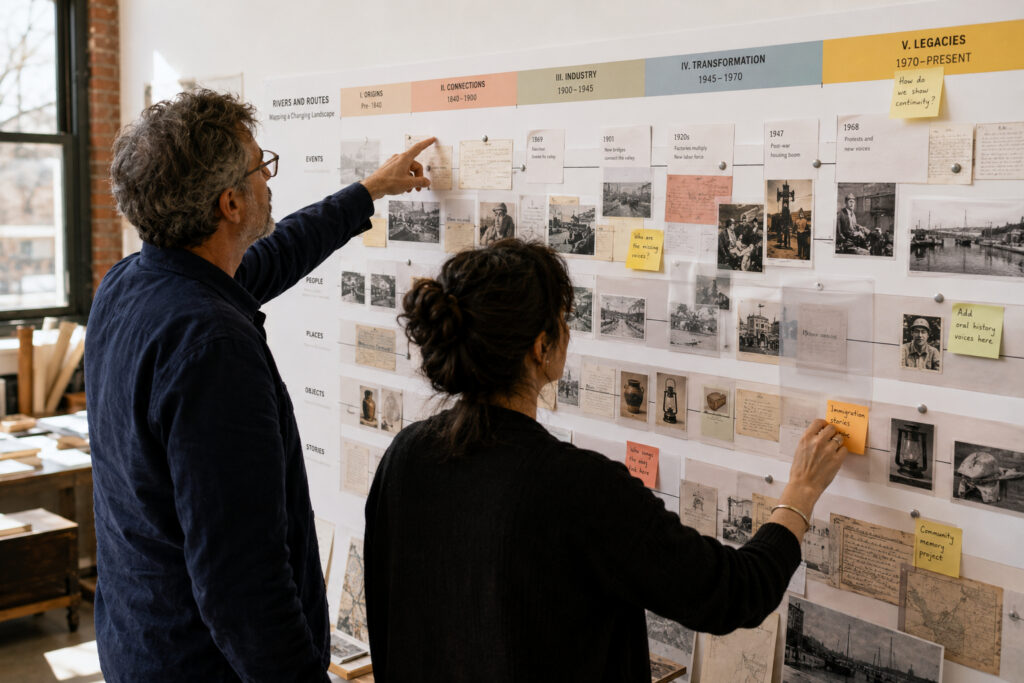
Effective historical timelines do more than list dates; they negotiate scope, narrative, and visual clarity.
For public audiences, timelines should invite curiosity while remaining legible and accurate.
Good timelines balance detail with accessible structure so visitors can explore at multiple levels.
This article outlines practical choices for planning, layout, and sourcing that support discovery.
The strategies below emphasize repeatable steps and user testing rather than rigid visual formulas.
Defining Scope and Audience
Defining scope and audience is the first essential design decision for any timeline project, because scale determines legibility and research needs.
Decide whether the timeline serves as an orientation tool, a thematic argument, or a research resource, and set temporal and topical boundaries accordingly.
- Clarify the intended setting: gallery, website, school, or mobile visit.
- Identify the primary questions the timeline should answer.
Consider the audience’s prior knowledge and the setting where the timeline will be encountered, and engage stakeholders early to surface priorities and blind spots.
Establishing Visual Hierarchy
Visual hierarchy helps readers parse dense chronological information quickly by signaling what to read first and what to explore later.
Use scale, typography, spacing, and color to differentiate headline events, secondary developments, and overarching trends so that patterns emerge at a glance, and maintain consistency across print and digital formats.
- Primary band for headline events with larger markers and concise captions.
- Secondary rows for contextual notes, local impacts, and parallel narratives.
- Layered or interactive views that allow users to zoom between decades and centuries without losing orientation.
Test mockups with representative users and iteratively refine emphasis; record the reasons behind typographic, spacing, and color choices for future maintenance and accessibility checks.
Contextualizing Events and Sources
Contextualizing events with clearly cited sources and brief interpretive notes strengthens credibility and encourages further inquiry rather than passive consumption.
Short primary-source excerpts, clear citations, and concise interpretive labels let readers trace the evidence behind claims while keeping the timeline readable, and flagging differing accounts helps surface complexity.
- Provide optional deep dives via QR codes, footnotes, or linked pages to keep the main surface uncluttered.
- Use images selectively to illustrate turning points without adding noise to sequence reading.
Be transparent about gaps, conflicting accounts, and uncertainties in the record, and invite visitor feedback and contributions to build a living, testable chronology.
Conclusion
Well-designed timelines prioritize clarity, context, and purposeful selection.
They guide audiences toward questions as much as toward answers, encouraging curiosity and further research.
Applied iteratively, these principles make complex histories discoverable and meaningful.