Uncover History’s Secrets with Daily Updates!
Daily News Entertainment
  • Home
  • History
  • Biographies
  • Eras
  • Regions
  • Timeline
No Result
View All Result
History Ours
  • Home
  • History
  • Biographies
  • Eras
  • Regions
  • Timeline
No Result
View All Result
History Ours
No Result
View All Result
Home Timeline

Practical Steps for Mapping Interconnected Historical Timelines

in Timeline
A Stepwise Approach to Sequencing Local Historical Events

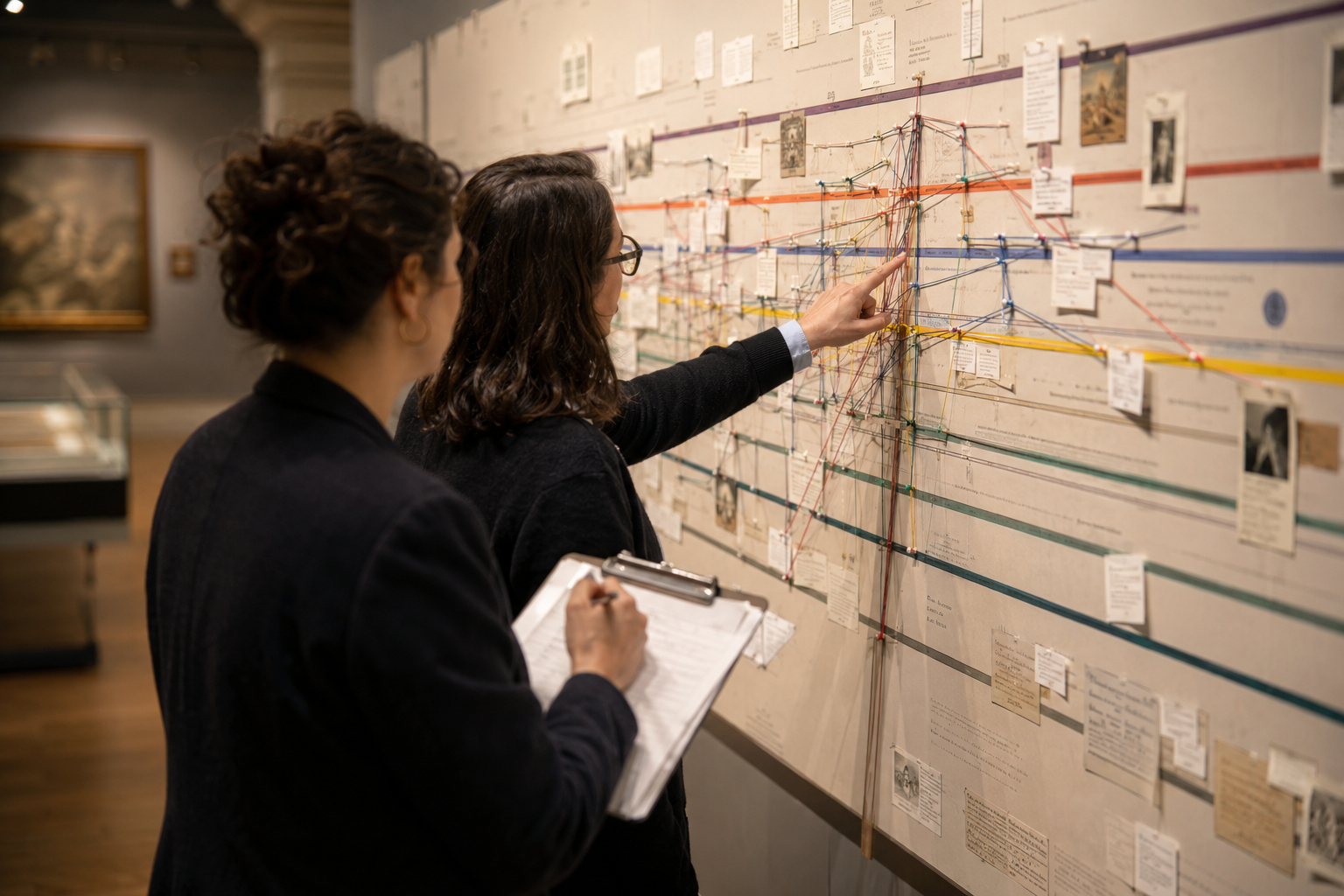
Timelines are tools for organizing events, relationships, and change across time. For public history projects, clear mapping of interconnected threads helps visitors understand complexity without being overwhelmed. This article outlines practical steps to define scope, link parallel narratives, and design visual structure so timelines communicate meaning as well as dates. These approaches balance research rigor with accessible presentation and are suitable for exhibits, educational websites, and community projects.

Define scope and narrative threads

Start by choosing a manageable time span and identifying the core threads—political, social, economic, or cultural—that will run across it. Limit scope so each thread can be followed clearly, and decide where intersections will be emphasized. Document criteria for selecting events so decisions are transparent to collaborators and audiences. A clear scope prevents clutter and creates space to show connections between threads.

Be explicit about inclusion rules and adjust scope during development. Small, well-defined timelines often do more to reveal patterns than exhaustive lists.

Design visual hierarchy and scale

Use size, color, and placement to signal importance and relationship across threads. Parallel bands or layered lanes let users scan one thread while seeing markers for others at intersections. Choose a time scale that reflects event density; compress long periods of low activity to keep focus on change. Ensure contrast and typography support legibility for diverse audiences and viewing distances.

Test layouts with sample data to find a readable balance. Iterate until hierarchy guides attention without hiding secondary details.

Integrate sources and interactive cues

Link brief citations and primary-source thumbnails to events so users can explore origins without leaving the timeline. Include hover or tap interactions that reveal additional context, alternate perspectives, or related events. Provide filters to highlight specific threads, dates, or themes and allow users to compare timelines side by side. Maintain source transparency by noting provenance and confidence for disputed dates or interpretations.

Design interactions that are discoverable and reversible to encourage exploration. Accessible controls and clear labels help visitors of varied backgrounds engage with the material.

Plan for interpretation and evaluation

Develop accompanying labels, guides, and narrative prompts that explain why connections matter and how to read the timeline. Provide short thematic essays or entry points that orient different audiences, from school groups to researchers. Include methods for gathering feedback, such as observation notes, short surveys, or analytics on interactive elements. Use evaluation findings to adjust content density, labeling, and interactive affordances in later revisions.

Regular review keeps the timeline responsive to new research and audience needs. Treat interpretation as part of the design, not an afterthought.

Conclusion

Thoughtful mapping of interconnected timelines helps audiences see patterns and the causes behind change. By defining scope, clarifying visual hierarchy, and integrating sources and interactions, you build narratives that invite inquiry. Apply these practical steps iteratively and test with real users to refine clarity and impact.


Previous Post

A Stepwise Approach to Sequencing Local Historical Events

Next Post

Trades, Taverns, and Neighborhood Life in Early Towns

Related Posts

How the Black Death Spread Across Europe, 1347–1351
Timeline

How the Black Death Spread Across Europe, 1347–1351

October 28, 2026
The Great Stink of 1858: How London Smell Rebuilt Itself
Timeline

The Great Stink of 1858: How London Smell Rebuilt Itself

October 28, 2026
A Timeline of the Dutch Golden Age and the VOC
Timeline

A Timeline of the Dutch Golden Age and the VOC

October 23, 2026
The Printing Press: A Timeline from Gutenberg to Mass Media
Timeline

The Printing Press: A Timeline from Gutenberg to Mass Media

October 23, 2026
Next Post
Trades, Taverns, and Neighborhood Life in Early Towns

Trades, Taverns, and Neighborhood Life in Early Towns

Search..

No Result
View All Result

Recent Articles

Mary Seacole: The Jamaican Nurse Who Went to War

Mary Seacole: The Jamaican Nurse Who Went to War

October 30, 2026
Ada Lovelace: The Poet Who Helped Imagine Modern Computers

Ada Lovelace: The Poet Who Helped Imagine Modern Computers

October 30, 2026
John Snow, the Broad Street Pump, and Cholera’s Fall

John Snow, the Broad Street Pump, and Cholera’s Fall

October 29, 2026
The Vasa: Sweden’s Giant Ship That Couldn’t Sail

The Vasa: Sweden’s Giant Ship That Couldn’t Sail

October 29, 2026
How the Black Death Spread Across Europe, 1347–1351

How the Black Death Spread Across Europe, 1347–1351

October 28, 2026

Subscribe Us

By clicking submit, I authorize History Ours and its affiliated companies to: (1) use, sell, and share my information for marketing purposes, including cross-context behavioral advertising, as described in our Terms of Service and Privacy Policy, (2) supplement the information that I provide with additional information lawfully obtained from other sources, like demographic data from public sources, interests inferred from web page views, or other data relevant to what might interest me, like past purchase or location data, (3) contact me or enable others to contact me by email with offers for goods and services from any category at the email address provided, and (4) retain my information while I am engaging with marketing messages that I receive and for a reasonable amount of time thereafter. I understand I can opt out at any time through an email that I receive, or by clicking here

Subscribe To Our Newsletter

By clicking submit, I authorize History Ours and its affiliated companies to: (1) use, sell, and share my information for marketing purposes, including cross-context behavioral advertising, as described in our Terms of Service and Privacy Policy, (2) supplement the information that I provide with additional information lawfully obtained from other sources, like demographic data from public sources, interests inferred from web page views, or other data relevant to what might interest me, like past purchase or location data, (3) contact me or enable others to contact me by email with offers for goods and services from any category at the email address provided, and (4) retain my information while I am engaging with marketing messages that I receive and for a reasonable amount of time thereafter. I understand I can opt out at any time through an email that I receive, or by clicking here.

© 2026 History Ours | All Rights Reserved

  • Contact Us
  • Privacy Policy
  • Terms of Service
  • Unsubscribe
  • Privacy Choices
  • Contact Us
  • Privacy Policy
  • Terms of Service
  • Unsubscribe
  • Privacy Choices

© 2026 History Ours | All Rights Reserved

No Result
View All Result
  • Home
  • History
  • Biographies
  • Eras
  • Regions
  • Timeline

© 2026 History Ours | All Rights Reserved

Skip to content
Open toolbar Accessibility Tools

Accessibility Tools

  • Increase TextIncrease Text
  • Decrease TextDecrease Text
  • GrayscaleGrayscale
  • High ContrastHigh Contrast
  • Negative ContrastNegative Contrast
  • Light BackgroundLight Background
  • Links UnderlineLinks Underline
  • Readable FontReadable Font
  • Reset Reset