
Uncover History’s Secrets with Daily Updates!
Daily News Entertainment
  • Home
  • History
  • Biographies
  • Eras
  • Regions
  • Timeline
No Result
View All Result
History Ours
  • Home
  • History
  • Biographies
  • Eras
  • Regions
  • Timeline
No Result
View All Result
History Ours
No Result
View All Result
Home Timeline

Shaping Historical Timelines for Clarity and Civic Insight

in Timeline
Shaping Historical Timelines for Clarity and Civic Insight

Timelines are powerful tools for making complex historical developments accessible and meaningful to the public. A well-crafted timeline balances factual accuracy with narrative clarity so visitors can quickly grasp patterns and turning points. Effective timelines foreground relationships between events, not just isolated dates, and guide viewers toward questions worth pursuing. This article outlines practical steps to shape timelines that inform, engage, and withstand public use.

Define Scope and Audience

Begin by clarifying the temporal span, geographic reach, and thematic focus of the timeline. Identify primary audiences — students, casual visitors, researchers, or community members — and consider how their prior knowledge should shape labels and explanations. Narrow scopes can illuminate causality while broader spans support long-term pattern recognition. Early decisions about scope also determine source needs and display scale.

Keeping the audience central prevents unnecessary complexity and makes editorial choices defensible. A transparent statement of scope can appear on the timeline to orient users and frame expectations.

Select Events, Narratives, and Sources

Choose events that advance a coherent narrative or reveal structural change rather than every available date. Combine political milestones with social, economic, and cultural markers to create multidimensional context. Prioritize primary and reputable secondary sources and document provenance on the timeline or in accompanying notes. When multiple interpretations exist, indicate competing perspectives rather than presenting a single, unqualified account.

Clear selection criteria improve trustworthiness and help future editors maintain consistency. Annotated references support further research and public confidence.

Design Visual Hierarchy and Scale

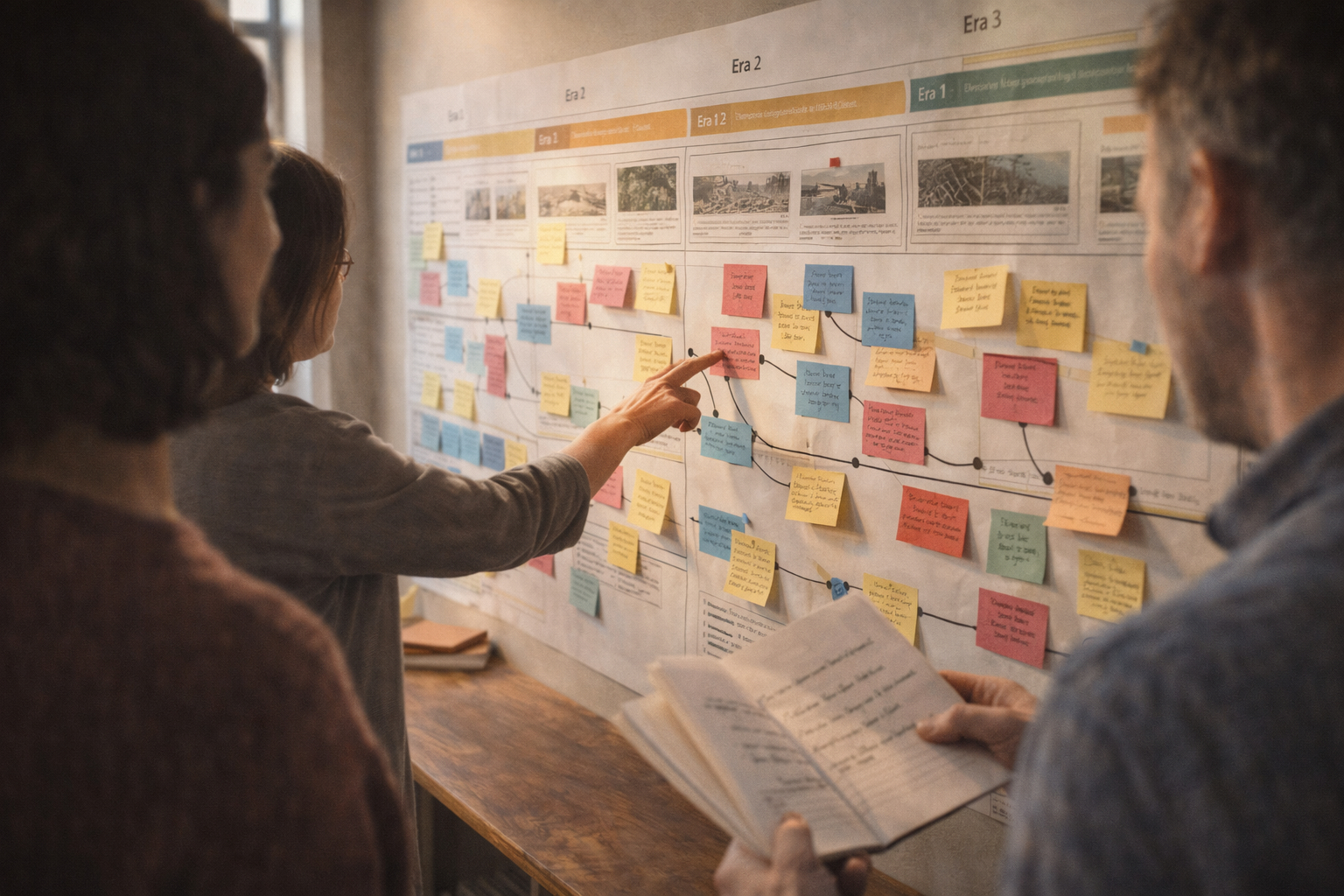
Visual hierarchy helps users read a timeline at a glance: major eras or themes should be prominent, while supporting details are subordinate. Use consistent spacing to represent time intervals and adjust scale where necessary, such as inset panels for dense periods. Color, icons, and typography can distinguish categories but should remain accessible and legible at different sizes. Aim for simplicity so visual cues reinforce rather than distract from the story.

Test designs at the intended display size and in different media to ensure readability. Consider responsive layouts for web presentation and tactile elements for public installations.

Iterate, Test, and Document Decisions

Prototype early and solicit feedback from target users and subject experts to catch confusing labels or gaps in context. Iteration reveals where assumptions about prior knowledge lead to misreadings, and user testing can uncover accessibility issues. Maintain versioned documentation that explains inclusion criteria, sources used, and editorial choices to support transparency and future updates.

A documented workflow streamlines revisions and helps collaborators maintain the timeline’s integrity over time. Ongoing evaluation keeps the timeline relevant as new research emerges.

Conclusion

Good timelines combine clear scope, disciplined selection, and thoughtful visual hierarchy to make history legible and meaningful.
Iterative testing and documentation safeguard accuracy and accessibility for diverse audiences.
When designed with purpose and care, timelines become platforms for public learning and civic reflection.


Previous Post

Regions in Layers: Landscape, Memory, and Everyday Lives

Next Post

Turning Dates into Story: Practical Timeline Construction Techniques

Related Posts

How Haiti Broke Its Chains: A 1791–1804 Timeline
Timeline

How Haiti Broke Its Chains: A 1791–1804 Timeline

September 15, 2026
From Horses to Wires: How the Pony Express Met the Telegraph
Timeline

From Horses to Wires: How the Pony Express Met the Telegraph

September 15, 2026
From Swamps to Shortcut: A Timeline of the Panama Canal
Timeline

From Swamps to Shortcut: A Timeline of the Panama Canal

September 15, 2026
1815–1818: The Tambora Eruption and the Year Without a Summer
Timeline

1815–1818: The Tambora Eruption and the Year Without a Summer

September 15, 2026
Next Post
Turning Dates into Story: Practical Timeline Construction Techniques

Turning Dates into Story: Practical Timeline Construction Techniques

Search..

No Result
View All Result

Recent Articles

The Disguise That Broke Chains: Ellen and William Craft

The Disguise That Broke Chains: Ellen and William Craft

September 15, 2026
Bass Reeves: The Marshal Who Hunted Outlaws in Indian Territory

Bass Reeves: The Marshal Who Hunted Outlaws in Indian Territory

September 15, 2026
How the Crystal Palace Turned Glass and Iron into a Modern Stage

How the Crystal Palace Turned Glass and Iron into a Modern Stage

September 15, 2026
Anne Bonny: The Pirate Who Broke Rules and Expectations

Anne Bonny: The Pirate Who Broke Rules and Expectations

September 15, 2026
How Haiti Broke Its Chains: A 1791–1804 Timeline

How Haiti Broke Its Chains: A 1791–1804 Timeline

September 15, 2026

Subscribe Us

By clicking submit, I authorize History Ours and its affiliated companies to: (1) use, sell, and share my information for marketing purposes, including cross-context behavioral advertising, as described in our Terms of Service and Privacy Policy, (2) supplement the information that I provide with additional information lawfully obtained from other sources, like demographic data from public sources, interests inferred from web page views, or other data relevant to what might interest me, like past purchase or location data, (3) contact me or enable others to contact me by email with offers for goods and services from any category at the email address provided, and (4) retain my information while I am engaging with marketing messages that I receive and for a reasonable amount of time thereafter. I understand I can opt out at any time through an email that I receive, or by clicking here

Subscribe To Our Newsletter

By clicking submit, I authorize History Ours and its affiliated companies to: (1) use, sell, and share my information for marketing purposes, including cross-context behavioral advertising, as described in our Terms of Service and Privacy Policy, (2) supplement the information that I provide with additional information lawfully obtained from other sources, like demographic data from public sources, interests inferred from web page views, or other data relevant to what might interest me, like past purchase or location data, (3) contact me or enable others to contact me by email with offers for goods and services from any category at the email address provided, and (4) retain my information while I am engaging with marketing messages that I receive and for a reasonable amount of time thereafter. I understand I can opt out at any time through an email that I receive, or by clicking here.

© 2026 History Ours | All Rights Reserved

  • Contact Us
  • Privacy Policy
  • Terms of Service
  • Unsubscribe
  • Privacy Choices
  • Contact Us
  • Privacy Policy
  • Terms of Service
  • Unsubscribe
  • Privacy Choices

© 2026 History Ours | All Rights Reserved

No Result
View All Result
  • Home
  • History
  • Biographies
  • Eras
  • Regions
  • Timeline

© 2026 History Ours | All Rights Reserved

Skip to content
Open toolbar Accessibility Tools

Accessibility Tools

  • Increase TextIncrease Text
  • Decrease TextDecrease Text
  • GrayscaleGrayscale
  • High ContrastHigh Contrast
  • Negative ContrastNegative Contrast
  • Light BackgroundLight Background
  • Links UnderlineLinks Underline
  • Readable FontReadable Font
  • Reset Reset