Uncover History’s Secrets with Daily Updates!
Daily News Entertainment
  • Home
  • History
  • Biographies
  • Eras
  • Regions
  • Timeline
No Result
View All Result
History Ours
  • Home
  • History
  • Biographies
  • Eras
  • Regions
  • Timeline
No Result
View All Result
History Ours
No Result
View All Result

Bahis vergilendirmesi Türkiye’de devlet kontrolündedir, ancak yeni açılan casino siteleri gibi uluslararası sitelerde oyuncular kendi kazançlarını yönetir.

Home Timeline

The Journey of Art: From Cave Walls to Canvas

in Timeline
The Journey of Art: From Cave Walls to Canvas

Art is one of humanity’s oldest languages — a way to express ideas, emotions, and beliefs long before written words existed. From ancient cave paintings to modern masterpieces on canvas, art has evolved alongside civilization itself. Each era of artistic expression tells a story of human progress, creativity, and the desire to make meaning out of the world. The journey of art is not just about materials and technique, but about the ever-changing relationship between people, culture, and imagination.

The Dawn of Expression: Cave Paintings

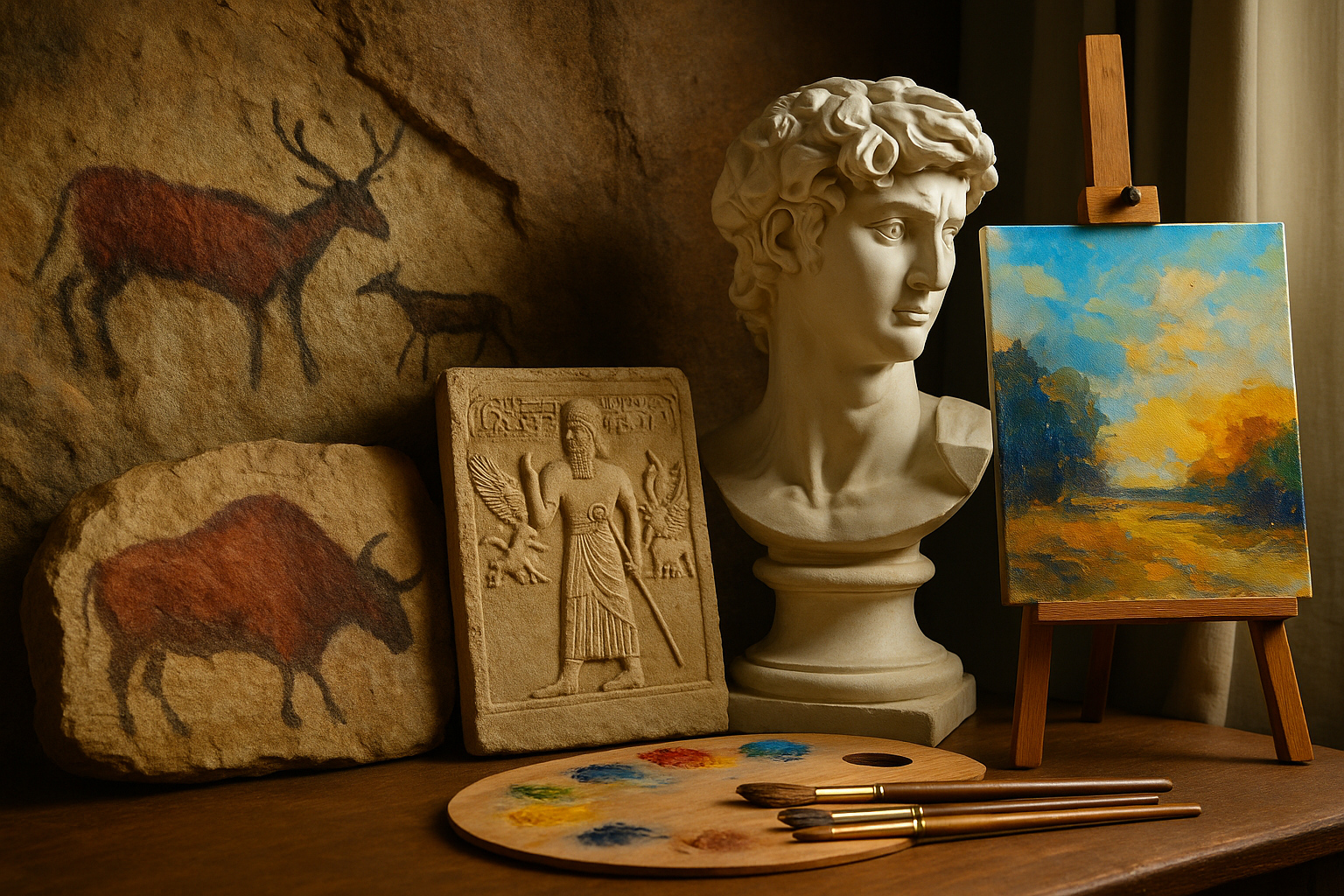
Art’s earliest roots lie deep within prehistoric caves, where humans used pigment, charcoal, and natural dyes to depict animals, hunting scenes, and symbols. These ancient works, found on cave walls across the world, reveal an early understanding of communication and storytelling. For early humans, art was both ritual and record — a bridge between survival and spirituality. These images still evoke awe today, reminding us that creativity is woven into the very fabric of human existence.

The Birth of Civilization and Symbolism

As societies developed, art became a reflection of culture and power. Ancient civilizations used art to tell stories of gods, kings, and everyday life. Egyptian murals, Greek sculptures, and Chinese calligraphy each represented unique worldviews and beliefs. Artistic technique advanced with architecture and mathematics, giving rise to proportion, perspective, and symbolism. Art evolved from raw expression into a sophisticated medium of identity, politics, and faith.

The Renaissance: Rebirth of Human Imagination

The Renaissance marked a turning point in art’s evolution — a celebration of human potential and reason. Artists such as Leonardo da Vinci and Michelangelo combined scientific observation with creative vision, bringing depth and realism to their work. Canvas became the preferred medium, allowing for greater experimentation in composition and color. This era also introduced the concept of the individual artist as a visionary, not just a craftsman. Art became a mirror of both the physical world and the human spirit.

The Modern Era: Breaking Boundaries

By the 19th and 20th centuries, art began to challenge tradition. Movements such as Impressionism, Cubism, and Abstract Expressionism questioned what art could be. Painters like Claude Monet, Pablo Picasso, and Jackson Pollock broke the rules of representation, focusing on perception, emotion, and innovation. Art became not just a reflection of reality but a way to reinterpret it. The rise of photography, digital media, and global influences expanded the definition of creativity beyond the canvas.

Art in the Contemporary World

Today, art lives everywhere — in museums, on city walls, and across digital screens. The tools may have changed, but the purpose remains the same: to inspire, provoke, and connect. Modern artists experiment with new materials, technologies, and social themes, blurring the lines between art, design, and activism. From digital painting to street art, the journey continues, proving that creativity has no limits.

Conclusion
From the flicker of firelight on cave walls to the vibrant colors of modern canvases, art’s journey is a story of human evolution — one of imagination, resilience, and expression. Each brushstroke, carving, or digital pixel carries forward a legacy that began thousands of years ago. Art remains a timeless reminder that even as civilizations rise and fall, the human need to create endures, painting the world with emotion, meaning, and endless possibility.
Previous Post

The Timeline of Great Philosophical Movements

Next Post

The Evolution of Money: From Barter to Blockchain

Related Posts

Turning Dates into Story: Practical Timeline Construction Techniques
Timeline

Turning Dates into Story: Practical Timeline Construction Techniques

March 17, 2026
Shaping Historical Timelines for Clarity and Civic Insight
Timeline

Shaping Historical Timelines for Clarity and Civic Insight

March 17, 2026
Practical Workflow for Creating Accurate Historical Timelines
Timeline

Practical Workflow for Creating Accurate Historical Timelines

March 12, 2026
Designing Timeline Layouts That Guide Public Understanding
Timeline

Designing Timeline Layouts That Guide Public Understanding

March 12, 2026
Next Post
The Evolution of Money: From Barter to Blockchain

The Evolution of Money: From Barter to Blockchain

Search..

No Result
View All Result

Recent Articles

Everyday Sites and the Shaping of Regional Memory

Everyday Sites and the Shaping of Regional Memory

March 21, 2026
Stacked Histories: How Places Accumulate Meaning

Stacked Histories: How Places Accumulate Meaning

March 21, 2026
Interpreting Eras: Principles for Clear Periodization

Interpreting Eras: Principles for Clear Periodization

March 20, 2026
Recognizing Historical Turning Points in Long-Term Change

Recognizing Historical Turning Points in Long-Term Change

March 20, 2026
Strategies for Weaving Sparse Records into Fuller Biographies

Strategies for Weaving Sparse Records into Fuller Biographies

March 19, 2026

Subscribe Us

By clicking submit, I authorize History Ours and its affiliated companies to: (1) use, sell, and share my information for marketing purposes, including cross-context behavioral advertising, as described in our Terms of Service and Privacy Policy, (2) supplement the information that I provide with additional information lawfully obtained from other sources, like demographic data from public sources, interests inferred from web page views, or other data relevant to what might interest me, like past purchase or location data, (3) contact me or enable others to contact me by email with offers for goods and services from any category at the email address provided, and (4) retain my information while I am engaging with marketing messages that I receive and for a reasonable amount of time thereafter. I understand I can opt out at any time through an email that I receive, or by clicking here

Subscribe To Our Newsletter

By clicking submit, I authorize History Ours and its affiliated companies to: (1) use, sell, and share my information for marketing purposes, including cross-context behavioral advertising, as described in our Terms of Service and Privacy Policy, (2) supplement the information that I provide with additional information lawfully obtained from other sources, like demographic data from public sources, interests inferred from web page views, or other data relevant to what might interest me, like past purchase or location data, (3) contact me or enable others to contact me by email with offers for goods and services from any category at the email address provided, and (4) retain my information while I am engaging with marketing messages that I receive and for a reasonable amount of time thereafter. I understand I can opt out at any time through an email that I receive, or by clicking here.

© 2026 History Ours | All Rights Reserved

  • Contact Us
  • Privacy Policy
  • Terms of Service
  • Unsubscribe
  • Privacy Choices
  • Contact Us
  • Privacy Policy
  • Terms of Service
  • Unsubscribe
  • Privacy Choices

© 2026 History Ours | All Rights Reserved

No Result
View All Result
  • Home
  • History
  • Biographies
  • Eras
  • Regions
  • Timeline

© 2026 History Ours | All Rights Reserved

Skip to content
Open toolbar Accessibility Tools

Accessibility Tools

  • Increase TextIncrease Text
  • Decrease TextDecrease Text
  • GrayscaleGrayscale
  • High ContrastHigh Contrast
  • Negative ContrastNegative Contrast
  • Light BackgroundLight Background
  • Links UnderlineLinks Underline
  • Readable FontReadable Font
  • Reset Reset